Independent comparisons. We may earn from shop links. More info

How to use a Fluke multimeter

Updated: 22 October 2026

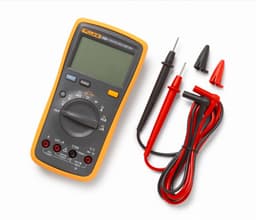
You have one of these Fluke handhelds on the bench, a UK socket or a dead-looking cable in front of you, and you want a number you can trust. How to use a Fluke multimeter, in this set, starts with the leads and the function, and it stops before you treat the screen as proof that a circuit is dead. The steps are for measuring once you are allowed to be on that circuit. They are not a safe-isolation procedure and they are not a substitute for GS38. Peter F. did not lab-test the meters. A qualifying purchase can earn a commission at no extra cost to you. The models are on the [Fluke multimeter comparison](/hub/measuring-equipment/fluke-multimeter).

You have one of these Fluke handhelds on the bench, a UK socket or a dead-looking cable in front of you, and you want a number you can trust.

Our top picks

Fluke Fluke 117

Best overall

Fluke Fluke 117
8.2/10about £215.00
Fluke Fluke 15B+

Best value

Fluke Fluke 15B+
7.1/10about £101.45
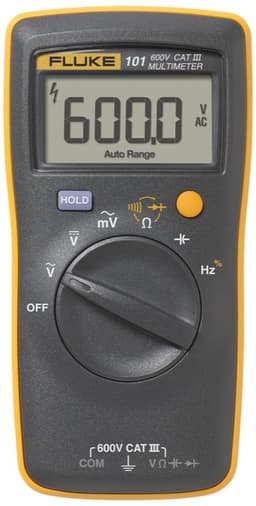
Fluke Fluke 101

Alternative

Fluke Fluke 101
6.7/10about £89.99
On this page

Check the meter before the circuit

Look at the leads before the display. GS38 wants finger guards, a CAT mark that matches the work, and an exposed tip no more than 4 mm, preferably 2 mm. Five listings print CAT III 600 V. The 177 and the 179 print CAT IV 600 V and CAT III 1000 V. A 1,000 V bullet on the 15B+ or the 17B+ does not rewrite the CAT III 600 V line. If you are unsure of the mark, read the Fluke CAT rating page first. Prove the instrument on a known live source or a proving unit. UK mains are about 230 V. Fit the leads into the meter first, and set the function before contact. Leads left in the current sockets and then placed across the mains put fault current through the meter.

Voltage, and why the function comes first

For voltage, use the AC voltage function and the voltage and common sockets. A reading near zero means you check the function, the leads and the proving step again. It does not, on its own, mean the circuit is dead. GS38 paragraph 19 prefers a test lamp or a two-pole detector to BS EN 61243-3. Continuity comes only after you have isolated and proved dead. The 101 will do continuity and voltage, and it will not do current. If you are holding a 101 and you came for amps, stop. The buying guide separates that pocket model from meters that list current. The 15B+ and the 17B+ state up to 10 A. Above that, use a clamp.
Fluke Fluke 117

Testsieger

Fluke Fluke 117
8.2/10about £215.00

Ghost voltage is a 117 problem to solve, not a proof

Only the 117 lists VoltAlert and low-impedance Auto Volt. On that meter, Auto-V/LoZ drops the input impedance to about 3 kΩ. A high-impedance input can show a ghost voltage on a disconnected conductor that runs beside a live one. LoZ loads that ghost and the figure collapses. That collapse is a clue, not a dead test. The 117 manual warns that if VoltAlert gives no indication, voltage could still be present, and that you should not rely on it with shielded wire. The circuit is still proved dead with a two-pole detector and a proving unit, before and after. The 15B+ and the 179 do not have this screen. Do not invent it.

Where you stop

Stop at the service head, any board you cannot lock off, any Electrical Installation Certificate, and any live fault-finding you are not trained for. The Electricity at Work Regulations 1989 expect conductors dead where they can be, then proved dead. HSG85's sequence is identify, disconnect, secure, post notices, then prove dead. Also stop if the meter or a lead is damaged, the battery will not hold, or the reading and the proving unit disagree. None of these seven meters is a multifunction tester.

Common questions

How do I measure mains voltage without the leads in the wrong sockets?
Put the leads in the voltage and common sockets on the meter before they touch the circuit, and set AC voltage first. GS38 tells you to connect to the instrument before the circuit and to choose the function before contact. Leads left in the current sockets and then placed across the mains put fault current through the meter. On a UK socket you are looking for about 230 V.
Can this meter prove the circuit is dead?
No. GS38 paragraph 19 prefers a test lamp or a two-pole voltage detector to BS EN 61243-3 when you need to know whether voltage is present or absent. A multimeter depends on its battery and on the range you selected, so a blank screen can be a flat cell or the wrong function. These Fluke listings measure. They are not the prove-dead device.
What is Auto-V/LoZ on the 117, and do the other models have it?
On the 117, Auto-V/LoZ sets the input impedance to about 3 kΩ so a ghost voltage coupled onto an open conductor is loaded and usually collapses. Fluke states VoltAlert and that low-impedance function for the 117. They are not stated for the 101, 107, 15B+, 17B+, 177 or 179, so you should not invent the same step on those dials. It is not proof the circuit is dead.
When do I use continuity?
Use continuity on a circuit you have already isolated and proved dead. It tells you whether a conductor is intact, and the beep is only a convenience. It is the wrong function on a live UK socket, and it is not a substitute for an insulation test. The 101 can do continuity. It still cannot do current. If the cable is damaged, or you cannot lock the board off, stop.
What if VoltAlert is silent?
On the 117, no indication does not mean no voltage. The manual says voltage could still be present, and it tells you not to rely on VoltAlert with shielded wire. Follow a silent detector with a contact voltage measurement on the leads, and use a two-pole detector when the question is whether the circuit is dead. The other six meters do not list VoltAlert.

Related pages

Sources

Public UK sources from the research digest, checked on 21 October 2026. Shelf prices and star lines are the amazon.co.uk figures for these seven listings. Price bands are this set, not a market average. A dollar price on a Fluke page is not a UK price.

  1. Fluke UK: multimeter safety guide (retrieved 21 October 2026)
  2. HSE GS38 (retrieved 21 October 2026)
  3. HSE HSG85 (retrieved 21 October 2026)
  4. HSE HSR25 (retrieved 21 October 2026)
  5. Fluke UK 117 (retrieved 21 October 2026)
  6. Fluke UK 179 (retrieved 21 October 2026)
  7. Fluke: 15B+ and 17B+ table (retrieved 21 October 2026)
  8. Electricity at Work Regulations 1989 (retrieved 21 October 2026)