Independent comparisons. We may earn from shop links. More info

Analogue multimeter for car electrics

Updated: 22 October 2026

You have a 12 V classic, or a hobby loom on the bench, and you want to see whether the voltage is sitting still or wandering. An analogue multimeter for car electrics only helps if the scale can show about half a volt between a resting battery and a charging system. Pointers that go up to 1000 V often put 12 V on a 0-50 V arc, where 12.2 V and 13.2 V are the same needle. The meters are on the [analogue multimeter comparison](/hub/measuring-equipment/analogue-multimeter). Peter F. used amazon.co.uk listings from 19 October 2026. A purchase through our amazon.co.uk links may earn a commission at no extra cost to you.

You have a 12 V classic, or a hobby loom on the bench, and you want to see whether the voltage is sitting still or wandering.

Our top picks

On this page

The two voltages that sit close together

Hagerty puts a healthy resting 12 V battery at about 12.6 V with the engine off, and a charging system at about 13.2 to 14.2 V, often summarised as about 13.5 V. The gap is under two volts. If the meter's DC tolerance is ±4 percent of full scale, which is what the Gardner Bender GMT-319 manual states, 4 percent of 50 V is 2 V. The entire charging rise can hide inside that specification. The MG Car Club's Lucas generator sheet asks for a moving-coil voltmeter with full scale at least 20 V and divisions good for 0.5 V. That is an instrument requirement, not a licence to run the unregulated-dynamo test in that PDF. The case for owning both a needle and a digital meter is on the versus page.

What a 0-50 V scale can and cannot show

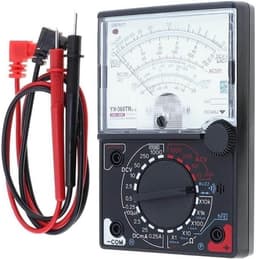
Draper 37317 reviewers say the scale that covers 12 V runs from 0 to 50 V, so 12.2 V, 12.9 V, and 13.2 V look the same. The amazon listing does not print a 10 V range. At £16.99 it remains a fair pocket meter for a dead-or-alive check on a lamp or a fuse. It is a poor charging-system meter, which is why it can be the best value on the comparison and still be the wrong buy here. The SENRISE YX 1000A bullet prints DC as 0-10, 50, 250, and 1000 V. Twelve volts is above the 10 V range, so you are on 0-50 V again. The unbranded listing at £8.68 does print both a 10 V and a 50 V DC position. A 10 V range cannot display 12.6 V. You step up to 50 V, and the same bullets limit protection to 230 V maximum. The Hilka listing states no ranges at all. One buyer saw about 30 V on a 12.4 V battery. That is a faulty meter, not a high battery.

When a needle helps on a dynamo

A dynamo does not hold a flat line the way a regulated alternator tries to. Club Triumph's thread distinguishes a digital meter, which shows ripple as a jumping figure, from a moving-coil needle, which averages it. One contributor still says a cheap digital meter can be fine when the test is steady. A needle helps only if full scale is near the Lucas request, at least 20 V, with divisions around 0.5 V. None of the amazon listings in this set prints that combination. The GMT-319 manual states 20 kΩ/V DC and CAT II 1000 V, and ±4 percent of full scale still makes a high range blunt for 12.6 against 13.5. The Austin 7 note in the Hilka reviews does not promote the Hilka. The same cluster includes the 30 V error on a 12.4 V battery. Positive earth, which MG T-type notes treat as a polarity trap, means the leads follow the car's earth. Confirm earth before you connect.

What not to use this shelf for

Do not use any of these meters to measure starter current. A starter is hundreds of amps. The GMT-319 manual's separate 10 A jack, and the MF47-style title's 0-10 A line, are not a starter test. Do not connect a pointer across a hybrid or EV traction battery. Do not turn the Lucas sheet into a driveway test that links D and F and revs an unregulated dynamo. That test can over-voltage the machine and the lamps. Consumer units stay off this page. A car battery is extra-low voltage. The household board is not, and the buying guide is where CAT II stops. For a number you must record, use a digital meter you have checked on a known cell. The how to use page covers zeroing once you have a meter that deserves the job.

Common questions

Can I check a car battery with an analogue meter?
You can see whether a 12 V battery is up or flat if the meter is honest and the range actually covers 12 V. You cannot, on a 0-50 V scale, see the difference Hagerty describes between about 12.6 V at rest and about 13.5 V while charging. Draper reviewers report exactly that blindness: 12.2 V, 12.9 V, and 13.2 V look the same. Use a digital meter for those two numbers. Use a needle only as a second view of movement.
Why does 12 V look the same as 14 V?
Because the arc is 50 V wide and the two voltages are about one and a half volts apart. The needle moves a small fraction of the scale, often less than the meter's full-scale tolerance. On the GMT-319, 4 percent of 50 V is 2 V, which is larger than the gap you are trying to see. A scale with 0.5 V divisions, and full scale nearer 20 V, is what the Lucas sheet asks for.
Which of these listings has a 10 V or 20 V range?
The SENRISE bullet prints 0-10 V DC and then 50 V, so 12 V leaves the 10 V range. The unbranded bullet prints a 10 V DC position and a 50 V position. Neither states a 20 V range. The Draper amazon page states no ranges. Its manual is a separate document and still does not fix the reviewer reports of a 0-50 V battery reading. No listing here prints the at least 20 V, to 0.5 V instrument the Lucas sheet names.
Is a needle better on a dynamo?
It can show the average while a digital meter shows ripple as a jumping number. That is the Club Triumph distinction, and the same thread allows that a cheap digital meter may be fine on a steady test. A needle is better only if you can resolve about half a volt. It is not better because it is old, and it is not a reason to distrust every digital reading on every classic. One Austin 7 owner preferred a needle. Their Hilka is not thereby the right meter.
My Hilka read 30 V on a 12 V battery. Is the battery high?
No. A UK reviewer compared that meter with a Fluke and saw a 12.4 V battery read about 30 V, and a 1.5 V cell read over 3 V. The battery was the known source. The meter was wrong. Do not adjust a regulator, condemn a dynamo, or buy parts from that reading. Check the same points with a meter that agrees with a known cell. The Hilka listing also states no ranges, so you cannot even confirm which arc you were on from the amazon text.
What about a positive-earth classic?
The meter does not care about fashion, and the car does. Positive-earth systems, which MG T-type notes flag as a polarity trap, put chassis on the opposite lead from a modern negative-earth car. Connect the meter to match the car, or the needle hits the stop. If you are unsure of the earth, find it from the battery terminal that goes to the chassis before you probe the loom. This page is not a rewiring guide.

Related pages

Sources

Public UK sources from the research digest, last checked on 19 October 2026. Shelf prices and star lines are the amazon.co.uk figures captured with these seven listings. The price bands are this set, not a market average.

  1. HSE GS38 (retrieved 19 October 2026)
  2. Electricity at Work Regulations 1989, regulation 14 (retrieved 19 October 2026)
  3. Draper 37317 manual, June 2023 (retrieved 19 October 2026)
  4. Gardner Bender GMT-319 manual (retrieved 19 October 2026)
  5. Electronics Club, multimeters (retrieved 19 October 2026)
  6. Electronics Notes, analogue multimeter sensitivity (retrieved 19 October 2026)
  7. Rapid, Metrix MX1 (retrieved 19 October 2026)
  8. amazon.co.uk listings, 19 October 2026 (retrieved 19 October 2026)