Independent comparisons. We may earn from shop links. More info

How to use an analogue multimeter

Updated: 22 October 2026

You have a pointer meter on the bench, and the dial looks like three instruments printed on top of each other. How to use an analogue multimeter comes down to matching the knob to one scale, zeroing ohms on the right, and stopping before the measurement is the dangerous one. Peter F. follows Electronics Club and the stop points in HSE GS38. This is not a product ranking. The listings are on the [analogue multimeter comparison](/hub/measuring-equipment/analogue-multimeter). If you buy through our amazon.co.uk links, we may earn a commission at no extra cost to you. Set the function before the probes touch anything.

You have a pointer meter on the bench, and the dial looks like three instruments printed on top of each other.

Our top picks

On this page

Set the range before you connect

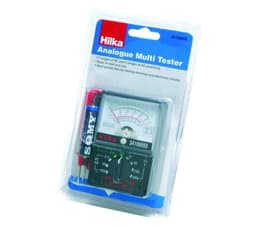
Voltage is measured in parallel. Current is measured in series, which is why a current range left selected will short a voltage source through the meter. Resistance is measured with the circuit dead, because the meter supplies its own small current from the cell. Start on the highest range that can still show the value you expect. A 230 V guess on a 10 V range is how needles bend. If plugs fall out, as reviews say of the Hilka, the Draper, and the SENRISE, tug the plug, and if it will not stay, stop. GS38 leads are on the buying guide.

Read the scale that matches the knob

Only one arc matches the knob. Halfway along a 0-50 arc is about 25. The same mark on a 0-10 arc is about 5. Mixing those arcs is the usual error. AC ranges often have their own marks. A needle that indicates 20 on the ×1k range is about 20,000 ohms, not 20 ohms. If your meter has a mirror, line the needle up with its reflection. The Fyearfly teaching bullet claims a mirror. The Hilka amazon listing does not.

Zero the ohms scale

The ohms zero sits at the right-hand end. Touch the probe tips together and turn the ohms-zero control until the needle sits there, then measure a component that is out of circuit and not powered. All About Circuits makes the same point: you do not measure resistance on a live object. Zero again if you change range. If the needle will not reach zero, the cell is flat or missing. The Draper needs an AA that reviewers say is not supplied. The GMT-319 manual states a buzzer below 100 Ω. The Draper manual does not list one.

When to stop

Stop when the lead is cracked or the plug falls out. GS38 says selecting current or ohms on a live supply causes arcing. That is not a technique to practise on a wall socket. UK mains are 230 V. A protection line of 230 V maximum, which the unbranded bullets state, is the ceiling. Stop at a consumer unit and at meter tails. Regulation 14 of the Electricity at Work Regulations 1989 is not permission to practise. Call an electrician for boards and for trips you cannot explain. The low-voltage case is the car electrics page.

Common questions

Which scale do I read?
Read the arc that belongs to the knob position you have selected, including the multiplier. Halfway on a 0-50 V arc is about 25 V. The same mark on a 0-10 V arc is about 5 V. AC often has its own marks. Ohms uses the non-linear arc and a multiplier such as ×10 or ×1k. If two arcs could fit the needle position, you have not matched the knob yet. Change nothing electrical until that match is obvious.
Why is zero ohms on the right?
Because the meter is applying its own current, and a short circuit, which is zero ohms, drives the needle to full scale. Full scale on these faces is the right-hand end. Voltage zeros sit on the left. The ohms numbers are also packed together at the high-resistance end, so a small needle movement there is a large change in ohms. Short the probes and set the right-hand zero before you believe any resistance figure.
The needle will not reach zero ohms. What now?
Fit or replace the cell, then short the probes and try the adjuster again. A Draper that will not zero is often missing the AA cell the box never included. If a fresh cell still cannot reach the mark, the movement or the battery contact is at fault, which matches review complaints on the cheaper pointers. Do not record a resistance from a needle that stops short of zero. Voltage readings are a separate question and may still work.
Do I need the cell for volts?
No. The moving coil on a voltage or current range is driven by the circuit you are measuring. The cell runs resistance, and a buzzer where the meter has one. You can see a battery voltage with a dead ohms cell. You cannot trust an ohms reading until the right-hand zero sets with the probes touched together. Buy the cell the manual names before you plan a resistance job.
Can I learn this on a wall socket?
No. Learn the arcs on a 1.5 V cell and on a resistor you have already measured, or on a low-voltage supply you can switch off. A UK socket is 230 V, and GS38 treats socket outlets as a CAT III example, while Megger's UK page words them under CAT II. Either way, the pocket meters in this set are the wrong classroom. Current or ohms selected by mistake on that socket is an arc, not a lesson.
Where do I stop and get an electrician?
Stop for a consumer unit, meter tails, a damaged socket or switch, and any trip you cannot explain from a single unplugged appliance. Regulation 14 is not a permission slip for practice. Also stop when the meter's own leads are cracked or the listing's protection line is 230 V maximum and you are already at mains. A needle that will not zero, or a plug that will not stay in, is a reason to change the meter, not to push on.

Related pages

Sources

Public UK sources from the research digest, last checked on 19 October 2026. Shelf prices and star lines are the amazon.co.uk figures captured with these seven listings. The price bands are this set, not a market average.

  1. HSE GS38 (retrieved 19 October 2026)
  2. Electricity at Work Regulations 1989, regulation 14 (retrieved 19 October 2026)
  3. Draper 37317 manual, June 2023 (retrieved 19 October 2026)
  4. Gardner Bender GMT-319 manual (retrieved 19 October 2026)
  5. Electronics Club, multimeters (retrieved 19 October 2026)
  6. Electronics Notes, analogue multimeter sensitivity (retrieved 19 October 2026)
  7. Rapid, Metrix MX1 (retrieved 19 October 2026)
  8. amazon.co.uk listings, 19 October 2026 (retrieved 19 October 2026)