Independent comparisons. We may earn from shop links. More info

Analogue vs digital multimeter

Updated: 22 October 2026

You already own a digital multimeter, and someone has told you a needle is better. Sometimes that is a real job, which is watching a value move. Analogue vs digital multimeter, on this page, is that split and nothing broader. Peter F. set these pointer listings on amazon.co.uk, captured on 19 October 2026, beside UK guides for a digital meter. Prices are on the [analogue multimeter comparison](/hub/measuring-equipment/analogue-multimeter). A purchase through our amazon.co.uk links may earn a commission at no extra cost to you. Keep the digital meter when you must record a number. Add a pointer when you must watch a number change.

You already own a digital multimeter, and someone has told you a needle is better. Sometimes that is a real job, which is watching a value move.

Our top picks

On this page

The one difference that matters

A digital meter samples and holds a figure. An analogue meter is a moving coil, so the needle can follow a rise or a wobble. Tester.co.uk gives the stable number to the digital meter and sudden fluctuation to the needle. Elec-Mate asks for digital, true RMS, and CAT III 600 V on UK installation work. The display does not set the safety rating. A needle with 1000 V on the dial can be CAT II. GS38 treats socket outlets and distribution boards as CAT III examples. If you are at a consumer unit, needle versus digits is the wrong argument. Category and leads are on the buying guide.

How hard the meter pulls on the circuit

Electronics Notes: 20 kΩ/V on a 10 V range is 200 kΩ between the probes. A typical digital input is about 10 MΩ, so it disturbs a high-impedance point less. The GMT-319 manual states 20 kΩ/V DC. The Draper manual states 10 kΩ/V DC, a heavier load. On a 12 V car battery either meter barely loads the terminal. A flickering digital meter is not proof that every classic needs a needle. Club Triumph describes dynamo ripple as a jumping number that a moving coil averages. That case is on the car electrics page. Loading and ripple are different faults.

Accuracy and the cell

Analogue is not more accurate. Where these manuals state a tolerance, it is a percentage of full scale. The GMT-319 manual says ±4 percent of full scale on DC. Four percent of 50 V is 2 V, which can swallow the gap between a resting battery and a charging voltage. A digital meter specified as a percentage of reading plus a few counts will usually put a tenth of a volt where you can write it down. A mirror cuts parallax. It does not turn full-scale percent into reading percent. A moving-coil voltage range is powered by the circuit under test, so a flat ohms battery can still show volts. A digital meter generally needs its battery for every function, including volts. The Draper manual does not list a buzzer. If you have hearing loss and a beep will not help, that silent dial matches the need, and you still have to read the ohms arc. The right-hand ohms zero is set on the how to use page.

Which to buy

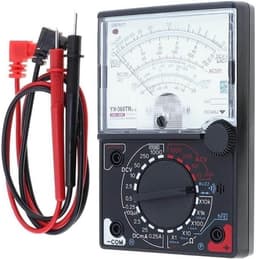
Buy the digital meter first if you can own only one. You will record voltages, you will get a high input impedance, and, if you choose one that states CAT III, you will be closer to the instrument UK installation guides actually recommend. Add an analogue meter when the job is a moving value: a null, a slow drift, or ripple that a fast digital sample turns into a flicker. In this amazon set the pointer that states 20 kΩ/V is the GMT-319, at £39.83, still CAT II. The best value pointer for occasional low-voltage checks is the Draper 37317 at £16.99, at 10 kΩ/V in the manual. Neither replaces the digital meter you use to write a number down. Skip a second meter if you have no job that needs the movement. True RMS and CAT III are the electricians' shopping list, not a feature of this pointer shelf.

Common questions

Which should I buy if I can only have one?
Buy a digital meter. You get a figure you can record, a high input impedance, and a realistic path to a CAT III rating if you choose one that states it. A pointer is the second instrument, for a value you need to watch moving. The pointers on this amazon shelf top out at CAT II where a manual exists. One meter for a UK householder who might meet a socket is the digital one, provided the category matches the work.
When is the needle actually better?
When the information is in the movement. A null adjustment, a drifting sensor, or dynamo ripple that a digital meter displays as a hunt are the cases UK hobby writing actually describes. The needle averages where a fast sample flickers. It is not better when you must write down 13.8 V rather than 12.6 V, because full-scale accuracy on a 50 V range is measured in whole volts. Use the needle beside the digital meter, not instead of it, for that job.
Will an analogue meter load the circuit?
Yes, more than a typical digital meter, and it depends on the range. At 20 kΩ/V, a 10 V range looks like about 200 kΩ. A common digital input is about 10 MΩ. The Draper manual is 10 kΩ/V DC, a heavier load again. Across a car battery the load is negligible. Across a high-impedance electronics node it can change the reading. If the circuit is that sensitive, the GMT-319's stated 20 kΩ/V is the pointer in this set, and a digital meter may still be kinder.
Does the needle work with a flat battery?
On voltage and current, it can. The coil is driven by the source you are measuring. On resistance, it cannot. The ohms zero will not reach the right-hand mark with a flat or missing cell, and any buzzer stays quiet. A digital meter usually needs its battery for volts as well. A Draper that reads a battery voltage and then refuses to zero on ohms is behaving as designed until you fit the AA cell.
Are analogue meters more accurate?
No. Do not buy one for accuracy. The GMT-319's DC specification is ±4 percent of full scale, which is 2 V on a 50 V range. Digital specifications are commonly a percentage of the reading plus digits, which is what you want for a recorded tenth of a volt. A mirror removes parallax. It does not turn full-scale percent into reading percent. The Draper manuals disagree on a percentage, so this page does not quote one.
Can I use either on a consumer unit?
Not from this pointer shelf, and not from an unspecified digital meter either. Installation guides that name a tool ask for CAT III, often 600 V, and true RMS on a digital meter. GS38's examples put boards and socket outlets at CAT III. The analogue listings here are CAT II where they say anything. Live work is constrained by regulation 14 of the Electricity at Work Regulations 1989. For a board, call an electrician rather than choosing a display style.

Related pages

Sources

Public UK sources from the research digest, last checked on 19 October 2026. Shelf prices and star lines are the amazon.co.uk figures captured with these seven listings. The price bands are this set, not a market average.

  1. HSE GS38 (retrieved 19 October 2026)
  2. Electricity at Work Regulations 1989, regulation 14 (retrieved 19 October 2026)
  3. Draper 37317 manual, June 2023 (retrieved 19 October 2026)
  4. Gardner Bender GMT-319 manual (retrieved 19 October 2026)
  5. Electronics Club, multimeters (retrieved 19 October 2026)
  6. Electronics Notes, analogue multimeter sensitivity (retrieved 19 October 2026)
  7. Rapid, Metrix MX1 (retrieved 19 October 2026)
  8. amazon.co.uk listings, 19 October 2026 (retrieved 19 October 2026)