Independent comparisons. We may earn from shop links. More info

How to use a digital caliper

Updated: 22 October 2026

A new digital caliper shows a number the moment the jaws touch. That number is only as honest as the zero you set and the faces you closed. Shut the jaws on grit, or squeeze until the beam flexes, and every later reading is wrong by the same amount. On a UK bench: wipe, close gently, press zero, pick the right faces, then check zero. Peter F. followed Axminster and Sealey, and these listings have no ratchet. Prices stay on the [digital caliper comparison](/hub/measuring-and-marking-tools/digital-caliper). A qualifying purchase through our links can earn a commission at no extra cost to you.

A new digital caliper shows a number the moment the jaws touch. That number is only as honest as the zero you set and the faces you closed.

Our top picks

Adoric Adoric (150 mm)

Best overall

Adoric Adoric (150 mm)
6.7/10about £6.99
Preciva Preciva (150 mm)

Preis-Tipp

Preciva Preciva (150 mm)
7.6/10about £16.99
On this page

Zero before you trust the number

Wipe the outside jaws, the inside jaws, and the depth rod with a dry cloth. Axminster’s 150 mm manual says not to use solvents. Oil or a chip of aluminium holds the jaws apart by more than the last digit. Unlock the screw if the listing names one. Acual does not. Close the outside jaws gently, at roughly room temperature. Sealey’s sheet talks about 20 °C and tells you not to dip the instrument. Press zero. The screen should read 0.00 mm, or 0.000 inch in that unit. If it does not, wipe and press zero again. Set the unit first. Most rows switch millimetres and inches. Kynup 170-2 also offers fractions.

Outside, inside, depth, and step

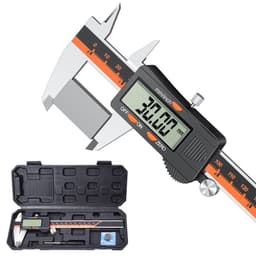
The large jaws take an outside length. Seat the part square on the faces, not on the tips. Mitutoyo’s handling note says there is no constant-force device and that the tips add error. A thumb and a finger are enough. The smaller jaws at the top measure a bore: open them until both faces touch, and rock until the screen shows the largest figure, the diameter rather than a chord. Depth uses the rod. Plant the beam on the rim and slide until the rod meets the bottom. Step uses the front of the slider on a shoulder. If the listing never names depth or step, as FortCeremy’s bullets do not, do not assume those faces exist. An outside zero does not prove the depth rod.
Adoric Adoric (150 mm)

Testsieger

Adoric Adoric (150 mm)
6.7/10about £6.99

Light pressure, then the lock

Close until the digits settle, then stop. A harder clamp bends a thin beam, which UK reviews describe on the EVRU. None of these listings has a ratchet. The lock, where it is named, holds the opening so you can read it in better light. Preciva, HARDELL, both Kynup models, Ueznirn, and Bryze name one. Use it after the reading has settled. With no lock, read while the jaws are still on the work, out of direct sun. Take the outside size twice. On a sub-£7 tool the printed line is about 0.2 mm. On a £20 stainless tool it is often ±0.02 mm or ±0.03 mm. You are checking your own repeat, not a certificate. Which claim to believe is in the digital caliper buying guide.

When to stop and measure again

After a part or two, close the outside jaws and look at zero. If it has walked off, wipe and zero again. Do not keep a personal offset in your head. Sealey allows a zero at any opening, so you can read only the extra length from a clean reference. Hand the job on when the part is safety-critical, the beam is nicked, or a report needs a certificate. A check against a known drill bit is not UKAS calibration. Spare button cells stay out of a child’s reach. A swallowed cell is an A&E emergency, and flat cells go to a shop battery point, as GOV.UK asks. If a screen is the wrong instrument, see vernier versus digital caliper.

Common questions

How do I zero a digital caliper?
Wipe the outside jaws, unlock if there is a screw, and close them gently until they meet. Press the zero button and wait until the screen reads zero in the unit you intend to use. If it does not, open, wipe, close, and press zero again. Do this at roughly 20 °C, on a dry bench, before the first part of the session and again whenever the closed jaws stop reading zero.
Which jaws measure a bore?
The smaller jaws at the top of a typical caliper, not the large outside faces. Put them into the hole, open until both touch the wall, and rock slightly so you catch the widest figure rather than a chord. Use the same light pressure you would on a shaft. Forcing the jaws open against the bore marks the hole and bends a thin beam, and the screen will still look precise.
How do I measure depth?
Rest the end of the beam on the rim of the hole so it sits flat, then slide until the rod at the back meets the bottom. Read the screen without lifting the beam off the rim. A zero you set on the closed outside jaws does not prove that the depth rod is right. If depth is the dimension you will cut to, check a known hole as well, or accept that this tool may not be the one for the job.
How hard should I close the jaws?
Until the faces touch and the digits settle, then no harder. There is no ratchet on the calipers in this set, including Adoric, so nothing clicks at a set force. A hard squeeze flexes the beam and shortens the reading. If two light repeats disagree by more than the accuracy line printed on your listing, wipe the faces and start again rather than averaging a squeeze.
What is the lock screw for?
It holds the jaws at the opening you just found, so you can move the tool into the light and read it. Lock after the digits have settled, not before the faces have met the part. Preciva, HARDELL, Ueznirn, and both Kynup models name a lock. Several cheaper rows do not. If yours has no screw, keep the jaws on the work while you read, out of direct sun.

Related pages

Sources

Public UK sources first, then the amazon.co.uk listings compared on this page. Shelf prices were captured on 19 October 2026. The Mitutoyo best-seller price and the scores are from 20 October 2026.

  1. BSI, BS EN ISO 13385-1:2019 (retrieved 20 October 2026)
  2. MSC UK, caliper accuracy and calibration (retrieved 20 October 2026)
  3. Cutwel, digital calipers explained (retrieved 20 October 2026)
  4. MQS, caliper buyer’s guide (retrieved 20 October 2026)
  5. IEC 60529 IP54 (retrieved 20 October 2026)
  6. Consumer Rights Act 2015, section 22 (retrieved 20 October 2026)
  7. GOV.UK, batteries and button-cell safety (retrieved 20 October 2026)
  8. amazon.co.uk Best Sellers, Digital Callipers (retrieved 20 October 2026)