Independent comparisons. We may earn from shop links. More info

Contour gauge for laminate flooring

Updated: 22 October 2026

The last plank is the one that meets a heating pipe or a door lining, and a tight scribe is how a floating floor buckles later. A contour gauge for laminate flooring copies the obstacle. It does not include the movement gap. You trace the shape, then add the clearance the floor maker asks for, and only then cut. This page stays with laminate and with the same idea on vinyl. The press-and-trace sequence is on [how to use a contour gauge](/hub/measuring-and-marking-tools/contour-gauge/sub/contour-gauge-how-to-use). Prices are on the [contour gauge comparison](/hub/measuring-and-marking-tools/contour-gauge), from amazon.co.uk listings captured on 19 October 2026. No lab laid this floor. A qualifying purchase through our links can earn a commission at no extra cost to you.

The last plank is the one that meets a heating pipe or a door lining, and a tight scribe is how a floating floor buckles later. A contour gauge for laminate flooring copies the obstacle.

Our top picks

On this page

The gap is not optional

Homebuilding, citing Quick-Step, says to leave 10 mm at walls, thresholds, stairs and pipelines. Tile Mountain says the same 10 mm at walls, door frames and pipes. Classen's UK installation PDF says 10 mm to pipes and other fixed objects. Wickes allows 10–12 mm at a doorway. Use 10 mm where those three say 10 mm. Use Wickes' 10–12 mm when you are following Wickes at a door. Do not collapse them into a single about a centimetre and then cut to the pin line. Draw the obstacle first, then mark the gap outside that line, on the waste side of the finished edge. A gauge pressed hard against the lining copies the lining. If you cut on that line, the plank touches the fixed object. You add the gap with the pencil after the pins have done their job.

Pipes

Classen says to cut pipe holes about 20 mm larger than the pipe, then split the hole through the centre so the plank can pass the pipe. That figure is the hole diameter, not the 10 mm perimeter gap. Wickes' example is a 32 mm hole for a pipe they describe as usually 15 mm, then a wedge cut. A pipe collar hides the clearance. Press the gauge so the pins show where the pipe sits relative to the plank edge, then drill the larger hole rather than jigsawing a tight circle. If the pipe is closer to the wall than your gauge is deep, the pins stop on the wall. MECHEER states 6 cm of depth. Measure before you assume the pins went round the back.

Door linings

A door lining is a profile, not a circle you drill. Tile Mountain and Classen both allow you to keep about 10 mm and notch the plank, or to undercut the architrave so the board slides under with the gap hidden. Ultimate Handyman saws the architrave using a scrap of laminate plus underlay as the height guide. Undercutting is a choice to move the clearance out of sight. If the lining stays, you notch. A 10 inch or 250 mm gauge is the width UK reviews use on door jambs. The shortlist with skip cases is on best contour gauge UK. Skip SULIVES for this job: it is a 6 inch listing, and UK reviews say the metal lock in the bullets was not on the tool.

What the plastic blade will not copy

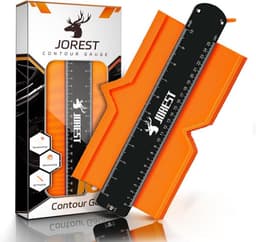
Architrave beads are often finer than an ABS pin. JOREST states 0.05 inch blades. MECHEER states 0.2 cm, and reviews call that too thick for a fine profile. A thick pin bridges the bead and gives you a blunt notch. If the beads matter and you are not undercutting, a needle gauge or a paper template will follow them more closely. Pin thickness, in the wider order of features, is in the contour gauge buying guide. The gauge stops when the line is on the board. Cut on the waste side of the gapped line. Offer the piece up before you click the plank into the row. If the floor is crooked, hollow, or wet, a template will not rescue it. Vinyl click floors need their own gap. Read that product's sheet rather than copying a laminate 10 mm onto a different brand.

Common questions

Do I scribe the plank tight to the wall?
No. Scribe the obstacle, then add the gap. Homebuilding, Tile Mountain and Classen use 10 mm at walls and fixed objects. Wickes uses 10–12 mm at a doorway. A line taken straight off the pins is the lining, not the finished edge of a floating floor. Cutting to that line is how the floor pinches later.
How big a hole do I leave around a heating pipe?
Classen says the hole should be about 20 mm larger than the pipe, then split through the centre. Wickes' worked example is a 32 mm hole for a pipe they describe as usually 15 mm, plus a wedge cut. That is separate from the 10 mm gap at walls. Cover the clearance with a pipe collar rather than closing it up.
Should I undercut the door lining instead?
You can. Tile Mountain, Classen and Ultimate Handyman treat undercutting as the other door method, so the board slides under and the gap is hidden. Use a scrap of laminate plus underlay as the height guide if you follow Ultimate Handyman. It is a rival to notching, not a fix for a gauge that was pressed out of square.
Is a 10 inch gauge enough for a door jamb?
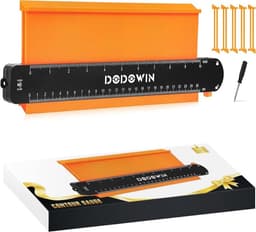
For one lining, usually yes. Reviewers in this set cite JOREST, DODOWIN and AI Gear for door jambs. A 6 inch gauge is the one reviewers wanted to be longer. A very wide opening may need a joined pair, which is a different listing.
Does the same 10 mm rule apply to vinyl?
The idea is the same: a floating floor needs room to move. The number belongs to the sheet for that vinyl, not automatically to Classen's laminate PDF. Amazon Basics reviews include vinyl at a door frame that was awkward to adjust without a lock. Trace at once, and read the vinyl instructions for the gap.

Related pages

Sources

Sources taken from the research digest. Listings were captured on 19 October 2026.

  1. Wikipedia — Profile gauge (retrieved 20 October 2026)
  2. Consumer Rights Act 2015, section 9 (retrieved 20 October 2026)
  3. Consumer Rights Act 2015, section 11 (retrieved 20 October 2026)
  4. General Product Safety Regulations 2005, regulation 5 (retrieved 20 October 2026)
  5. CAP Code, section 3 — misleading advertising (retrieved 20 October 2026)
  6. Wickes — Vitrex XTREME profile gauge, 200 mm (retrieved 20 October 2026)
  7. Homebuilding & Renovating — How to lay laminate flooring (retrieved 20 October 2026)
  8. amazon.co.uk search — contour gauge (retrieved 19 October 2026)