Independent comparisons. We may earn from shop links. More info

Combination square vs try square

Updated: 22 October 2026

You searched combination square vs try square because the two names sit on the same amazon.co.uk page, and one title says "engineers square" over a sliding rule. They both draw a right angle. They are not the same tool, and a grade printed for one does not move across. This page says when you pick up the sliding head and when you want a fixed blade. It does not rank the twelve listings on the [combination square comparison](/hub/measuring-and-marking-tools/combination-square). Peter F. used the BSI scope for BS 939:2007 and UK tool notes. We did not measure a grade in a lab. A qualifying purchase can earn us a commission at no extra cost to you.

You searched combination square vs try square because the two names sit on the same amazon.co.uk page, and one title says "engineers square" over a sliding rule. They both draw a right angle.

Our top picks

On this page

Two tools that both draw a right angle

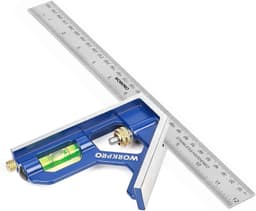
A combination square is a rule that slides through a metal head and locks. The head has a 90° face and a 45° face, and usually a small vial and a scribe. A try square is a fixed blade on a stock. It does not slide, it does not offer 45°, and it does not double as a depth gauge. Tooled-Up puts it that way: the try square is fixed at 90° and more rigid, and the combination square adds depth, 45° and a removable rule. BuildWiz says a try square is redundant for construction if you already own a combination square. That is a fair line for skirting, and a weaker line for furniture, where a fixed blade that cannot creep is the reference.

When the combination square is the one you pick up

Pick up the combination square when the mark is a mitre, a repeat distance, or a depth. A try square has no 45° face, so it cannot mark that angle. A parallel line is the head on the edge and a pencil at the end of a locked rule. A rebate depth is the head on the face and the rule slid to the bottom, then locked, then read. Axminster splits the tools the same way. The steps are on the how to use a combination square page. The nut can be left slack and a head can arrive out of square. Prove it with a flip test: lock, mark, flip, and look for parallel lines. Diverging lines mean you return a new square. The vial is not proof the 90° face is true. A speed square is a fixed roofing triangle, not a substitute for either tool.

When the try square is the reference

Use a try square when you are checking a corner, a machine fence, or a finished joint, and you do not need 45° or a variable depth. The blade cannot slip in a slot because there is no slot. It is the reference only when you have checked it and a grade is actually stated. An ungraded bargain try square is not automatically that reference. Use the combination square to mark and to set 45°. Use a graded try square when the only question is whether a corner is 90°.

What BS 939 does not cover

BS 939:2007 covers engineers' squares, including cylindrical squares and block squares. The BSI scope excludes adjustable squares. Grades AA, A and B belong to those fixed forms. They do not transfer to a combination square. Wonkee Donkee calls grade B the usual workshop grade for those fixed squares. Stanley's Class I line is a claim about the rule's scale, not a BS 939 grade for the head. Auyuiiy's amazon.co.uk title says "Engineers Square". The bullets describe an adjustable 300 mm head with 45° and 90°. That wording is not a BS 939 claim. Read the sliding stock, not the word engineers. Length, lock and stock are on the combination square buying guide. Named listings are on the best combination square page.

Common questions

Can one combination square replace a try square?
For marking on site, often yes, if you have flip-tested it and you lock the nut. BuildWiz treats a try square as redundant for construction once you own a combination square. For a graded check of a corner, or for a fence you do not want to depend on a lock, the fixed try square still has the job. One tool does not delete the other in every workshop.
Why keep a fixed square if the combination square does 90°?
The combination square's 90° depends on a lock and a head that can arrive out of true. A fixed try square has no sliding rule to creep. You keep it when the question is only whether a corner is 90°, especially on furniture and machine setup. You do not need it to mark 45° or a rebate depth, because it cannot.
Does BS 939 apply to a combination square?
No. BS 939:2007 covers engineers' try squares, cylindrical squares and block squares, and the scope excludes adjustable squares. A combination square can still be square enough for DIY layout after a flip test. It is not a BS 939 square, and it does not inherit grade AA, A or B.
What is grade B?
Grade B is the usual workshop grade for engineers' try squares, with AA and A used for finer reference, as Wonkee Donkee explains for those fixed squares. It is not a label you can attach to a sliding combination square. WORKPRO and Stanley in this folder are not grade B tools. If you need the grade, buy a square that states it.
Is an "engineers square" in an Amazon title the same tool?
Not by itself. Auyuiiy's title says engineers square, and the bullets describe a sliding 300 mm head with 45° and 90°. That is a combination square. An engineers' square in the BS 939 sense is a fixed try square, a cylindrical square or a block square. Read the head, not the adjective.
Where does a speed square fit?
A speed square is a fixed roofing triangle, used for rafters and quick angle marks on site. It is not a combination square and it is not a try square. Buy it for roofing layout, and do not treat it as either of the tools on this page.
What should I use to check the combination square itself?
Use the flip test on a straight edge. Lock the nut, mark along one blade edge, flip the square, and mark again. Parallel lines mean the head agrees with itself. A known-good fixed try square can be a second opinion on a 90° face. If a new combination square diverges, return it rather than filing the head.

Related pages

Sources

Sources taken from the research digest. Listings were captured on 19 October 2026.

  1. BSI, BS 939:2007 — engineers' squares (retrieved 20 October 2026)
  2. BSI, BS 4372:1968 — engineers' steel measuring rules (retrieved 20 October 2026)
  3. Measuring Instruments Regulations 2016, Schedule 1I (retrieved 20 October 2026)
  4. RS — combination squares (retrieved 20 October 2026)
  5. Cutwel — precision squares, angles and materials (retrieved 20 October 2026)
  6. BuildWiz — flip test for a builder's square (retrieved 20 October 2026)
  7. amazon.co.uk search — combination square (retrieved 20 October 2026)