Independent comparisons. We may earn from shop links. More info

How to use a combination square

Updated: 22 October 2026

You have a combination square on the bench and timber that needs a right angle, a mitre mark, or a set distance in from the edge. The sequence is the same each time: prove the head, tighten the nut, then mark. This is how to use a combination square, without ranking the twelve listings on the [combination square comparison](/hub/measuring-and-marking-tools/combination-square). Peter F. used public how-to notes and did not film a workshop test. If the square itself is the problem, the [combination square buying guide](/hub/measuring-and-marking-tools/combination-square/sub/combination-square-buying-guide) is the buying page. A qualifying purchase can earn us a commission at no extra cost to you.

You have a combination square on the bench and timber that needs a right angle, a mitre mark, or a set distance in from the edge. The sequence is the same each time: prove the head, tighten the nut, then mark.

Our top picks

On this page

Check it, then lock it

Start with a flip test before you trust any line. Tighten the nut so the rule cannot creep. Hold the head against a straight edge and mark a line along one side of the blade. Flip the square so the same blade edge is against the timber again, and mark a second line. Parallel lines mean the head agrees with itself. Diverging lines mean return a new square. Do not file the stock. BuildWiz treats a gap at the far end as about double the error, as a rule of thumb, not as a measured grade. Push the rule with your thumb after you lock it. If it slides, the setting is not a setting. The vial is not this check.

Mark 90° and 45°

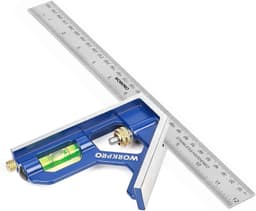
The wider face of the head, the anvil, is the 90° register. Seat it flat on the edge of the timber, not on a round or a painted lump, and draw the line with a sharp pencil or a knife against the blade. If the head rocks, the line will not be square even when yesterday's flip test passed. The narrower shoulder is the 45° register. Seat that face on the same straight edge and mark along the blade. Some Faithfull listings also print 135°, which is that same face used from the other side, not a third angle we measured. None of these listings includes a centre head. The combination square vs try square page is where the fixed 90° square belongs.

A line at a set distance, and a depth

To gauge a parallel, set the blade so the distance you want sits between the head and the end of the rule. Lock the nut. Hold the head against the edge and run a pencil at the end of the blade. On a 300 mm square, part of the rule is inside the head, so you cannot mark the full nominal length. The 150 mm or 300 mm combination square page is the size choice if the blade will not span the job. For a rebate or a mortice, rest the head on the face, slide the rule down until it touches the bottom, and lock the nut. Lift the square and read the scale where the head meets the rule. Do not read the depth with the nut slack. If the rule has metric and imperial scales, pick one and stay on it.

Pencil, scribe, and when to stop

On show-face timber use a sharp pencil or a knife. Use the pin on metal, on laminate, and on a waste edge. The point is sharp. Cap it or retract it when you put the square away. Reviews in this set say the pin is easy to lose. You can transfer a 90° or 45° setting to a saw fence if you lock the nut, then recheck after you clamp the fence. Call a joiner for stairs, fitted kitchens and structural timber. If the square is work equipment, PUWER 1998 means a damaged one comes out of use.

Common questions

Which face is 90° and which is 45°?
The wider face of the head, often called the anvil, sits on the timber for 90°. The narrower shoulder sits on the timber for 45°. Keep the head flat on a straight edge and mark along the blade. A 135° mark on some Faithfull bullets is that 45° face used the other way, not a separate angle we measured in a lab.
Why did my line move?
The nut was probably slack, so the rule crept between the two marks. Tighten it and push the rule with your thumb before you draw. A head that rocks on a rough edge will also move the line. If a flip test shows diverging lines with the nut tight, the square itself is out and a new one should go back.
How do I mark the same distance all along a board?
Set the blade so the distance you want is between the head and the end of the rule, then lock the nut. Hold the head against the edge and run a pencil at the blade end. That gives a line parallel to the edge for as far as the blade can reach. Join a second setting if the board is longer than the rule.
How do I read a rebate depth?
Rest the head on the face, slide the rule down until it touches the bottom of the rebate, and lock the nut. Lift the square and read the scale at the head. Do this with the nut tight. Stay on one scale if the rule shows both millimetres and inches. The vial is not the depth reading.
Pencil, knife, or the pin in the head?
Use a sharp pencil or a knife on show-face timber so you do not scratch the face. Use the scribe pin on metal, laminate, or a waste edge. The pin is sharp and easy to lose, so put it away retracted or capped. A pencil in the pocket covers the jobs where the pin is the wrong mark.
How do I check the square before I trust it?
Lock the nut. Mark a line from a straight edge along one blade edge. Flip the square, use the same blade edge, and mark again. Parallel lines mean the head agrees with itself. Diverging lines mean return a new square rather than filing it. Repeat the check after a drop.
Can I set a saw with it?
You can transfer a 90° or 45° setting to a fence if you lock the nut and check the fence after you clamp it. The square does not stay on the saw as a guide. Recheck if the fence moved. Stairs, fitted kitchens and structural timber are joiner's work, not a fence you set once and forget.

Related pages

Sources

Sources taken from the research digest. Listings were captured on 19 October 2026.

  1. BSI, BS 939:2007 — engineers' squares (retrieved 20 October 2026)
  2. BSI, BS 4372:1968 — engineers' steel measuring rules (retrieved 20 October 2026)
  3. Measuring Instruments Regulations 2016, Schedule 1I (retrieved 20 October 2026)
  4. RS — combination squares (retrieved 20 October 2026)
  5. Cutwel — precision squares, angles and materials (retrieved 20 October 2026)
  6. BuildWiz — flip test for a builder's square (retrieved 20 October 2026)
  7. amazon.co.uk search — combination square (retrieved 20 October 2026)