Independent comparisons. We may earn from shop links. More info

Combination square buying guide

Updated: 22 October 2026

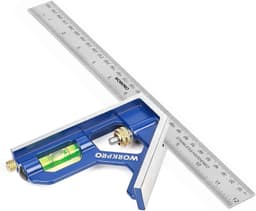
You are about to order a combination square from amazon.co.uk, and the photos all show a sliding rule, a 45° face and a 90° face. The choice that changes the mark is the blade length and whether the lock holds, not the brand line at the top of the title. This combination square buying guide uses the twelve listings in the [combination square comparison](/hub/measuring-and-marking-tools/combination-square), captured on 19 October 2026. Prices in that folder run from £6.98 to £34.99. Peter F. used those listings and did not lab-test the squares. A qualifying purchase can earn us a commission at no extra cost to you.

You are about to order a combination square from amazon.co.uk, and the photos all show a sliding rule, a 45° face and a 90° face.

Our top picks

On this page

Length and lock come before the brand

If the only question is whether 150 mm or 300 mm fits the timber in your hand, the 150 mm or 300 mm combination square page takes that decision on its own. A 150 mm blade suits a hinge recess and a pouch. Faithfull FAICS150 is that length at £6.99 and 99.8 g, and reviewers often say it is smaller than the photo suggested. A 300 mm blade suits skirting and a sheet layout. WORKPRO W064028 is 300 mm and 410 g at £25.91. Part of any blade sits inside the head, so the line you can draw is shorter than the number on the box. Tighten the nut and try to push the rule along the head. If it creeps, the next mark will not land on the first. PRESCH reviews include a rule that creeps and a thumbscrew that is stiff or fragile. Stanley STA046151 reviews say the brass nut must be tight or the rule slips.

Stock, rule, and the scale you can read

Stanley STA046151 claims a cast-iron stock and machined faces, at 430 g and £23.78. WORKPRO claims a zinc-alloy head and a 2 mm stainless rule. PRESCH claims cast zinc and a brass lock, and the set weighs 580 g. Those are listing claims, not a measurement we made. Faithfull Prestige FAICS300TCNC is black anodised aluminium at £28.49, and reviewers say the rule bends. Common Woodworking's buying note treats a cast-iron head as the stiffer default. Most of these listings are metric and imperial. PRESCH is metric only. Stanley's bullets specify millimetres and centimetres plus inches in 1/8 and 1/16. If you still mark in inches, a millimetre-only blade will slow you down.

Vial and scribe are extras

Almost every square here includes a small bubble and a pin. The bubble is for a short check of the head or a small face, not for a long run of skirting or a floor. Buy the square for the 90° face and the lock. The scribe is useful on metal and on laminate, where a pencil line is too thick. On show-face timber a pencil or a knife is kinder. Neither feature replaces the flip test.

What the British standards do not promise

BS 939:2007 covers engineers' try squares, cylindrical squares and block squares. The BSI scope excludes adjustable squares, so a combination square is not a BS 939 square and it does not carry grade AA, A or B. The combination square vs try square page keeps that distinction. A title that says "engineers square", as Auyuiiy's does, is still describing a sliding head. Class I is about the marks. The Measuring Instruments Regulations 2016, SI 2016/1153 Schedule 1I, limit the class I error between two non-consecutive marks to (0.1 + 0.1L) mm, with L the length in metres rounded up. Stanley's listing attaches Class I to the steel rule. It does not mean the head is square. The first 50 reviews of STA046151 include heads that arrived out of square. Diverging lines on a flip test mean you return a new square rather than filing the stock. Named picks are on the best combination square page.

Common questions

Do I need cast iron, or is zinc good enough?
Cast iron is the stiffer claim in this set, and Stanley STA046151 states it at 430 g and £23.78. Zinc is what WORKPRO and Auyuiiy state, and PRESCH states cast zinc. Zinc is enough for DIY marking if the lock holds and a flip test shows parallel lines. Aluminium, as on the Prestige rules, is the material reviewers here call flexible.
What does Class I on the Stanley rule actually mean?
Stanley STA046151 attaches Class I to the etched steel rule, not to the head. Under the Measuring Instruments Regulations 2016, class I limits the error between two non-consecutive marks to (0.1 + 0.1L) mm, with L in metres rounded up. That limit is about the marks. It says nothing about whether the stock is square to the blade. Reviewers still report heads out by about 1.5 mm to 2 mm along the blade.
Should the vial decide the purchase?
The bubble is a short vial in the head. It does not replace a spirit level on a long run of skirting or a floor. In this set, one Faithfull twin-pack review would not trust the vial, and one Makloee review says the level is not accurate. Buy on length, lock and a flip test. Keep the vial as a spare check you can ignore when it disagrees with a known straight edge.
Metric only, or metric and imperial?
PRESCH 10110 is the metric-only pair in this folder, at £34.99 for 150 mm and 300 mm. Reviewers who work in millimetres praise that. Reviewers who still mark in inches miss the second scale. Stanley, WORKPRO, Faithfull and most of the others print both. Pick metric only when your rods, tapes and cut lists are already in millimetres.
Is a combination square a BS 939 square?
BS 939:2007 covers engineers' try squares, cylindrical squares and block squares, and it excludes adjustable squares. Grades AA, A and B do not transfer to a sliding head. A combination square can still be useful for 45°, 90° and a depth, after you flip-test it. It is not a graded reference. If a new one fails the flip test, return it rather than filing the stock.
What should I do if a new square fails a flip test?
Lock the nut, mark a line from a straight edge, flip the square and mark again with the same blade edge. If the lines diverge, the head does not agree with itself. Return a new square rather than filing the face. The Consumer Rights Act 2015 covers goods that are not of satisfactory quality or not as described.

Related pages

Sources

Sources taken from the research digest. Listings were captured on 19 October 2026.

  1. BSI, BS 939:2007 — engineers' squares (retrieved 20 October 2026)
  2. BSI, BS 4372:1968 — engineers' steel measuring rules (retrieved 20 October 2026)
  3. Measuring Instruments Regulations 2016, Schedule 1I (retrieved 20 October 2026)
  4. RS — combination squares (retrieved 20 October 2026)
  5. Cutwel — precision squares, angles and materials (retrieved 20 October 2026)
  6. BuildWiz — flip test for a builder's square (retrieved 20 October 2026)
  7. amazon.co.uk search — combination square (retrieved 20 October 2026)