Builders line vs chalk line: choose the right one

Builders line vs chalk line explained for brickwork, slabs and layout work, including when to snap a mark and where a hanging line level fits in.
On this page

You have marked both ends of a wall, stretched a line between them and now need to decide whether to leave it in place or lift and snap it. That choice is builders line vs chalk line: one is a physical guide you work to, while the other deposits a straight mark on a surface. Pick by asking whether the line must remain at working height or merely leave evidence of where it ran.
In short
Use a chalk line when you need a quick straight mark across a dry, reasonably flat surface such as a slab, board or tiled area. Use a builders line for brickwork, fence alignment or any job where a taut guide must stay visible while you work. If you want to check that height with a hanging vial, the builders line is the one you need.
Two lines, two different jobs
A chalk line is cord in a case of powdered chalk. You pull the cord out, stretch it between two measured points, lift it and release it against the surface. That chalk line snap leaves a straight coloured trace. You then rewind the cord and work to the mark. It is useful because the cord does not have to stay in the way.
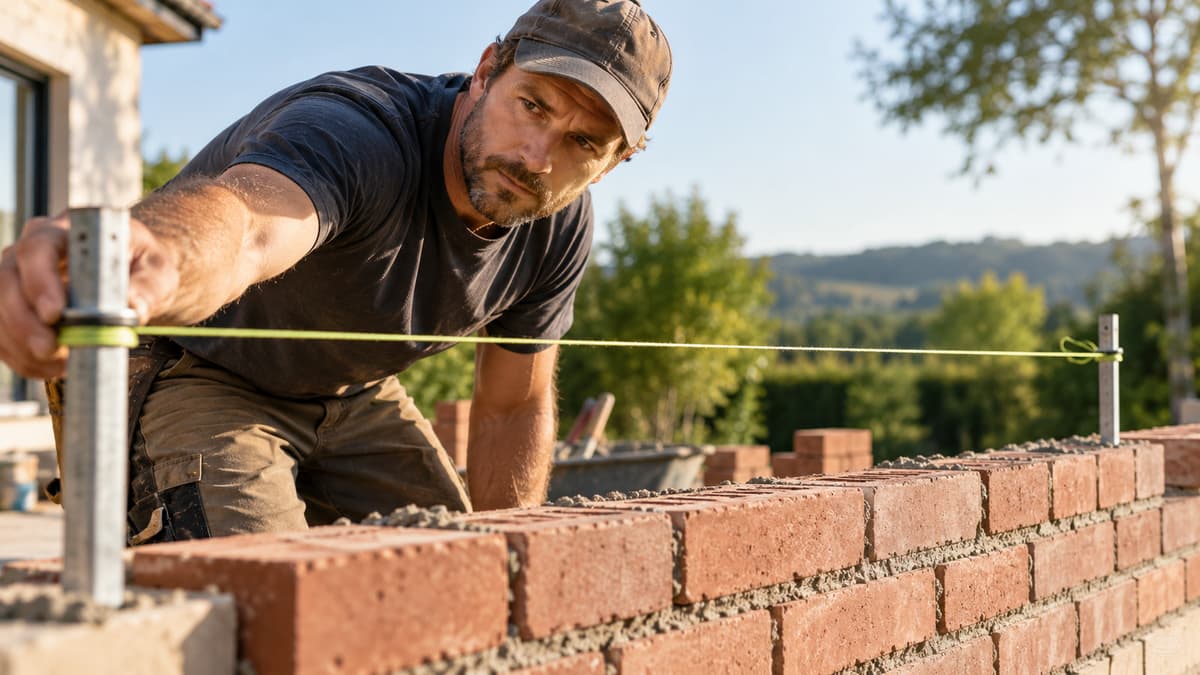
A builders line, also called brick line, mason line or string line, does the opposite. You secure it at two endpoints, tension it and leave it up while you build or align the work. On a wall it can show the face and top of the next brick course. Once that course is complete, you raise the line rather than replacing it with a chalk mark.
Neither tool finds level, distance, square or plumb by itself. Each joins the endpoints you set, even when those endpoints are wrong. A line can be perfectly straight and still slope, sit at the wrong offset or run diagonally across an out-of-square slab. Establish and check the points first, then use the line to transfer or preserve them.
When to snap a chalk line
Snap chalk when the surface can take a visible mark and you need both hands free afterwards. Typical jobs are a cut across sheet material, the first row of tiles, partitions laid out on a slab, or two pencil marks extended over a distance. The mark lies flat, so it will not catch a tool, deflect around materials or have to be lifted before you cross the area.
For a clean chalk line snap, hold the cord tight against the two endpoints and pull it directly away from the surface, not sideways. A modest lift is enough. Releasing from too high scatters chalk and leaves a wider, less precise line. On a long run, a helper can pin the cord at an intermediate point so it does not shift while you snap each section.
Surface condition is the limit. Dust stops contact, damp blurs the mark and rain may remove it. Rough concrete can leave a broken but usable trace; wet ground needs another method. Keep small reference marks in case the chalk goes. Red chalk may stain floors and plasterboard. Blue or white is the safer start. Test a hidden patch before you snap a finished surface.
When to pull a builders line
Pull a builders line when the guide must stay available as the work progresses. For brickwork, fix it at the ends of the course and bring it to the intended face and height. Lay each brick close to the line without pushing it. Even slight contact bows the cord and carries that error along the course. Move the line up only after the course is complete.
Tension matters. A loose string sags. An overstretched or poorly fixed one can slip, break or pull an end fixing out. On a long run, recheck the centre and the ends, and split the span with intermediate points you have set. How to stop a builders line sagging covers tension and a support in the middle.
The same idea helps with fence lines and straight drainage runs. The string stays visible above disturbed ground and shows sideways drift. It does not set depth unless you measure down from a separate datum. For a small garden wall, builders line plus pins or line blocks is the kit. A chalk reel can mark the foundation first, but it cannot replace the guide for each course. Brickwork choices sit on string spirit levels for bricklaying.
Which line suits the job?
Choose by what has to remain after you let go of the cord.
- Brick course: builders line. It stays up as a face and height guide and rises one course at a time. Chalk is only a mark.
- Slab: chalk if the concrete is dry. Measure the ends, snap, and keep reference points. On a damp external slab, do not expect the line to last until the next day.
- Fence: builders line between set end posts or profiles. It shows straightness in plan, not level post tops.
- Drainage or a datum: the string stays visible over an excavation, but the route and the fall are separate. Set known levels and measure down. A centred bubble is not a drainage gradient, as set out in a centred bubble is not a drain fall.
- Sheet material, tiles or an indoor partition: chalk is quicker. Snap only where the surface can take chalk, and use a straightedge if the finish will stain.
Where a hanging vial fits
A hanging vial, often called a string line level, belongs on a taut builders line. Set firm endpoints, tension the line to limit sag, hang the vial near the centre and let it settle. The string spirit level comparison is the set for that tool. The vial compares the supports. It does not fix sag, wind, a heavy vial or a moved end. Reverse it, take a second reading, and use a longer level or a laser on a tight tolerance or a long span.
There is no equivalent during a chalk snap. You may set the two endpoints level with another instrument, but clipping a vial to the cord while you lift and release it is not a check. Set the ends, take the level off if it is in the way, then snap the cord only to transfer their straight route onto the surface.
What you still measure with a tape
Both lines start from points you have located, which is why you still need a tape. Measure the run, the offsets from a reliable edge, the openings and the repeated centres before you stretch either cord. On a slab, mark the ends and check the diagonal or the right angle the layout needs. On brickwork, measure returns, reveals and wall thickness rather than trusting the string to invent them.
A useful order is measure, mark, cross-check, then line. If a second dimension can expose an error, take it before you snap chalk or lay a course. Once the cord is up, measure back to a fixed reference at both ends so one point has not shifted while you tensioned it. Lengths and formats are in the tape measure guide. A crisp chalk mark or a tight string can make a wrong measurement look authoritative.
Common mistakes to avoid
These are the mistakes that make a straight line the wrong line.
- Straight is not level. One support can be higher. Check height before you follow a builders line or snap a level datum.
- Do not let the work move the guide. Bricks should not touch a mason line, and posts should not push it sideways. Reset it if it moves.
- Chalk is not permanent. Feet, a broom, rain and dust fade it. Keep small measured points so you can recover the layout.
- A strong red line is easy to see and hard to remove from a floor or plasterboard. Start with blue or white where appearance matters, test a hidden patch, and keep durable marks for surfaces that allow them.
Common questions
Can I snap a chalk line and call it level?
Which line do bricklayers leave up?
Will a chalk line survive rain?
Which chalk colour is least likely to stain?
Do I still need a tape measure?
Where does a hanging line level fit?
Is a plumb bob the same as either line?

Peter F. is the editor for DIY & tools at productscompared.co.uk. Comparisons in this category are checked against amazon.co.uk listings, review evidence and public UK sources.
Related articles
Builders line sag: how to keep your line true
A loose builders line dips across brickwork and a fence run. Tension, span and a mid-span support decide whether it stays true.

String line fence posts UK: keep every post straight
End posts, a taut string and measured centres keep fence posts in a straight line on level ground and on a slope.

Drain fall 1 in 40: why a centred bubble is wrong
A centred bubble means level. It is not a 1 in 40 drain fall, and it will not set the gradient on its own.