Engine stand vs engine crane
You are about to buy one tool to both pull the engine and hold it for the rebuild. An engine stand vs engine crane comparison stops that purchase. The crane lifts the engine out of the bay. The stand holds and turns what is already out. A load leveller only tilts a hanging engine, and a support beam holds an engine that stays in the car. The [engine stand comparison](/hub/lifting-equipment/engine-stand) keeps seven stands, none of them a crane. Peter F. wrote this on 20 October 2026 from Health and Safety Executive guidance, with no lab test. A qualifying purchase can earn a commission at no extra cost to you.
You are about to buy one tool to both pull the engine and hold it for the rebuild. An engine stand vs engine crane comparison stops that purchase. The crane lifts the engine out of the bay.
You are about to buy one tool to both pull the engine and hold it for the rebuild. An engine stand vs engine crane comparison stops that purchase. The crane lifts the engine out of the bay. The stand holds and turns what is already out. A load leveller only tilts a hanging engine, and a support beam holds an engine that stays in the car. The engine stand comparison keeps seven stands, none of them a crane. Peter F. wrote this on 20 October 2026 from Health and Safety Executive guidance, with no lab test. A qualifying purchase can earn a commission at no extra cost to you.
Our top picks
| Badge | Product | Stand type | Stated load | Head | Note | Price | Offer |
|---|---|---|---|---|---|---|---|
| Best overall |  T-Mech T-Mech folding engine stand, 900 kg | Rotating engine and gearbox stand | 900 kg / 2,000 lb | 8 locks at 45° | 8.3 | about £149.99 | View offer |
| Best value |  AB Tools AB Tools rotating engine stand, 450 kg | Rotating engine and gearbox stand | 450 kg | 6 locks at 45° | 6.9 | about £79.75 | View offer |
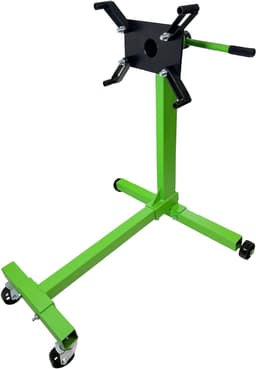
| Alternative |  Garvee Garvee rotating engine stand | Rotating folding engine stand | Title 340 kg; bullet 680 kg | 360°, lock count not stated | 3.8 | about £56.99 | View offer |


On this page
Four tools, four jobs
The crane number is a chart, not a badge
The legs have to interlock
What a home garage is not signing
Common questions
Can an engine stand pull the engine out of the bay?
What does a load leveller do that the stand does not?
What is an engine support beam for?
Why does a 2 tonne crane become a much smaller crane with the jib out?
Does a home garage need a LOLER certificate for the stand?
Related pages
Sources
Public UK sources named below. amazon.co.uk prices, stars and review counts on these seven listings were read on 19 October 2026. Page updated October 2026.
- HSE OC 803/69: motor vehicle repair (retrieved 19 October 2026)
- PUWER 1998, regulation 6 (retrieved 19 October 2026)
- HSE: LOLER overview (retrieved 19 October 2026)
- HSE: working under vehicles (retrieved 19 October 2026)
- Sealey ES350.V3 instructions (retrieved 19 October 2026)
- HSE: design and supply of products (retrieved 19 October 2026)
- GOV.UK: General Product Safety Regulations 2005 (retrieved 19 October 2026)
- HSE: inspection of work equipment (retrieved 19 October 2026)