Independent comparisons. We may earn from shop links. More info

How to use an engine stand

Updated: 22 October 2026

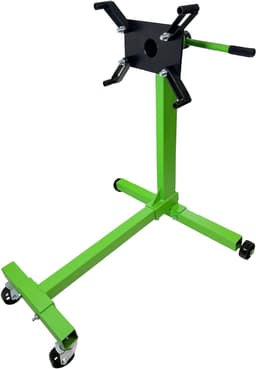
The engine is out of the bay and the stand is where it has to live next. How to use an engine stand, on a rotating pin-head, is a short sequence: lock the plate before you bolt the load, take the weight on the handle before the pin comes out, push from behind the post, and do not work underneath. The [engine stand comparison](/hub/lifting-equipment/engine-stand) is the product set these steps sit beside. Peter F. wrote this on 20 October 2026 from Sealey’s ES350.V3 instructions and Health and Safety Executive pages, with no lab test. A qualifying purchase can earn a commission at no extra cost to you.

The engine is out of the bay and the stand is where it has to live next.

Our top picks

On this page

The stand starts when the crane still has the weight

A stand does not lift the engine out of the car. Leave the crane holding the engine until the stand is locked, the arms are on the block and the bolts are tight. Only then does the crane hand the weight over. If you are still deciding whether you needed a crane, that split is on the engine stand versus engine crane page. On the Sealey ES350 the limit is 350 kg, the head swivels 360 degrees and the maximum load length is 700 mm. Those figures belong to that model. T-Mech states 900 kg and eight locks. AB Tools states six locks. Read the plate on the stand you own. Do not borrow 350 kg for a different frame.

Lock, then bolt

Lock the mounting plate before you fix the load. On the ES350 that is the instruction. The pin should be seated before the crane lowers the engine onto the arms. If you bolt first and lock later, the block can rotate as the sling goes slack. A pin that stops halfway is not a lock. Sit the mass over the stand, not hung off one side. The ES350’s 700 mm maximum load length is that model’s limit. Stop if the arm cannot reach a solid point. If the head moves after the pin is in, or a weld is cracked, the engine goes back on the crane.

Turn, then roll

Turn the engine only after the bolts are tight and the crane is clear. Take the weight on the handle before you pull the pin. Move one position, and seat the pin again before you let the handle go. If the handle loads up harder than you can hold, put the pin back. Push from behind the post so the castors lead. Do not pull a loaded stand backwards. The ES350 sheet is explicit about that. The floor wants to be firm and level. T-Mech states two rear brakes. If your stand has no brake and the floor is not flat, do not park the engine and walk away. You still do not lie under the sump. Roll the head, with the pin seated, until the work faces you, or leave the job.

When you stop, and which stands this is not

Stop when the pin will not seat, when the head is twisted, or when the dressed weight is not under the one figure on the plate. If it may be over the plate, use the engine stand weight capacity page before you bolt anything. At work, HSE cites engine stands for inspection under PUWER regulation 6. That duty does not fix the interval at 12 months, and a private garage is not an employer’s LOLER examination. The pin sequence does not transfer to a strap cart or a Chevy cradle, which do not state a rotating head. The DETYI bench weighs 4.2 kg under a 1,000 lb title. If the engine is still in the car and you have no rated crane and slings, use a workshop.

Common questions

Why take the weight on the handle before the pin comes out?
The handle is what holds the engine once the pin is out. If you pull the pin first, the block can rotate through the free arc. Hold the handle, take the turning load, withdraw the pin, move one position, and seat the pin before you release the handle. If you cannot hold that load, the mount or the weight is wrong for the stand.
Can I lie under the sump while it is on the stand?
No. The ES350 instructions say not to work underneath. Turn the head, with the pin seated, until the work faces you, or stop. An engine on a stand is still a heavy unit on a pin and bolts. Workplace guidance about under-vehicle work is aimed at employers, and the same body position is a bad idea on a home floor.
What if the pin will not seat or the head is twisted?
Stop. Put the weight back on the crane if the engine is already on the arms, and do not start the rebuild. A UK review describes a twisted holding part on an ES350, and another describes excessive head play on a T-Mech. Those are returns, not a few minutes of running in. A pin that stops halfway is an unlocked head.
Do these steps apply to a strap stand or a Chevy cradle?
The pin and handle sequence is for a rotating head. The YOLANDO cradle and the Performance Tool strap stand do not state one, so do not invent a pin routine for them. You still stay inside the stated load, and you still do not work underneath. The DETYI stand is a light motorcycle bench, not the place for this car-engine sequence.
Where does the crane stop and the stand start?
The crane stops when the stand is locked, the bolts are tight and the sling is slack. Until then the crane still has the weight, and its legs have had to fit around the stand. The stand does not pull the engine out of the bay. If the legs foul the stand, move one of the tools before you lower the hook.

Related pages

Sources

Public UK sources named below. amazon.co.uk prices, stars and review counts on these seven listings were read on 19 October 2026. Page updated October 2026.

  1. HSE OC 803/69: motor vehicle repair (retrieved 19 October 2026)
  2. PUWER 1998, regulation 6 (retrieved 19 October 2026)
  3. HSE: LOLER overview (retrieved 19 October 2026)
  4. HSE: working under vehicles (retrieved 19 October 2026)
  5. Sealey ES350.V3 instructions (retrieved 19 October 2026)
  6. HSE: design and supply of products (retrieved 19 October 2026)
  7. GOV.UK: General Product Safety Regulations 2005 (retrieved 19 October 2026)
  8. HSE: inspection of work equipment (retrieved 19 October 2026)