Independent comparisons. We may earn from shop links. More info

Self-propelled vs push lawn mower

Updated: October 2026

You are looking at a driven cordless mower because the advert makes drive sound like a free upgrade, and you are not sure your lawn is big enough to need it. On a small flat UK lawn you can already mow, a push mower spends the battery on the blade and weighs less. A self-propelled vs push lawn mower decision flips when the pushing, not the cutting, is what stops you. The [self-propelled cordless lawn mower comparison](/hub/lawn-and-garden-equipment/self-propelled-cordless-lawn-mower) keeps driven machines only. Products Compared used the amazon.co.uk listings saved on 22 October 2026 and did not run a timed trial. A purchase through our links can earn a commission at no extra cost to you.

You are looking at a driven cordless mower because the advert makes drive sound like a free upgrade, and you are not sure your lawn is big enough to need it.

Our top picks

On this page

What each machine asks you to do

A push mower rolls. You supply every step. The motor turns the blade and nothing else. A self-propelled mower turns at least one axle as well. You steer, you hold the bail, and you manage a second control for the wheels. Large rear wheels are not drive. A category title is not drive. You can often release the drive and push a self-propelled mower. Mow and Edge makes that point, and then makes the next one: the mower does not become a light push mower when you do. The drive hardware stays on the handle. Gtech's own guide, written for its customers, says that for a typical small flat British garden the extra weight and cost are not justified, and that drive belongs on a sprawling or steep lawn or where mobility is the limit.

Weight and the battery

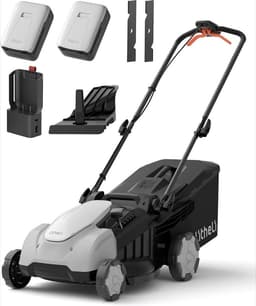
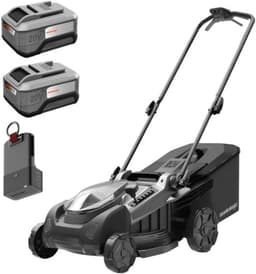
The driven kits in this capture publish two weights. The Litheli is listed at 14.9 kg. The woRkologie is listed at 16.2 kg. The Greenworks weight is not stated, so it stays out of the comparison. Those kilograms are what you lift onto steps and into a shed. Drive does not climb steps. A folding handle, which the Litheli and the Greenworks mention, changes how the mower stores. It does not change the mass on the staircase. The battery is the other cost. Power that goes to the wheels does not go to the blade. A woRkologie review says a faster drive shortens the run. We are not turning that into a minute count, and we are not importing an American claim that drive costs about ten minutes. Which? says drive is why some buyers look for a self-propelled mower when the machine is heavy.

When the answer flips

Stay with a push mower when the lawn is small, flat, and already inside what you can push. You avoid the drive's weight on the steps, you put the charge into the blade, and you do not pay for an axle you will leave switched off. Mow and Edge puts push mowers in that lighter role. Nothing in this capture is a push mower we are ready to name. Move to drive when you stop because of the push, when the ground rises, or when fatigue is the constraint. Rear-wheel drive is the version to look for on a bank, and only the woRkologie states it with a speed. The Litheli claims gentle slopes without naming the axle or a degree. How steep is too steep is the whole of the slopes page, including the fact that the guides do not agree on a number.

A recommendation with a condition

Choose a self-propelled mower if the push is what stops you, or if the lawn rises and you can still walk it. The condition is that you accept a heavier machine on the steps and a shorter run when the drive is on the faster setting, as that woRkologie review describes. Under that condition the Litheli is the only listing here with at least 500 reviews, at 4.3 from 684 and about £249.99, and there is no best-value badge because nobody reaches 1,000 reviews.

Common questions

Is drive worth it on a small flat lawn?
Usually no. You carry extra weight and you spend some of the battery on the wheels for a job you can already finish by pushing. UK retail guides put drive on large lawns, slopes, and people who tire. A compact level lawn does not clear that bar.
Does the drive use battery?
Yes. Energy sent to the axle is energy the blade does not get. A woRkologie review says the faster drive shortens the run. There is no minute figure from this capture to attach to that sentence. On a short lawn you may not notice. On a lawn that already uses a full pack, the speed setting is part of whether you finish.
Can I push a self-propelled mower with the drive off?
Yes, if the drive releases cleanly. The mower stays heavier than a purpose-built push mower, because the drive hardware is still there. Mow and Edge makes that distinction. Try the release on flat ground before you rely on it near a step. If the lever sticks, you do not have a push mower. You have a fault, and the lawn can wait.
Is a push mower in this comparison?
No. The main set is drive-only on purpose. Push machines were removed because they did not fit the category. This page is where you decide you might want one anyway. We are not putting those deleted models back in as recommendations. Shop for a push mower elsewhere, then come back if the lawn turns out to be more than you can push.
When does a slope change the answer?
When you are leaning into the mower because of the gradient, not because of the distance. A bank you can still walk is the case for rear-wheel drive, stated properly, which in this set means the woRkologie's speed line and not a guessed angle. A bank you cannot walk is not a case for a push mower or a driven walk-behind. The slopes page keeps that degree gap open.

Related pages

Sources

Buying notes from the sources below, checked for this page on 22 October 2026. Prices, stars and review counts are from the amazon.co.uk captures of that date.

  1. Noise Emission in the Environment by Equipment for use Outdoors Regulations 2001 (retrieved 22 October 2026)
  2. Environmental Protection Act 1990 (retrieved 22 October 2026)
  3. GOV.UK: noise nuisances and how councils deal with complaints (retrieved 22 October 2026)
  4. RHS: mowing (retrieved 22 October 2026)
  5. BBC Gardeners' World: best cordless lawn mowers (retrieved 22 October 2026)
  6. Consumer Rights Act 2015 (retrieved 22 October 2026)
  7. IEC 62841-4-3:2020, electric walk-behind lawn mowers (retrieved 22 October 2026)
  8. Husqvarna UK: how to use the drive on a lawn mower (retrieved 22 October 2026)