Independent comparisons. We may earn from shop links. More info

Self-propelled lawn mower for slopes

Updated: October 2026

Your lawn rises toward the fence, and you want to know whether a self-propelled lawn mower for slopes is enough or whether you should stop and use something else. Drive helps on a bank you can still walk. It does not publish a safe angle by itself. None of the three amazon.co.uk listings in our [self-propelled cordless lawn mower comparison](/hub/lawn-and-garden-equipment/self-propelled-cordless-lawn-mower) states a gradient in degrees. Products Compared used the listings saved on 22 October 2026 and did not measure your bank. A purchase through our links can earn a commission at no extra cost to you.

Your lawn rises toward the fence, and you want to know whether a self-propelled lawn mower for slopes is enough or whether you should stop and use something else. Drive helps on a bank you can still walk.

Our top picks

On this page

Why the driven axle matters

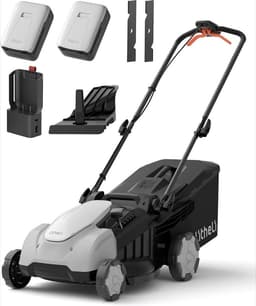
On a climb, weight shifts toward the back of the mower. Rear-wheel drive puts the driven tyres under that weight, which is why UK guides treat it as the usual domestic choice for a slope. Front-wheel drive steers more easily around a shrub and then unloads the front tyres as the nose points uphill, so the wheels can spin. All-wheel drive exists and costs more. In this set, only the woRkologie states rear-wheel drive, at 2.2–4.7 km/h, also printed as 1.4–2.9 mph. That is the only axle-and-speed claim we can apply. It is not a verdict that the woRkologie is the best mower for slopes. There was no slope test. The Litheli says the drive suits uneven ground and gentle slopes, and it does not name the axle. A push mower on the same bank makes you supply all the force, which is why the self-propelled versus push lawn mower page sends tiring ground toward drive.

Degrees the listings do not give

Gentle slopes on the Litheli bullet is not a tested angle. The woRkologie claims slopes and prints no degrees. The Greenworks prints no degrees and no speed. Garden guides do not fill that gap, because they do not agree. One designer's note treats gradients over about 15 degrees as a reason to want drive, and a steeper figure around 25 degrees appears in the same kind of article as a point where a walk-behind machine stops making sense. Walk the bank before you buy. If you cannot walk it while imagining about 15 kg in your hands, a sentence that says gentle will not make it gentle. The buying guide tells you how to read a drive bullet. It does not invent the missing degree either.

Downhill, wet grass, and weight

Drive is built to push the mower along the stripe. Downhill, the weight wants to go anyway. Release the drive and the mower can still run on if you are standing above it. Mow across a moderate slope rather than straight down it, and turn on the flatter ground at the end. Do not walk backwards down the bank to keep a machine in check. Listed weight is 14.9 kg for the Litheli and 16.2 kg for the woRkologie. The Greenworks weight is not stated, and it does not inherit either number. Sixteen kilograms on a dry path is a lift into the shed. Sixteen kilograms on a wet bank is a load you are trying not to chase. If you cannot hold the mower still with the drive released, the bank is too steep for that machine that day, whatever the bullet says.

When to stop

Stop when your feet slip, when the mower will not hold on the slowest drive setting, or when you would have to stand below the deck to keep it from running on. Stop if the blade does not die when you release the bail. Those are the same stop rules as on flat ground, and the slope makes them shorter. A hover mower, or a purpose-built bank mower, is the next tool when the walk-behind cannot keep its tyres planted.

Common questions

Is rear-wheel or front-wheel better on a bank?
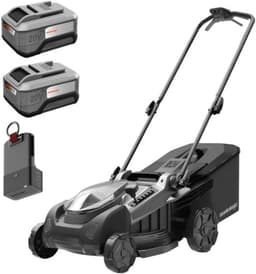
Rear-wheel, for a bank you can still walk. Weight moves backwards on a climb, so the driven rear tyres stay loaded. Front-wheel drive is easier to steer around obstacles and loses grip as the nose rises. In this set only the woRkologie states rear-wheel drive with a speed. The Greenworks says the rear wheels are driven and gives no speed.
How steep is too steep?
When you cannot keep your footing while holding the mower. Guides disagree on degrees, from about 15 degrees as a point where drive starts to help, to higher cutoffs where they send you toward a hover. This page does not pick one official angle, because the listings print none. Wet grass lowers whatever limit you thought you had.
Does gentle slopes on a listing mean a tested angle?
No. The Litheli uses that phrase and does not state degrees. The woRkologie claims slopes with no degrees. Treat both as marketing lines until a manual gives a number, and then treat the number as that manufacturer's limit in the dry. We did not verify either machine on a ramp. A review count does not convert the phrase into a degree.
Will drive hold the mower going downhill?
Do not assume it. Drive is there to move the mower forward under power. Downhill, gravity is already doing that. Release the drive before you change direction, mow across a moderate slope rather than straight down, and stop if the deck starts to lead you. A slow speed setting is not a brake specification. None of these listings prints one.
What if the grass is wet?
Leave it. The RHS advises against mowing very wet soil, and a wet bank adds slip to clogging. The BALI professional slopes note warns against assuming a stated maximum gradient still applies in the wet. These domestic listings do not state a maximum at all. Waiting a day is the control you actually have. Drive does not dry the surface.

Related pages

Sources

Buying notes from the sources below, checked for this page on 22 October 2026. Prices, stars and review counts are from the amazon.co.uk captures of that date.

  1. Noise Emission in the Environment by Equipment for use Outdoors Regulations 2001 (retrieved 22 October 2026)
  2. Environmental Protection Act 1990 (retrieved 22 October 2026)
  3. GOV.UK: noise nuisances and how councils deal with complaints (retrieved 22 October 2026)
  4. RHS: mowing (retrieved 22 October 2026)
  5. BBC Gardeners' World: best cordless lawn mowers (retrieved 22 October 2026)
  6. Consumer Rights Act 2015 (retrieved 22 October 2026)
  7. IEC 62841-4-3:2020, electric walk-behind lawn mowers (retrieved 22 October 2026)
  8. Husqvarna UK: how to use the drive on a lawn mower (retrieved 22 October 2026)