Independent comparisons. We may earn from shop links. More info

How to install lawn edging

Updated: October 2026

The bed line is ragged, the listing says no digging, and you still do not know whether the first peg will enter the ground. How to install lawn edging depends on the product in the box: a pegged plastic coil or galvanised sections with spikes. This page is the order of work for a UK garden, from a marked line to a top the mower can pass. Choosing the material sits on the [lawn edging comparison](/hub/lawn-and-garden-equipment/lawn-edging) and in the [lawn edging buying guide](/hub/lawn-and-garden-equipment/lawn-edging/sub/lawn-edging-buying-guide). Peter F. wrote this from saved amazon.co.uk listings, RHS guidance and UK utility advice, on 22 October 2026. We did not fit these strips in a trial. If you buy through our links, we may earn a commission at no extra cost to you.

The bed line is ragged, the listing says no digging, and you still do not know whether the first peg will enter the ground.

Our top picks

VOUNOT VOUNOT 20 m brown

Rank 2

VOUNOT VOUNOT 20 m brown
8.8/10about £19.49
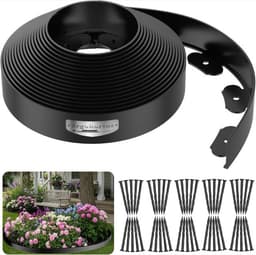
Ergohortus Ergohortus 10 m

Alternative

Ergohortus Ergohortus 10 m
6.7/10about £18.99
On this page

Mark the line before any plastic goes in

Start with the line, not the mallet. The Royal Horticultural Society describes a string or a hose on the curve you want, then a half-moon to cut the turf, and it tells you to avoid frozen or waterlogged ground. If you are adding a strip, the same mark stops you from following the coil’s old curl. A no-dig plastic bullet is asking you to lay the strip on a cleared surface and pin it. Garden Ninja, writing as a designer, cuts turf and sets plastic in a trench in his own method. Match the one that belongs to the box you bought. Clear stones before you unroll. A coil that still holds a circle will not become straight because you hammer faster.

Pegs, spikes and the no-dig claim

No-dig, on these listings, means the manufacturer says you do not cut a trench. It does not mean every UK soil will take a plastic stake. Ergohortus’s line says peg every three holes. Follow the holes on the strip you have. Push or tap one peg at the start of the run. If it bends, stop. Galvanised sections, such as the Harbour Housewares 5 m set, use spikes that are already on the metal. Reviews talk about a mallet and a hacksaw for a short last piece. Garden Ninja’s steel method puts a timber block between the hammer and the edge so the top does not mushroom. That block is from his article, not a part in the box. Fit the clips as you go.

Set the top against the mower

A lip that stands proud of the grass meets the mower blade or the strimmer line. Set the top so the blade passes it. Garden Ninja’s install article uses about 3 mm proud in his own steel method. That is his practice, not a British Standard. The RHS maintenance page describes a cut gutter of about 7.5 cm with no product in it. Do not bury a 5 cm plastic face to chase 3 mm, and do not dig a 7.5 cm channel because a coil is in the shed.

When the ground or the services say stop

Stone and a dry clay pan are reasons to stop. Wetting the soil will not turn flint into a peg socket. If the first peg bends, change the route or leave the bed as a cut edge. Before a trench, or before pegs close to the house, use LinesearchbeforeUdig. Health and Safety Executive guidance says plans indicate a service and do not prove where it is. If the tool strikes anything unexpected, stop. Call someone else when the strip must hold a bank, or when the run is a listed boundary or a highway edge. A retaining edge is not a 5 cm coil.

Common questions

Do I have to dig a trench?
Only if the product you bought is meant to sit in one. Several plastic bullets in this set say no digging, and they mean pegs into a cleared surface. Garden Ninja’s plastic method uses a trench, and that is his designer sequence, not the text on those coils. Steel spikes still need the ground to accept them. If you are cutting a deep channel by the house, check for services first. The listing sentence does not survey your lawn.
How far apart should the pegs be?
Use the holes, not a guessed measurement. Ergohortus says peg every three holes, and other bullets in this set say every two or three. There is no single centimetre spacing printed across these listings. Start with one peg. If the strip lifts between holes, add a peg at the next hole rather than hitting the same stake harder. A spacing that works in damp loam can fail in stone, which is a soil limit, not a number you can copy from a different garden.
What if the peg bends?
Stop on that peg. Reviewers describe broken spikes and strips that creep off the line as hammering continues. A bent peg is the test the bullet did not run in your ground. Wetting dry soil is the step some listings allow. Drilling is something individual reviewers tried, and it is not a safe next step beside a house wall or anywhere a cable might run. Move the line, choose a different edge, or leave the border as a cut with a half-moon.
How high should the top sit for the mower?
Low enough that the blade and the strimmer do not strike a lip. There is no single UK millimetre for these retail coils. Garden Ninja’s figure of about 3 mm proud belongs to his steel method. The RHS figure of about 7.5 cm is a sheared gutter in turf, with no strip in it. For a 5 cm plastic face, keep the lawn side mowable and accept that grass can still creep. A scratched face in one review is what happens when a strimmer meets a taller plastic edge.
When should I stop and call someone?
Stop when a peg or a spike hits something unexpected, when the drawing shows a service on your line, or when the edge is meant to retain soil on a bank. A listed boundary or a highway edge is not a Sunday coil. Those jobs need the person who is allowed to work on them. Fitting a light bed marker in open lawn, after one successful test peg, is the job these kits are describing.

Related pages

Sources

Public UK sources from the research digest. amazon.co.uk prices, stars and review counts on these twelve listings are the saved figures, scored on 23 October 2026.

  1. RHS: How to create a lawn edge (retrieved 23 October 2026)
  2. RHS: How to maintain lawn edges (retrieved 23 October 2026)
  3. Garden Ninja: How to install lawn edging (retrieved 23 October 2026)
  4. GPDO 2015, Schedule 2, Part 2 (retrieved 23 October 2026)
  5. HSE: Excavations and underground services (retrieved 23 October 2026)
  6. LinesearchbeforeUdig (retrieved 23 October 2026)
  7. Consumer Rights Act 2015, section 22 (retrieved 23 October 2026)
  8. Straightcurve UK: Corten and weathering steel (retrieved 23 October 2026)