Independent comparisons. We may earn from shop links. More info

How to install metal lawn edging without denting it

Updated: October 2026

If you are standing over a coil or a pack of spiked sections, the safest answer to how to install metal lawn edging is not simply to hammer it in. Mark the finished line, open the ground where necessary, connect sectional products while you can still reach the joins, and strike a timber block rather than the metal top. Thin rolls need a supporting slot. Spiked 1.6 mm sections may enter prepared soft soil with less digging. The [main lawn edging metal comparison](/hub/lawn-and-garden-equipment/lawn-edging-metal) shows which saved products include spikes and which rely on burial. The sequence below works from that distinction. A qualifying purchase can earn a commission at no extra cost to you.

If you are standing over a coil or a pack of spiked sections, the safest answer to how to install metal lawn edging is not simply to hammer it in.

Our top picks

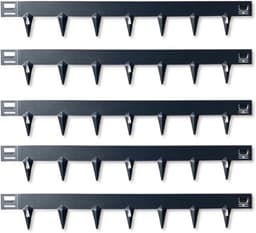
CORE EDGE CORE EDGE 65 mm black

Best overall

CORE EDGE CORE EDGE 65 mm black
8.2/10about £38.49
VOUNOT VOUNOT 10 m galvanised

Best value

VOUNOT VOUNOT 10 m galvanised
8.0/10about £23.49
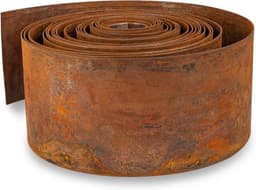
UNIGARDIA UNIGARDIA corten 10 m

Alternative

UNIGARDIA UNIGARDIA corten 10 m
7.1/10about £37.99
On this page

Mark the line and cut a slot

Lay out the route before you open the soil. Use a taut string for a straight run and a hose for a curve, then view it from the house and the lawn. Mark the line and check that the stated pack length covers joins and any return. Remove turf and roots with an edging iron or a sharp spade. A spiked section in moist, stone-free soil may need only a narrow opening. A 0.5 to 0.7 mm coil usually needs a continuous slot, because unsupported thin steel can buckle when struck. VOUNOT reviewers describe trenching the 18 cm panels. UNIGARDIA owners report a channel rather than hammering the 0.6 mm top. Decide the finished height before you dig. Blade clearance is in mowing over a steel edge.

Join first, then tap on a block

Read the connector before the first section goes in. CORE EDGE uses a top connector and lower locking tabs bent with pliers. Join the pieces while both are accessible, align the tops, then move the run to the slot. Bury one section fully first and the next join can be difficult without pulling it out. Wear gloves and boots. Place a timber block across the top and strike the block, not the steel. Direct blows dent a thin strip or mark black powder coating. Work in small increments and sight along a straight top after every section. On a curve, adjust over a useful length. A tight kink in 0.6 mm coil is hard to remove once the soil is compacted. Backfill both sides in layers. Add stakes only if the system allows them. ECCO’s CORE EDGE guidance adds a 300 mm pin for soft ground.
CORE EDGE CORE EDGE 65 mm black

Testsieger

CORE EDGE CORE EDGE 65 mm black
8.2/10about £38.49

Hard ground and coils

If a spike stops abruptly, do not hit harder until something bends. Lift the section and open the path with an edging iron or chisel. A saved CORE EDGE review needed a chisel in hard ground. If the obstruction may be a cable, pipe or drain, stop. For rocky soil, dig a narrow trench, clear the stones and backfill. Focefec’s bullet moves from no digging in soft damp soil to inserting and hammering, while reviewers say hard ground bends the strip. Unroll a coil on a flat area, restrain the loose end and ease the curve out. UNIGARDIA corten reviews describe bent tops and kinks. A shallow slot, a timber block and progressive backfill give the metal a line. If you must cut, use the cutter the maker specifies. EdgeScape allows a hacksaw and says to file the cut. A damaged zinc or powder coat behaves differently from weathering steel. See corten versus galvanised lawn edging.

When this is no longer a DIY edge

Stop if the route crosses a service, a drain or an unknown hard object. Ordinary flexible edging is a separator, not a retaining wall, and it is not for vehicle loading. In England, a means of enclosure is often limited to 1 m beside a vehicular highway and 2 m elsewhere, with further limits for listed buildings. A flush bed edge is not a fence, but a road, a listed boundary or a neighbour’s structure needs a check with the planning authority. Scotland, Wales and Northern Ireland do not copy that English order. Call an installer for welded corners, a hard-ground line you cannot hold, or cutting beyond your tools.

Common questions

Do you dig a trench or just hammer?
Spiked sections may tap into moist, prepared soil, but thin coils and panels usually need a continuous slot. Hard, dry or stony ground also calls for trenching. If resistance increases sharply, stop and open the route rather than driving harder. The shortest sentence on a listing is not a soil survey.
Which way should the joins face?
Follow the maker’s connector drawing, because systems differ. For CORE EDGE-style sections, connect the top and bend the lower tabs with pliers while the pieces remain accessible. Assemble and align the tops before you fully bury the join. A buried lock is much harder to correct than one you can still see.
What stops the top from denting?
Put a timber block across the steel and strike the block with a suitable mallet or lump hammer. Move along the run gradually so one end does not reach final depth while the rest stands high. Direct blows concentrate force on a small area and can mark a coating or deform thin steel.
How do I deal with hard or stony ground?
Lift the edge, cut a narrow slot and remove stones or roots that are safe to disturb. A chisel may prepare the path for integral spikes. Stop immediately if an obstruction could be a buried service, a drain or an irrigation line. More hammer force is the wrong response to a sudden stop.
Why will a coiled roll not go straight?
The strip retains the curve in which it was packed, and thin metal can kink when it is forced in one spot. Ease it open over a long distance, place it in a continuous slot and use progressive backfilling to hold the intended line. A stamp or a bare hammer on the top tends to lock the wave in.
When should I call a professional?
Get help for retaining work, vehicle loading, welded layouts, uncertain buried services, or a difficult road and listed-property boundary. A professional should also take over when the required cutting or ground preparation exceeds the tools you can use safely. A flush garden edge is a different job from a wall that holds a bank.

Related pages

Sources

Public UK sources for this comparison. Prices and star lines were saved from amazon.co.uk on 19 October 2026.

  1. GPDO 2015 Schedule 2 Part 2 Class A (retrieved 19 October 2026)
  2. General Product Safety Regulations 2005 (retrieved 19 October 2026)
  3. RHS: how to maintain lawn edges (retrieved 19 October 2026)
  4. EverEdge FAQs (retrieved 19 October 2026)
  5. CORE EDGE product page (retrieved 19 October 2026)
  6. Kinley: how to choose landscape edging (retrieved 19 October 2026)
  7. Straightcurve: steel lawn edging in the UK (retrieved 19 October 2026)
  8. Consumer Rights Act 2015, Part 1 Chapter 2 (retrieved 19 October 2026)