Independent comparisons. We may earn from shop links. More info

Metal lawn edging buying guide: what to check first

Updated: October 2026

You can put two products labelled metal lawn edging side by side on amazon.co.uk and find that they are built for quite different jobs. One may be a 0.5 mm coil that takes a curve. Another may be a 1.6 mm section with integral spikes and enough stiffness for a clean lawn line. Before comparing finishes, decide what must stay straight, what will hold the edge, and how much steel the price buys. The [main lawn edging metal comparison](/hub/lawn-and-garden-equipment/lawn-edging-metal) shows the saved UK listings. This guide explains the checks that make those rows comparable. A qualifying purchase can earn a commission at no extra cost to you.

You can put two products labelled metal lawn edging side by side on amazon.co.uk and find that they are built for quite different jobs. One may be a 0.5 mm coil that takes a curve.

Our top picks

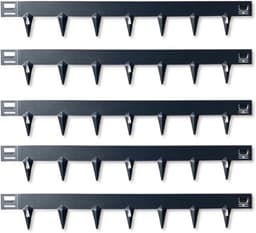
CORE EDGE CORE EDGE 65 mm black

Best overall

CORE EDGE CORE EDGE 65 mm black
8.2/10about £38.49
VOUNOT VOUNOT 10 m galvanised

Best value

VOUNOT VOUNOT 10 m galvanised
8.0/10about £23.49
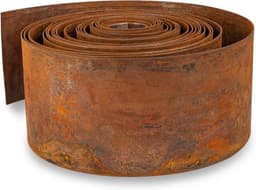
UNIGARDIA UNIGARDIA corten 10 m

Alternative

UNIGARDIA UNIGARDIA corten 10 m
7.1/10about £37.99
On this page

What you are actually comparing

The first distinction is shape. A continuous coil is useful around a circular bed, but it stores energy in the roll. When you uncoil 5 or 10 m, the strip may keep a wave where you force it straight. The 0.5 mm Jordbrux and 0.6 mm UNIGARDIA rolls belong here. Panel systems split the run into short lengths. VOUNOT states ten 1 m panels with plug-in ends and no pegs, so the 0.7 mm panels depend on a trench. Spiked sections are a third form. The 1.6 mm CORE EDGE products have ground spikes on each section and a locking joint, so the steel and the fixing work together. The fitting order is in how to install metal lawn edging.

Thickness before the brand

Treat the stated gauge as a job clue, not a complete quality score. In this saved set, 0.5 to 0.7 mm steel bends for curves, but it is easier to dent, buckle in hard ground, or leave wavy on a straight run. For a 0.6 mm roll, plan a slot, soil support and a timber block on the top. At 1.5 to 1.6 mm a section is stiffer. Both CORE EDGE rows state 1.6 mm, the spiked UNIGARDIA states 1.6 mm, and the Nicoman bullet states 1.5 mm. EverEdge uses 1.6 mm for ordinary lawn-to-bed work and 2.5 mm where vehicles may cross. That is maker guidance, not a British Standard. Kinley advises aiming at about 3 mm for trade edging, partly because very thin weathered steel may leave a sharp lip.
CORE EDGE CORE EDGE 65 mm black

Testsieger

CORE EDGE CORE EDGE 65 mm black
8.2/10about £38.49

Height, fixings and a length you can trust

Height only helps when you know how much remains above the soil. A title may say 150 mm while including a spike under a lower face. The spiked UNIGARDIA title says 150 mm, while one UK reviewer reports a face of about 65 mm. CORE EDGE separately states a 100 mm face and a 95 mm spike on the deeper version. For a lawn edge, the top normally sits around soil level or below cutting height. An 18 cm panel can work if most of it is buried. It is not automatically a mow-over edge. Integral spikes, pegs, plug-in ends and gloves are not interchangeable. Gloves do not anchor a 10 m roll. If no stakes are listed, the trench and backfill must hold the run. A price per metre only follows a length you can trust. VOUNOT says 10 m, about £2.35 per stated metre at about £23.49. The anthracite UNIGARDIA title says 12 m while a unit cell says 6 m. The CORE EDGE titles do not state pack metres. Do not import a manufacturer length into that Amazon price.

Where the saved listings break a check

The Nicoman title combines corten with pre-rusted galvanised, although its bullet only states 1.5 mm flexible steel. If the brown look decides the purchase, the limits are in corten versus galvanised lawn edging. The anthracite UNIGARDIA mixes two length signals and powder-coated with galvanised wording, so cost per metre and the corrosion system stay unclear. Jordbrux states 0.5 mm in a bullet, while a review disputes a separate 5 mm figure. Use the 0.5 mm bullet. These conflicts do not make a product unusable. They ask whether you can verify the dimension, the fixing and the finish before the trench is open.

Common questions

How thick should metal lawn edging be for a normal lawn?
A stated 1.5 to 1.6 mm section is a practical middle ground in this comparison for a lawn-to-bed line, especially when it has integral spikes. Thin 0.5 to 0.7 mm coils can work when they are well buried, but they need more support from the trench and the backfill. A crossing for vehicles calls for a heavier product than these domestic coils.
Is 0.6 mm steel enough if the title says heavy duty?
The measurement is more useful than the adjective. A 0.6 mm roll may suit curves and supported borders, but saved reviews show that it can kink or wave on straight runs. Do not assume a heavy-duty phrase makes it equivalent to a 1.6 mm spiked section with an anchor formed into the steel.
Do I need spikes in the box?
Not always, but you need a clear means of restraint. Integral spikes simplify positioning, while a panel without pegs relies on its trench, joins and compacted backfill. Check the box list rather than assuming that product photographs include every fixing shown beside the steel.
What face height should show above the grass?
For mowing, keep the top around soil level or below the blade’s cutting height. A raised face may separate mulch or gravel, but the mower should not cross it. The visible height depends on whether the edge is a barrier or a line the mower is meant to pass.
Why do two cells give two lengths?
Marketplace pages can combine a title, a variation and catalogue data that do not agree. When the title says 12 m and another cell says 6 m, withhold the price-per-metre calculation and confirm the selected variation before you order. A length you cannot divide is not a settled cost per metre.
Is corten a grade or a colour word?
COR-TEN began as a trademark, while weathering steel is the broader material category. On marketplace listings, corten may also be used loosely for a rusty appearance. A brown colour alone does not verify a particular steel grade, a thickness, or how the surface will age beside pale paving.

Related pages

Sources

Public UK sources for this comparison. Prices and star lines were saved from amazon.co.uk on 19 October 2026.

  1. GPDO 2015 Schedule 2 Part 2 Class A (retrieved 19 October 2026)
  2. General Product Safety Regulations 2005 (retrieved 19 October 2026)
  3. RHS: how to maintain lawn edges (retrieved 19 October 2026)
  4. EverEdge FAQs (retrieved 19 October 2026)
  5. CORE EDGE product page (retrieved 19 October 2026)
  6. Kinley: how to choose landscape edging (retrieved 19 October 2026)
  7. Straightcurve: steel lawn edging in the UK (retrieved 19 October 2026)
  8. Consumer Rights Act 2015, Part 1 Chapter 2 (retrieved 19 October 2026)