How to measure a lawn in square metres: a practical method

Measure your lawn in square metres, handle awkward shapes, subtract patios and beds, and choose a mower capacity that fits the grass you actually cut.
On this page
A mower labelled for a certain area is only useful once you know how much grass you actually cut. Learning how to measure a lawn in square metres takes a tape measure, a sketch and a calculator. Patios, beds and awkward corners can distort the answer. Measure the lawn itself, break complicated outlines into simple shapes, and keep that figure separate from any spare capacity you want when choosing a mower.
In short
Measure in metres, multiply length by width for each rectangular section, then add the sections. Subtract patios, large beds, sheds and other areas that are not grass. Use that net figure when comparing mower area ratings. Do not automatically add the 5–10% waste allowance often suggested when ordering turf.
What you need before you measure
A long tape measure is enough for a typical garden. A measuring wheel helps on long runs, and a sketch plus a calculator covers the rest. The arithmetic is multiplication, addition and subtraction. If someone else holds the tape, the line is less likely to drift diagonally.
Draw a rough bird's-eye view first. It does not need to be to scale. Show the main lawn, any front patch, and fixed features such as a patio, pond, shed or island bed. Mark each length and write m beside it, so feet or centimetres are not treated as metres. Walk the boundary before you choose the lines. Planting, curves and furniture hide the grass edge, and a tape pulled around an obstacle reads longer than a straight line. Measure twice where access is awkward. A reliable figure matters more than the last centimetre, and a soft edge is not a surveyed boundary.
How to measure a rectangular lawn
For a square or rectangle, measure length and width in metres and multiply them. A lawn 10 m long and 8 m wide covers 80 m². That is an example, not a typical UK lawn. If the edges vary, measure the grass as it is. Taking the widest point on both axes overstates the area. For a quick estimate, average two or three widths. Where the boundary steps in or out, split the lawn into smaller rectangles so the exclusions stay visible.
Keep decimals until the total is done. A length of 7.6 m times 5.4 m is 41.04 m². Rounding both dimensions first can produce 40 m² or 48 m². Round the finished lawn area only after every section and exclusion is included. If you measured in feet, multiply the square-foot area by 0.092903. One thousand square feet is about 92.9 m². Do not apply that factor to each linear side. Starting in metres avoids the conversion.
How to measure an odd-shaped lawn
Most uneven lawns become manageable when you divide them into rectangles. An L-shaped lawn can be drawn as two rectangles that touch but do not overlap. Calculate length times width for each, then add the answers. Label the parts A and B on your sketch so you can trace every number back to a physical section.
Take care at the inside corner of an L shape. One common mistake is to measure two large rectangles that overlap there, counting the same grass twice. Another is to use the full outer length and full outer width, which treats the missing corner as lawn. A shaded sketch usually shows both errors before they reach the calculator.
For a curve, estimate several strips. Narrower strips follow the edge more closely, but dozens of tiny sections rarely change a mower comparison. A triangle is base times perpendicular height, divided by 2. Use the height at a right angle to the base, not the sloping side. If the outline will not sit in simple shapes, plot it on graph paper and combine partial squares. A map-based lawn area calculator can cross-check a large outline, though trees and shadows hide edges on a small garden. Measure front, back and any side strip separately, then add them. Keep the subtotals, because access between zones can matter as much as the combined size.
What to leave out of your lawn area
The useful number is the grass the mower must maintain, not the area inside the property boundary. Subtract a patio, deck, shed base, greenhouse, pond, gravel section and substantial flower beds if they sat inside your main rectangle. For a rectangular feature, use length times width and deduct that area from the gross total.
Suppose the outer rectangle is 10 m by 8 m and a 20 m² patio occupies part of it. The lawn area is 60 m², not 80 m². That difference can change which mower capacity band you look at, particularly where a model sits close to its stated upper limit.
Subtract an island bed when it takes meaningful space. A rectangular bed is length times width. A roughly circular bed needs a careful estimate only if it sits near a mower threshold. Tiny surrounds rarely change the band, though they can still affect a robot's route. Leave thin or shaded grass in the total if the mower still cuts it. Leave out a verge that is not yours, even when it falls inside a convenient rectangle.
Matching the area to a mower
Once you have the net grass area, compare it with the manufacturer's stated coverage. An "up to 600 m²" description is a capacity ceiling under the conditions assumed for that machine. It is not an instruction to buy it for every lawn under 600 m². The area narrows your options. It does not settle the choice by itself.
Do not increase the lawn figure by 5–10% because turf guides suggest that allowance. Extra turf covers cutting waste and imperfect pieces when laying a lawn. A mower does not consume square metres, so that allowance is not a mower-sizing formula. Keep the measured area factual, then decide whether the machine should have spare capacity for reasons that apply to mowing.
Spare capacity can be sensible for slopes, obstacles, narrow corridors, separate zones or a short window in which a robot may run. There is no single margin that replaces the maker's guidance. A simple 350 m² lawn and an awkward 350 m² lawn are different jobs. Check gradient, passage width, zone support and installation rather than folding every complication into one percentage. A push mower can be carried between front and back. A robot may need a connected route, a second zone or a manual move.
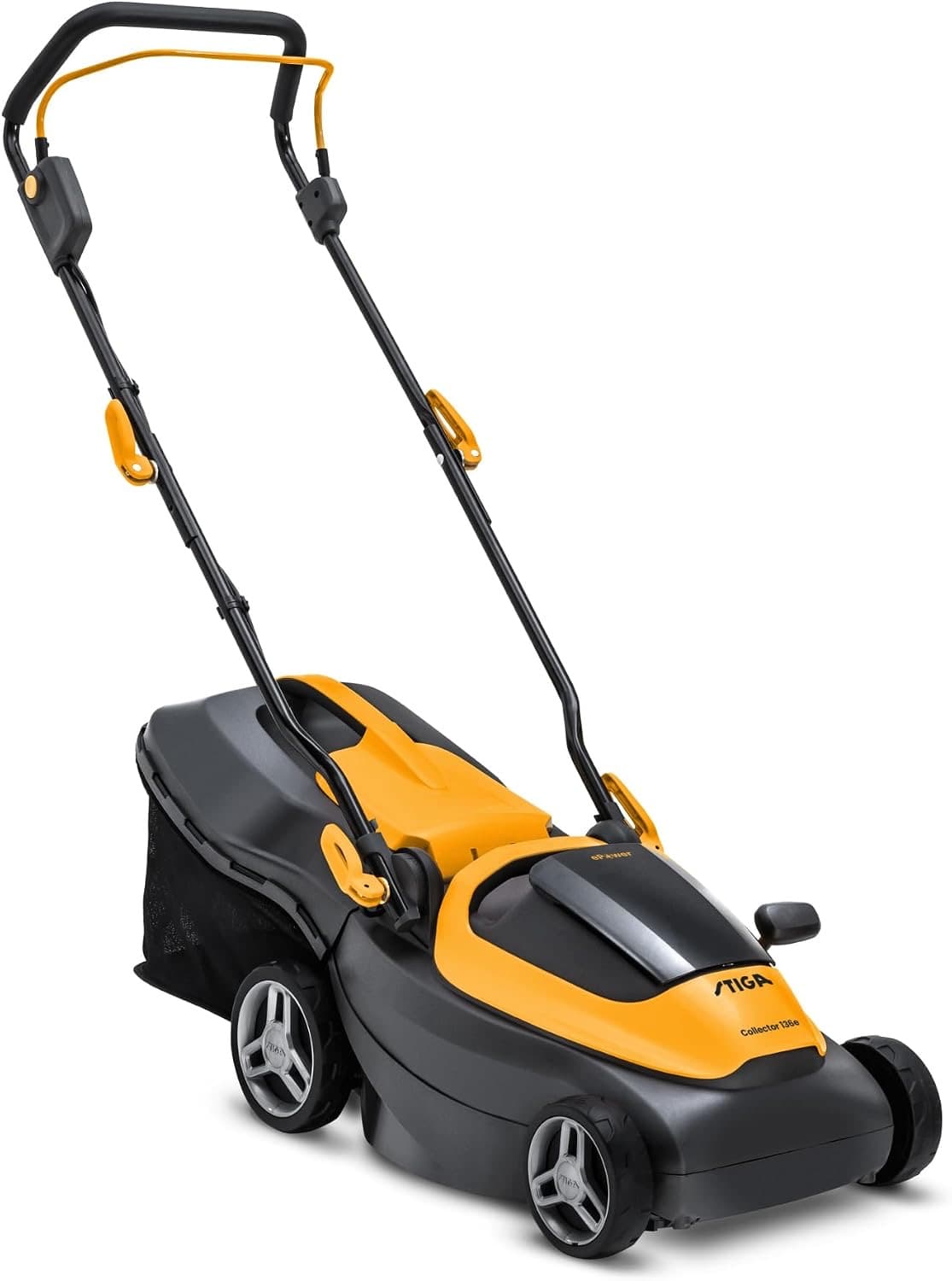
With the figure ready, compare ranges rather than guessing from the plot's appearance. In the Stiga lawn mower comparison, the top pick is the Collector 136e Kit at about £199, listed up to 300 m², with 4.4 from 264 amazon.co.uk reviews. Reviewers still report the charge finishing before the lawn, so the stated area is a ceiling, not one battery charge. Also see Worx robot lawn mowers and Yard Force robotic lawn mowers, then check each candidate's current specifications against your layout. A purchase through those links can earn a commission at no extra cost to you.
Check your figure before you buy
Run a final sense check while standing in the garden. Confirm that every measured section appears once on the sketch, that no two shapes overlap, and that the total excludes hard landscaping. Check that all dimensions use metres and that you multiplied linear measurements before adding areas. If the answer looks unexpectedly large or small, repeat the longest measurements.
Keep the gross outline and the deductions. "Main rectangle 80 m² minus patio 20 m² equals 60 m² grass" is easier to audit than a bare 60. Photograph the sketch if you will compare models later. Real edges are rarely perfect geometry, so a little uncertainty is normal. If the figure sits close to a model's maximum, remeasure the awkward sections and check the machine's other limits before you buy.
Common questions
Do I include a patio when measuring my lawn?
How do I measure an L-shaped lawn?
Should I add 10% when choosing a lawn mower?
How do I convert square feet to square metres?
Is the front garden a separate mowing zone?
What does an up to 600 m² mower rating mean?
How much spare mower capacity should I allow?
Can I use an online lawn area calculator?

Peter F. is the editor for DIY & tools at productscompared.co.uk. Comparisons in this category are checked against amazon.co.uk listings, review evidence and public UK sources.
Related articles
Best mower for a small garden UK: choose the right size
Measure the grass first, then compare a collector with a robot for access, edges and storage.

Lawn mower slope percentage: how steep is too steep?
A slope percentage is a limit on the bank, separate from the square metres you have just measured.
Is a robot mower worth it for a small garden?
Area alone does not make a robot worthwhile on a tiny lawn, long grass or a garden full of obstacles.