Lawn mower slope percentage: how steep is too steep?

Learn what a lawn mower slope percentage means, how to measure your bank, and why exact model limits, wet grass, ponds and boundaries change the answer.
On this page
A mower reaches the bottom of a bank, starts climbing and then spins, slides or turns away. The lawn mower slope percentage only helps when it belongs to your exact model and to the stretch you are measuring. A printed 45% maximum does not cover every mower from that brand, or every bank beside a pond, wall or drop. Calculate the slope, read the model limit, and inspect the top and bottom. This guide uses public UK manufacturer information and amazon.co.uk listings. It is not a laboratory traction test.
In short
A 45% slope rises 45 cm over a horizontal run of 100 cm and is roughly 24 degrees. Compare your measurement with the figure for the exact mower model, then allow extra margin for wet grass, turns and boundaries. If a listing gives no percentage, words such as “challenging slopes” are not a usable safety limit.
What lawn mower slope percentage means
Slope percentage is rise divided by horizontal run, multiplied by 100. If the ground rises 45 cm while you travel 100 cm horizontally, the result is a 45% slope. The run is level horizontal distance, not the longer distance measured along the surface of the bank.
Percentage and degrees are different scales. A 45% gradient is about 24 degrees. A 45-degree bank would be a 100% gradient, with one metre of rise for one metre of horizontal run. Confusing those figures can make a product claim look much more capable than it is.
The steepest short patch matters more than the garden average. A lawn can rise one metre over ten metres, which averages 10%, and still hide a lip of 30 cm over 60 cm. That lip is 50%, and it may be where a robot loses traction or a push mower becomes hard to control. Measure the route the mower takes. A diagonal crossing is a different gradient from a straight climb, and the machine can change line while it turns.
Use the rating for your exact model
A slope figure belongs to one model, not to a whole brand. STIGA UK product information for the A 6v states a maximum of 45%, about 24 degrees. The comparison material for this guide also prints 45% for the A 8v and the 5 Ah A 15v. Those figures apply only to those named versions. The relevant STIGA manual lists 45% or 50% depending on variant, so do not copy the largest number from a shared manual or a search result. Match the figure to the model code and battery version you will buy.
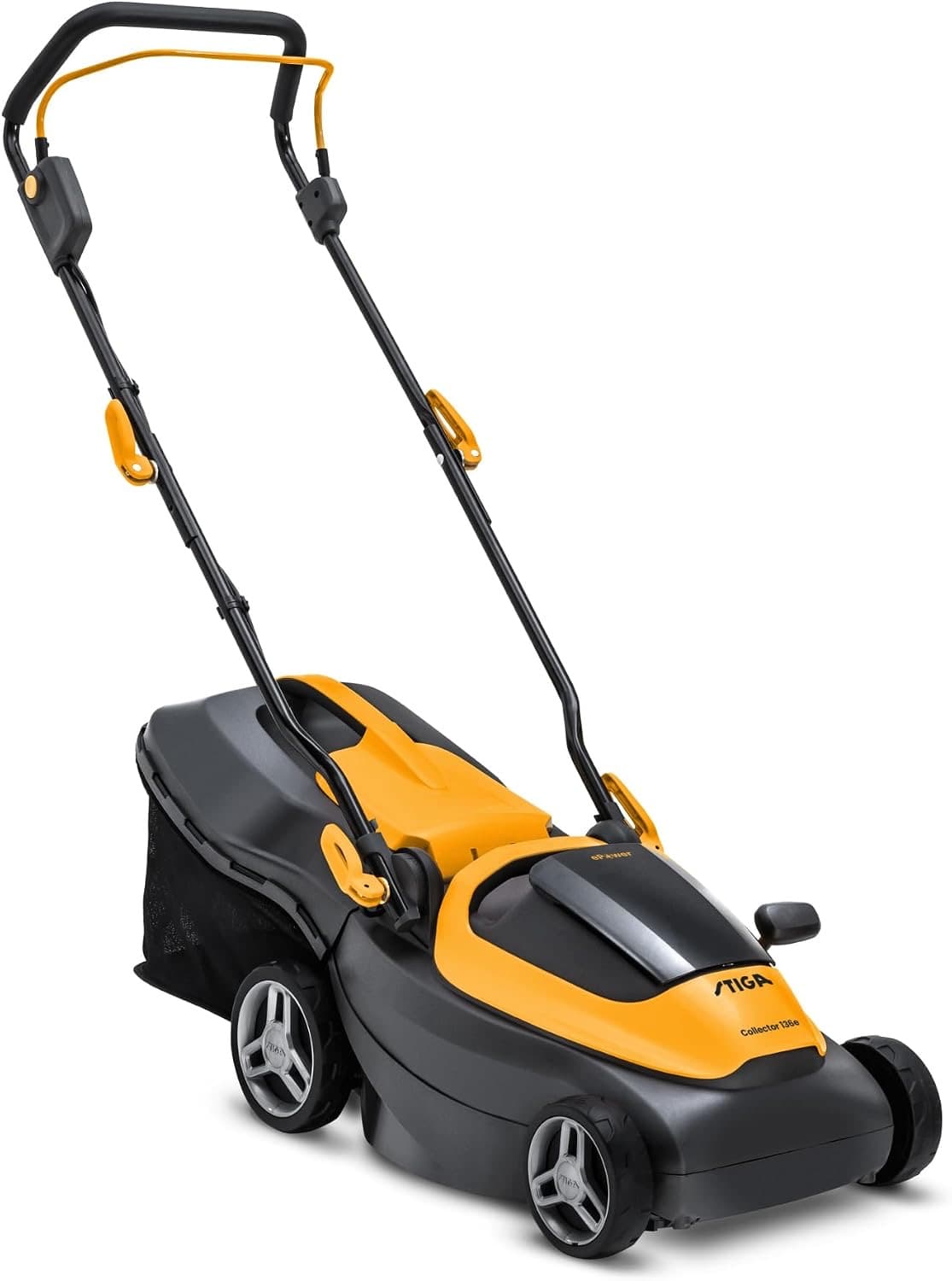
Check the current UK product page and manual against the retailer name, battery and model code. In the STIGA lawn mower comparison the top pick is the Collector 136e Kit at about £199, with 4.4 from 264 amazon.co.uk reviews, a 34 cm cut and a height of 25–75 mm. Neither that listing nor the material for the Collector 132e prints a slope percentage. Silence is not zero and it is not permission. “Easy handling” and “challenging terrain” are not a maximum gradient. A qualifying amazon.co.uk purchase can earn a commission at no extra cost to you.
A boundary percentage for a Husqvarna robot does not become a STIGA limit. Figures in the Worx robot lawn mower comparison have to be checked against the specific Worx model. Similar machines can use different wheels, software, weight and boundary behaviour.
Edges, ponds and drops change the answer
The centre of a broad bank is not the same problem as its edge. In the middle, a robot may have room to correct after wheel slip. Near a pond, step, retaining wall or drop, a small error has a more serious consequence. A working-area maximum is not automatically a boundary maximum, and perimeter rules are not interchangeable. Check where the wheels travel relative to the boundary, and whether the manual tells you to exclude steep sections. A map or boundary wire sets where the machine may go. It is not a physical barrier.
For the STIGA platform covered by the research manual, the instruction is to keep the working area one metre from water and to exclude steeper banks. That one-metre figure applies only when the manual matches your machine. Wet margins, algae, soft soil and clippings can reduce grip before the mower reaches the nominal edge. A gentle dry margin is a different risk from a liner immediately below a steep grassy lip, even if the boundary points sit at the same distance.
A solid barrier can separate the mower from a hazard, but it does not raise the rated climbing ability, and it must not create a trap. Where a failure could put the machine into water or over a drop, exclude that ground and follow the installation manual. A mower may climb a straight section and still struggle when it pivots, especially near the top where one drive wheel carries less load. Watch early runs from a safe place. Revise the map if you see repeated spinning, sliding, soil damage or aborted turns.
How to measure your lawn slope
You can get a useful measurement with a straight piece of timber, a spirit level and a tape. Measure several points rather than the easiest-looking line, and do the work when the ground is firm enough for secure footing.
- Choose a one-metre horizontal run. Set one end of a straight timber at the higher point and project it downhill. Repeat over any abrupt lip.
- Level the timber with a spirit level by raising the lower end. Do not lay it along the grass, or you measure surface length instead of run.
- Measure straight up from the lower ground to the underside of the timber. A rise of 35 cm over 100 cm is 35%.
- Repeat at the centre, the boundaries, the turns and the top and bottom. Keep the highest credible result.
- Compare that percentage with the manual for the exact mower, including any separate limit near the boundary.
For any other run, divide rise by horizontal run and multiply by 100. A 30 cm rise over 80 cm is 37.5%. Keep both figures in the same unit. A phone inclinometer can cross-check the result, but only if the phone sits on a representative surface. Do not round down to slip under a specification. Readings near the stated maximum leave little allowance for error, wet ground or reduced grip.
Push mowers need a different decision
Robot-mower gradient specifications should not be transferred to walk-behind machines. With a push mower, your footing, the machine’s mass, the drive, the cutting direction and the consequences of a slip decide whether a bank is manageable. A robot’s 45% number says nothing about your ability to hold a collector mower on the same grass. Some UK listings provide no numerical slope limit. That absence does not prove the mower is unsuitable for every incline, but it prevents a percentage-based recommendation. Ask the manufacturer for model-specific written guidance if slope capability is central to the purchase.
Inspect for holes, loose soil, roots, stones and hidden edges. Dew and rain make dry grass slippery, and a full grass box changes the weight you control. Stop if the mower pulls you downhill, has to be hauled up, slides sideways or turns towards a hazard. A strimmer may suit an isolated strip, with its own protective equipment. Where access stays doubtful, use a professional service. The Yard Force robotic lawnmower comparison is a starting point for lower-priced robots, not a substitute for that model’s slope and boundary figures.
Wet grass, wear and real-world margin
A published maximum applies under the manufacturer’s stated conditions. Rain, dew, mud, moss and compacted clippings can reduce grip, and worn wheels can change behaviour without changing the bank. If your steepest reading nearly equals the model maximum, a damp morning or a tight turn can expose the gap. Keep the mapped area below the limit and clear of hazards. After installation, watch for wheel spin that strips turf and leaves a softer patch. Correct the boundary when that pattern appears.
Common questions
What does a 45% lawn slope mean?
Can a robot mower cut a 45% slope?
Is the slope limit the same beside a boundary?
How close can a robot mower work to a pond?
Do STIGA 132e and 136e mowers have a slope rating?
Does wet grass reduce the slope a mower can handle?
When should I mow a bank by hand?

Peter F. is the editor for DIY & tools at productscompared.co.uk. Comparisons in this category are checked against amazon.co.uk listings, review evidence and public UK sources.
Related articles

How to measure a lawn in square metres: a practical method
Measure the grass you actually cut, then match that area to a stated mower capacity.

Boundary wire or GPS robot mower: which setup suits you?
A wire or a GPS map sets where a robot may work. Neither one is a physical fence.
Is a robot mower worth it for a small garden?
Steep edges, water and awkward access can make a robot a poor fit for the garden you have.