Independent comparisons. We may earn from shop links. More info

Water booster pump vs shower pump

Updated: 17.10.2026

In a water booster pump vs shower pump decision, the pipe matters more than a shared 32 L/min claim. A twin shower pump raises separate gravity-fed hot and cold supplies for a mixer. A compact inline booster usually serves one permitted outlet. A self-priming garden pump is a third duty. The eight listings in the [water booster pump comparison](/hub/hot-water/water-booster-pump) include all three under overlapping names. Choose the system first. A qualifying purchase can earn a commission at no extra cost to you.

In a water booster pump vs shower pump decision, the pipe matters more than a shared 32 L/min claim. A twin shower pump raises separate gravity-fed hot and cold supplies for a mixer.

Our top picks

Bristan Bristan ST PUMP15TN

Best overall

Bristan Bristan ST PUMP15TN
8.4/10about £200.68
Gugxiom Gugxiom 100W 24V

Preis-Tipp

Gugxiom Gugxiom 100W 24V
8.2/10about £38.99
KATSU Tools KATSU 151438

Alternative

KATSU Tools KATSU 151438
7.4/10about £129.99
On this page

They are different machines

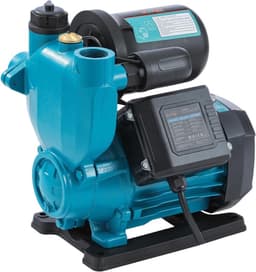
The Bristan ST PUMP15TN is a conventional twin shower pump. Two hydraulic sides boost gravity-fed hot and cold together before a mixer. The maker specifies 1.5 bar, 32 L/min and positive-head operation, with 15 mm connections and 230 V. The instructions prohibit a direct mains connection. Felenny, Gugxiom and Aolidsive are compact inline boosters on one line, with low-voltage DC at the pump. A Gugxiom review reports faster washing-machine filling and a stronger hot tap. That is not balanced mixer performance, and it is not mains approval. The KATSU 151438 is a 13.1 kg self-priming home-and-garden pump with 45 m stated head. The listing says it is not suitable for drinking water and gives conflicting power figures. Use the water booster pump buying guide to tell gravity, combi and unvented systems apart.

Single impeller or twin impeller?

A mixer needs hot and cold that stay reasonably balanced. A twin-impeller pump boosts both gravity feeds together, which is the normal choice on a vented cylinder-and-cistern system. The Stuart Turner Showermate S1.5 uses the same twin layout for gravity-fed positive-head duty, so it is a product class, not a Bristan label. A single positive-head pump boosts one gravity supply. That can suit one tap. It is not the default for an ordinary mixer. Salamander warns that boosting only one side can create imbalance. A single universal pump can boost gravity hot against mains cold only where the manufacturer documents that system. A shower close to the cistern may need a universal twin instead. Head type and impeller count are different questions.
Bristan Bristan ST PUMP15TN

Testsieger

Bristan Bristan ST PUMP15TN
8.4/10about £200.68

When an inline booster is enough

An inline pump can make sense for one slow hot tap, a slow gravity-fed appliance, or a permitted single outlet. The Gugxiom listing claims 25 L/min and 25 m head. UK reviews include a clearer washing-machine fill and better hot-tap flow. It includes a separate power supply. At £38.99 it is cheaper than a twin because the job is narrower. Gugxiom's IP56 claim appears only in the title. One reviewer questions the socket position, and another reports failure within a month. The £29.99 Felenny variants share one 97-review extract, so that evidence cannot be doubled. A 24 V pump still needs a suitable mains supply and enclosure. If the outlet is part of a mixer, compare a twin with the risk of pumping only one side.

Which should you buy?

For a gravity-fed mixer with enough natural positive-head flow, buy a twin. In this set the Bristan ST PUMP15TN is the clearest example: documented gravity duty, 1.5 bar, 32 L/min and a 0.8 L/min switch, with 4.2 from 86 reviews. The best water booster pump shortlist covers the replacement footprint and the cold-side failure report. For one compatible outlet, an inline is worth considering only when the instructions match the pipe, temperature and electrics. Equal 32 L/min headlines do not prove equal pressure or endurance. For a combi, choose neither family by default. It needs a purpose-designed mains booster where boosting is appropriate. None of these eight listings has enough evidence for that role. Read the water booster pump for a combi boiler guide before you buy on a boiler keyword.

Common questions

Is a water booster pump the same as a shower pump?
Not necessarily. Water booster pump can describe a small single-line pump, a mains booster, or a larger self-priming unit. A shower pump normally means equipment designed for a specific gravity-fed shower arrangement. Check whether it is single or twin, positive head or universal, and suitable for the actual water supply.
When do I need a twin-impeller pump?
Use a twin where both hot and cold sides of a gravity-fed mixer need boosting together and the maker's head requirements are met. It helps preserve balance between the two supplies. A twin is not automatically suitable for a combi, an unvented cylinder, or a negative-head shower. Those conditions need different equipment.
Can a 24 V inline pump replace a 1.5 bar twin?
Not as a general rule. A 24 V inline pump normally boosts one pipe, while a 1.5 bar twin pump boosts separate gravity-fed hot and cold feeds together. Similar claimed litres-per-minute figures do not prove equal pressure, switching or endurance. Replace one with the other only if a designer or manufacturer documents the exact arrangement.
Which pump is suitable for one weak tap?
A small inline booster may suit one tap if the water temperature, available flow, ports and electrical installation fit its instructions. The Gugxiom has UK review evidence of stronger hot-tap flow, but it also has electrical-location and early-failure concerns. Diagnose restrictions in the tap or pipe before you add a pump.
Can either type go on a combi boiler?
A conventional gravity shower pump cannot. A generic inline pump also lacks permission merely because its title mentions boilers. A combi requires a mains-specific product designed for that inlet arrangement and the applicable 12 L/min rules. Have incoming flow and boiler performance checked before you decide that any booster is needed.
Why can two pumps both claim 32 L/min?
The number may come from different test conditions and may be an open-flow maximum rather than output at useful pressure. The Felenny claim is a marketplace listing figure, while the Bristan figure accompanies a documented 1.5 bar shower-pump duty. Without comparable performance curves, equal headline flow does not mean equivalent shower performance.

Related pages

Sources

Public UK sources and the amazon.co.uk listings in this comparison, retrieved on 15 October 2026.

  1. Water Supply (Water Fittings) Regulations 1999, regulation 5 (retrieved 15 October 2026)
  2. Water Supply (Water Fittings) Regulations 1999, Schedule 2 paragraph 15 (retrieved 15 October 2026)
  3. Water Supply (Water Fittings) Regulations 1999, regulation 4 (retrieved 15 October 2026)
  4. Water Regs UK: when a pump or booster must be notified (retrieved 15 October 2026)
  5. Ofwat: water pressure (retrieved 15 October 2026)
  6. Customer Service Standards Regulations 2008, regulation 17G (retrieved 15 October 2026)
  7. Salamander Pumps: what is a positive head shower pump? (retrieved 15 October 2026)
  8. Northern Ireland Water Fittings Regulations 2009 (retrieved 15 October 2026)