Independent comparisons. We may earn from shop links. More info

How to install a water booster pump

Updated: 17.10.2026

How to install a water booster pump depends on whether it is a gravity shower pump, a small 24 V inline unit, or a self-priming pump. One sequence does not fit all three. The manufacturer's instructions take priority over an online title. Use the [water booster pump comparison](/hub/hot-water/water-booster-pump) to check supply, ports and priming before work begins. A mains connection, uncertain bathroom-zone electrics, a new circuit, or the wrong stored-water layout needs a plumber or electrician. A qualifying purchase can earn a commission at no extra cost to you.

How to install a water booster pump depends on whether it is a gravity shower pump, a small 24 V inline unit, or a self-priming pump. One sequence does not fit all three.

Our top picks

Bristan Bristan ST PUMP15TN

Best overall

Bristan Bristan ST PUMP15TN
8.4/10about £200.68
Gugxiom Gugxiom 100W 24V

Alternative

Gugxiom Gugxiom 100W 24V
8.2/10about £38.99
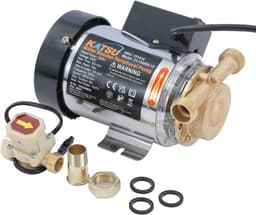
KATSU Tools KATSU 260W booster

Preis-Tipp

KATSU Tools KATSU 260W booster
7.8/10about £69.99
On this page

Put the pump where the maker allows

A gravity shower pump is commonly placed near the base of the hot-water cylinder, on a firm level surface, with flooded air-free supplies and room to service it. Do not hide it under towels or linen. Retained heat can shorten its life. For the Bristan ST PUMP15TN, the instructions require a dedicated air-free cold supply and a minimum 22 mm cold feed. It must not connect to the rising main, and hoses should stay within the maker's 30-degree bend limit. Measure height and pipe centres before you replace an older pump. Confirm head type before you cut pipe. A positive-head pump needs enough natural flow to trigger, so a shower close to or above the cistern may need a universal model. Salamander uses more than 600 mm of vertical distance in its own guidance. Apply the chosen maker's rule. If you find a combi or an unvented cylinder, stop and read the water booster pump on a combi boiler guide.

Make the water connections and fill the pump

Isolate the supplies, let hot water cool, and drain as the maker directs. Keep flux and debris out of the pump, do hot work away from plastic parts, and fit the specified isolation valves. Support rigid pipe so you are not forcing the connectors into line. The Bristan package uses 15 mm push-fit connections. BritTherm lists 3/4-inch coupling nuts. A UK review reports 32 mm ports on the KATSU 151438. The KATSU 260 W is not self-priming and warns that a dry run can damage the seal and impeller. Open the supplies in the prescribed order, vent air through the outlets, and confirm the chamber is full before you apply power. On a controlled start the pump should stop when every tap is closed.
Bristan Bristan ST PUMP15TN

Testsieger

Bristan Bristan ST PUMP15TN
8.4/10about £200.68

Decide between plug, fused spur and electrical work

Bristan specifies a permanent connection through a double-pole switched fused spur, and says the pump must not share the boiler or immersion-heater circuit. A 24 V pump with an external adapter is a different arrangement. Either way, the circuit has to match the equipment's protection, isolation and earthing. The KATSU 260 W arrives without a plug and states 220 V. Fitting a BS 1363 plug without checking voltage tolerance, cable and fuse is not a plan. The Gugxiom includes a separate power supply, but the extract does not confirm a BS 1363 plug, and one reviewer questions the socket's proximity to the outlet. A Felenny line that only says 24 V does not show that the mains adapter is suitable. In England, a new circuit is notifiable under Part P, and bathroom zones can rule out a plug. Other UK nations have their own building-control routes. Call a registered electrician for a new circuit, a fixed connection you are not competent to make, or work in a bathroom zone. Call a plumber for a dedicated cistern connection, an unclear system, or a boost that could affect the main. The water booster pump buying guide is the check before you buy.

Check what happens after fitting

Run the outlets, check every joint, and confirm the pump stops when demand ends. KATSU 260 W buyers mention a slow automatic switch, a short cable and a high-pitched sound. One BritTherm buyer reports continuous running after about three months. If a pump runs with every outlet closed, isolate the electrical and water supplies and arrange diagnosis. If the product is the wrong type, use the best water booster pump shortlist rather than repeating the job at a higher wattage.

Common questions

Where should a shower pump sit?
For a typical vented gravity system, it is often installed near the base of the hot-water cylinder on a firm, accessible surface, with flooded feeds and ventilation. Follow the exact pump instructions for pipe take-offs, head and clearances. Do not cover the unit with towels or bury it behind stored linen to reduce noise.
Can I connect a Bristan shower pump to the rising main?
No. The Bristan ST PUMP15TN fitting instructions state that it must not be connected directly to the mains. It is a gravity-fed shower pump requiring suitable stored hot and cold supplies. A combi or unvented mains-pressure system needs a different assessment and, where boosting is appropriate, a purpose-designed mains product.
How do I prime a non-self-priming pump?
With the electricity isolated, establish the water connections exactly as the manual shows, open the supplies and vent outlets until water flows without trapped air. Confirm the pump chamber is flooded before you energise it. The KATSU 260 W listing warns that dry running can damage the seal and impeller, so do not use power to pull water into it.
The pump has no plug. What should I do?
Check the manufacturer's electrical instructions and ask a qualified electrician to provide the specified connection. The KATSU 260 W listing says 220 V and no plug, which is not enough information to choose a fuse and fit a plug casually. A new circuit, fixed spur or bathroom-zone installation may also bring building-regulation requirements.
When should I stop and call a professional?
Stop if the system may be mains-fed, the pump needs a new or uncertain electrical connection, the pipe take-offs are unsuitable, or the unit cycles with no demand. Also stop for leaks near electrical parts, repeated dry running, or unclear potable-water suitability. A plumber and an electrician can divide the water and electrical work where both trades are needed.

Related pages

Sources

Public UK sources and the amazon.co.uk listings in this comparison, retrieved on 15 October 2026.

  1. Water Supply (Water Fittings) Regulations 1999, regulation 5 (retrieved 15 October 2026)
  2. Water Supply (Water Fittings) Regulations 1999, Schedule 2 paragraph 15 (retrieved 15 October 2026)
  3. Water Supply (Water Fittings) Regulations 1999, regulation 4 (retrieved 15 October 2026)
  4. Water Regs UK: when a pump or booster must be notified (retrieved 15 October 2026)
  5. Ofwat: water pressure (retrieved 15 October 2026)
  6. Customer Service Standards Regulations 2008, regulation 17G (retrieved 15 October 2026)
  7. Salamander Pumps: what is a positive head shower pump? (retrieved 15 October 2026)
  8. Northern Ireland Water Fittings Regulations 2009 (retrieved 15 October 2026)