Independent comparisons. We may earn from shop links. More info

Water booster pump buying guide

Updated: 17.10.2026

A weak upstairs shower can point to several plumbing problems, and the wrong pump can leave you with noise, poor balance, or a connection that should never have been made. This water booster pump buying guide starts with the system, then measured flow. amazon.co.uk places 24 V inline pumps, self-priming units and twin shower pumps under similar names. Compare the eight listings on the [water booster pump comparison](/hub/hot-water/water-booster-pump). A qualifying purchase can earn a commission at no extra cost to you.

A weak upstairs shower can point to several plumbing problems, and the wrong pump can leave you with noise, poor balance, or a connection that should never have been made.

Our top picks

Bristan Bristan ST PUMP15TN

Best overall

Bristan Bristan ST PUMP15TN
8.4/10about £200.68
Gugxiom Gugxiom 100W 24V

Alternative

Gugxiom Gugxiom 100W 24V
8.2/10about £38.99
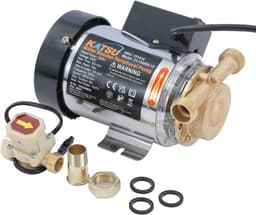
KATSU Tools KATSU 260W booster

Preis-Tipp

KATSU Tools KATSU 260W booster
7.8/10about £69.99
On this page

Which water system do you have?

Start in the airing cupboard and the loft. A traditional gravity-fed system normally has a cold-water storage cistern and a vented hot-water cylinder. The height between the stored water and the outlet creates the natural head. A twin shower pump boosts the separate hot and cold gravity supplies together. The Bristan ST PUMP15TN in this set is that type: a 1.5 bar twin for gravity-fed showers, not a whole-house mains booster. A combi usually has no stored hot-water cylinder, because it heats water from the incoming main. An unvented cylinder also works at mains pressure. A gravity shower pump should not be attached to either merely because a title mentions showers. If your hot water comes from a combi, use the water booster pump and combi boiler guide first. One weak outlet is the third case. A small inline pump may help a permitted tap or appliance feed. It is not a twin shower pump. The water booster pump versus shower pump page sets out that split.

Measure flow before you choose head

Measure what reaches the outlet before you compare bar, metres of head or watts. Turn off other taps, collect water for six seconds, then multiply the litres by ten. If you collect 0.7 litres, the flow is about 7 L/min. Repeat on hot and cold, because a mixer can fail when one side is much stronger. Positive-head pumps need enough natural flow to operate their switch, and there is no universal threshold. Salamander uses 2 L/min in its explanation of positive head. The Bristan data sheet for the ST PUMP15TN gives a flow-switch requirement above 0.8 L/min. Read the exact model sheet. If your flow does not reach that trigger, an ordinary positive-head pump may fail to start, and a universal or negative-head design may be required.
Bristan Bristan ST PUMP15TN

Testsieger

Bristan Bristan ST PUMP15TN
8.4/10about £200.68

Bar rating is a guide, not a law

Retail guides commonly place 1.0 to 1.5 bar at the gentler end for one small shower and 1.5 to 2.0 bar for a stronger result. Those bands are orientation, not a guarantee. A restrictive shower head, a long pipe run or an undersized supply can still limit a 1.5 bar twin. Choosing 3.0 bar without checking cylinder recovery and pipework can empty stored water quickly. A pump cannot create water. A bigger motor is not a cure for inadequate storage, air in the feed, or unsuitable take-offs. Do not turn maximum lifting height into a shower pressure rating. Compare the intended duty and the maker's curve.

What to read on the listing

UK mains are nominally 230 V, and a normal domestic plug is BS 1363. The KATSU 260 W says 220 V and arrives without a plug. The Gugxiom is a 24 V pump with a separate power unit. The Felenny listings do not clearly identify the mains adapter. A competent person has to confirm supply, earthing, protection and location. Check ports against the pipework. The Bristan includes a 15 mm kit, BritTherm lists 3/4-inch nuts, and one KATSU 151438 reviewer reports 32 mm openings. The KATSU 260 W is not self-priming and warns against dry running. Reviews can then help with noise and switching. They cannot make an incompatible pump suitable. Named shortlists are on the best water booster pump page.

Common questions

How do I know whether my house is gravity-fed?
A typical gravity-fed home has a cold-water storage cistern above the outlets and a vented hot-water cylinder, often in an airing cupboard. A combi normally has no hot-water cylinder, while an unvented cylinder is mains-pressure equipment. If labels and pipe routes do not make the arrangement clear, ask a plumber to identify it before you buy a pump.
What bar shower pump do I need for one shower?
For one modest gravity-fed shower, retail guidance often starts around 1.0 to 1.5 bar, with 1.5 to 2.0 bar used for a stronger flow. Treat this as a rule of thumb. Natural flow, head type, pipe size, shower restrictions and stored-water capacity can all make a nominal bar rating unsuitable.
What is a positive-head shower pump?
A positive-head pump relies on enough natural gravity flow to trigger its flow switch. The required amount is model-specific: the Bristan ST PUMP15TN data sheet uses more than 0.8 L/min, while Salamander's general explanation uses 2 L/min for its products. If the measured flow is below the chosen maker's threshold, look at an appropriate universal design.
Can I use the same pump on a combi boiler?
Not if it is a conventional gravity shower pump. A combi takes water from the mains and needs a mains-specific solution designed around the applicable flow limit and installation rules. The Bristan fitting instructions explicitly prohibit direct mains connection, and a generic inline listing does not become combi-compatible simply by mentioning boilers.
What if a pump says 220 V and has no plug?
Do not fit a random plug and assume it is suitable for UK use. UK mains are nominally 230 V, but the manufacturer's voltage range, earthing class, fuse, cable, switching and installation location still need checking. A qualified electrician should handle any uncertain fixed connection, new circuit, or work affected by bathroom electrical zones.

Related pages

Sources

Public UK sources and the amazon.co.uk listings in this comparison, retrieved on 15 October 2026.

  1. Water Supply (Water Fittings) Regulations 1999, regulation 5 (retrieved 15 October 2026)
  2. Water Supply (Water Fittings) Regulations 1999, Schedule 2 paragraph 15 (retrieved 15 October 2026)
  3. Water Supply (Water Fittings) Regulations 1999, regulation 4 (retrieved 15 October 2026)
  4. Water Regs UK: when a pump or booster must be notified (retrieved 15 October 2026)
  5. Ofwat: water pressure (retrieved 15 October 2026)
  6. Customer Service Standards Regulations 2008, regulation 17G (retrieved 15 October 2026)
  7. Salamander Pumps: what is a positive head shower pump? (retrieved 15 October 2026)
  8. Northern Ireland Water Fittings Regulations 2009 (retrieved 15 October 2026)