Independent comparisons. We may earn from shop links. More info

Electric towel rail buying guide

Updated: 22 October 2026

You are about to spend about £48 to £105 on a rail that may sit in a bathroom for years, and amazon.co.uk mixes plumbed radiators, element kits and true dry-electric ladders in one search. This buying guide covers wattage, mounting and moisture ratings so you can shortlist on the [electric towel radiator comparison](/hub/heating/electric-towel-radiator) before you open a listing. Peter F. used the seven amazon.co.uk pages in that set. There was no lab test. A qualifying purchase can earn a commission at no extra cost to you.

You are about to spend about £48 to £105 on a rail that may sit in a bathroom for years, and amazon.co.uk mixes plumbed radiators, element kits and true dry-electric ladders in one search.

Our top picks

On this page

Electric, not the plumbed rail you nearly bought

Several cheap listings in the original batch were central-heating towel radiators. The giveaway is pipe centres, BSP connections, valves and a BTU figure, with no watts and no fused-spur instruction. Five of those misfits were removed so this table only holds dry electric elements. A low plumbed price is useless without flow and return. A hardwired Manissa needs an electrician and no boiler in summer. If the combi already runs from October to March, a plumbed rail can cost less to run than a timed 100 W element. That trade-off is on electric vs central heating towel rail.

Wattage and what the room will feel like

The seven rails span roughly 60 W to 136 W. That warms towels. It does not hold a family bathroom at 21 °C on a January morning. A 60 W narrow rail suits a cloakroom. An 80–100 W ladder at 720 mm adds bar area. The 110 W Manissa and the 136 W AQUAWORLD are the most element headroom here, and they still will not replace a sized panel radiator. Use the label as a cap. Many rails cycle once warm. As a rule of thumb at the Ofgem cap of 26.32 p/kWh for October to December 2026, 100 W flat out for six hours is about 16 p a day. That compares rails. It is not your bill if the element cycles off. For dry towels in June, even 80 W can be enough.

Wall hardwired or freestanding plug-in

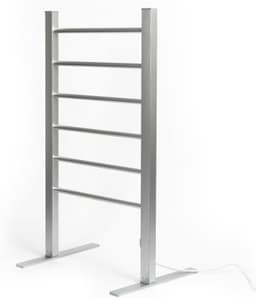
Most Manissa and AQUAWORLD units are wall-mounted and expect a 3 A fused spur, with a short factory lead into the connection unit. The spur lives outside zones 1 and 2. IPX4 on the Manissa bullets, with zone 2 wording, means splash resistance on the product. It is not permission to put a socket behind the shower. The Status rail at about £47.99 is the outlier: plug-in, a 1.5 m lead, IPX1, non-slip feet and no tile drilling. Reviews praise moving it for summer drying, and they mention a short cable and wobbly feet if the legs are wrong. It is a poor stand-in for a fixed zone 2 install. Choose it when you rent or cannot run a spur. Choose hardwired when the rail must stay put. The spur sequence is on how to install an electric towel rail.

Timers and thermostats in this set

Manissa Siena sizes share a foot-mounted switch: on/off plus a 2 or 4 hour countdown. There is no clock, so you cannot set an overnight start. A review on the 500 × 720 mm unit wishing for six hours is the same limit. AQUAWORLD adds 1–8 hour selection and surface temperature in 10 °C steps from 30 °C to 60 °C. That is finer than the countdown, but the listing had nine UK reviews and no IP code beside the zone 2 claim. The Status rail uses a thermal cut-out, not a user timer. None of these is a room thermostat.

What to decide on the main comparison

Confirm hardwired versus plug-in, then match the wall, from 300 mm in a cloakroom up to 1200 mm on the AQUAWORLD, then pick wattage and controls. Manissa sizes share review text, so the stars are family-level comfort, not proof that one height wins. Check the IP claim on each row. A shortlist by room is on best electric towel rail. Open the main comparison for the seven prices once the class of rail is settled.

Common questions

What wattage do I need for a small toilet?
For a downstairs WC with one or two towels, 60–80 W on a narrow ladder is usually enough to dry them and take the edge off the chill. Move toward 100–110 W if you hang large bath sheets or the room is draughty. Those figures still do not heat the room on their own.
Can I plug an electric towel rail in like a fan heater?
Only if you choose a plug-in freestanding model, such as the Status rail in this set. The hardwired Manissa and AQUAWORLD listings specify a fused spur, not a bathroom socket. Running a spur-fed rail from an extension lead breaks both the listing and normal bathroom wiring practice.
What does IPX4 mean for a bathroom rail?
IPX4 means splash resistance from any direction on the rated product. It supports a manufacturer zone 2 claim for the rail itself when it is mounted as instructed. It does not relax the rules for the fused spur or the switch. Those stay outside the wet zones.
Will it heat the room or just the towels?
Owners in this review sample describe warm towels and slightly warmer air nearby. A downstairs toilet can feel less chilly. For a medium family bathroom as the only heat source, plan a proper radiator or a panel heater. Even 110–136 W stays in the towel-warmer class.
Do I need an electrician?
For a fixed hardwired rail in or near a bathroom, yes. Part P notification applies to most householders. The Status plug-in unit needs a suitable socket outside the wet area and a lead that does not trail through spray. It does not need a new spur.
What is the difference between a 2/4 hour timer and a digital schedule?
Manissa’s switch runs for two or four hours from the moment you press it. There is no clock time. AQUAWORLD’s digital timer lets you select a number of hours, from 1 to 8 in the bullets. It is still not a seven-day programmer of the kind some premium rails offer.

Related pages

Sources

Public UK sources named below. amazon.co.uk prices, stars and review counts on these seven listings were taken from the listing files dated 19 October 2026. Page updated October 2026.

  1. NICEIC bathrooms and electrics (retrieved 19 October 2026)
  2. ProCerts spurs in bathrooms (retrieved 19 October 2026)
  3. Sanctuary Bathrooms heating types (retrieved 19 October 2026)
  4. The Radiator Warehouse buying guide (retrieved 19 October 2026)
  5. Home Energy Quotes running costs (retrieved 19 October 2026)
  6. Ofgem price cap October to December 2026 (retrieved 19 October 2026)
  7. Sterlingham 230 V installation guide (retrieved 19 October 2026)
  8. BS 7671:2018+A3:2024 (retrieved 19 October 2026)