Independent comparisons. We may earn from shop links. More info

Infrared heater for a workshop

Updated: 22 October 2026

The fan heater is on, the roller door has been open for a delivery, and the air on your hands is cold again within a minute. An infrared heater for a workshop is the alternative that aims at you, not at the volume of air the door just exchanged. It still will not hold a warehouse at a set temperature, and it will not warm someone standing behind a van. This page stays on the occupied bench, the glare and the plug. It does not size a terrace, and it does not walk through bracket holes. The ten listings are in our [commercial infrared heater comparison](/hub/heating/commercial-infrared-heater), with amazon.co.uk prices from 19–20 October 2026. Peter F. checked those listings against public UK guidance. There was no lab test. A purchase through our links can earn a commission at no extra cost to you.

The fan heater is on, the roller door has been open for a delivery, and the air on your hands is cold again within a minute.

Our top picks

On this page

Heat the person at the bench

Infrared heats people and surfaces in line of sight. It does not first heat a roomful of air, which is why a fan heater feels pointless in a leaky UK garage: the warm air leaves through the door, the eaves and the gap under the shutter. A bar over the bench can still warm the person in the beam while the air around them stays cool. That is the point of zone heat, and it is also the limit. Step behind a rack, a vehicle or a pillar and you are out of the beam. You go cold immediately. Coverage claims such as 25 m² are seller lines from patio listings, not a measured workshop. Installers who work on this problem say to heat the bench, not the roof. Infrared Heating Installers publish a rule of thumb of about 1–2 kW per working position. Mark that as their commercial rule of thumb, not as a test of the heaters below, and not as a promise that 2 kW equals comfort in your building. Air movement shrinks the useful zone. A door open to a yard is not a fault in the heater. It is the building. More than one bar, aimed at more than one station, is the usual answer when a single tube is asked to cover a whole aisle. Trade-offs on type and socket sit in the buying guide.

No light for a full shift

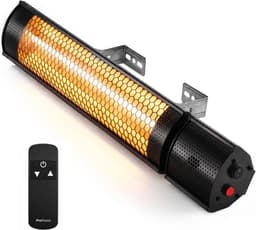
A glowing patio tube is a poor all-day bench light. It can feel strong, and Pro Breeze reviews do praise that halogen heater against a fan heater in a shed or workshop. Those reviewers are also living with a bright element, a 182 cm lead, and a carton that several other buyers say contradicts the outdoor title. Devola reviews include a workshop bench as well. Both are carbon or halogen patio heaters. Use them for a short task if you accept the glare and the listing conflicts. Do not make them the default for a full shift at a vice. The no-light listings in this set are the far-infrared bars. Radi8’s LHW18DW is 1800 W, white, about 111.6 cm, with a WiFi thermostat and remote, at £290, sold for an indoor garage, workshop, warehouse or restaurant. Radi8’s LH30J is 3000 W, black, about 184 cm, at £226.80, with no built-in controls, sold for indoor halls and factories. Mirrorstone’s Ionis 1200 W at £148.94 and Ionis 2400 W at £199.97 are indoor wall bars, non-remote, with tilt and overheat protection. Neither Radi8 page had amazon.co.uk reviews in this capture. The 1200 W Ionis has two. The 2400 W Ionis has one. The hanging SOUTHEATIC stays off this wall if your instructions match a UK review that excludes commercial use and calls the heater domestic. The difference in glow and wind is patio heater versus far-infrared bar.

Thermostat, plug, and more than one bar

Radi8’s 1800 W bar is the only one here with a thermostat in the box, plus schedules and a remote. That is the control you want over a bench you leave and return to, so the bar is not running flat out all afternoon. There are no reviews to show whether the app pairs. The listing does not say whether a BS 1363 plug is fitted. The current row prints 7.83 A at 230 V, which is inside a 13 A conversation if the plug exists. Radi8’s 3000 W bar does not include that thermostat. The page points to a Netmostat sold separately. It prints 13.04 A at 230 V and does not say plug or hardwire. Electrical Safety First treats 3000 W as the top of a 13 A socket, not spare capacity. One bar at that current is already the whole socket. A second bar on the same socket is not a plan. Mirrorstone’s shared bullet puts 1.2–1.8 kW on a plug and 2.4–3 kW on a hardwired supply. The 1200 W Ionis is the plug-in workshop bar, with a review that the lead does not reach once it is at least 2.1 m up and that the on-unit switch is then awkward. The 2400 W Ionis is the hardwire size. Its single review is positive and short. The dimension row copies the smaller bar, so do not assume the cases match. Two modest bars aimed at two benches beat one huge claim aimed at a roof. Bracket holes and the short-lead stop are in the installation guide.

16°C is guidance, not a heater promise

The Workplace (Health, Safety and Welfare) Regulations 1992, regulation 7, require a reasonable temperature during working hours, and heating that does not give off injurious or offensive fumes. You need a way for people to check, which in practice means a thermometer, not a guess from the doorway. HSE’s Approved Code of Practice says the temperature should normally be at least 16°C, or at least 13°C if the work is strenuous physical effort. Those figures are guidance. They are not a result any listing in this set has demonstrated. They do not apply where a comfortable temperature is impractical, such as a room open to the outside. There is no HSE maximum workplace temperature. Where the whole room cannot be held comfortable, HSE’s own case for local heating is the reason a bar over a bench exists. Do not tell staff that one 3000 W heater has satisfied the 16°C line. Measure the temperature where they stand, in the beam and out of it, with the doors used as they are actually used. Infrared does not replace ventilation. It does not clean fumes from solvents, welding or a running engine. If the air is the hazard, the heater is the wrong tool to fix it. A workplace, including a unit with employees, sits under the Electricity at Work Regulations 1989. Hardwiring, a new circuit, or a heater that has tripped, warmed a plug or smelled of burning is an electrician’s job. A householder heating their own garage on the house supply is closer to Approved Document P in England, and still has to respect the plug-in band on the listing.

Common questions

Will an infrared heater warm a workshop?
It will warm the people and the surfaces in the beam. It will not first warm the air, so a draughty garage does not defeat it in the way a fan heater is defeated, and it also will not make the whole building feel even. Step out of the beam and the effect drops away. A door open for a delivery shrinks the comfortable patch further. Plan on the occupied bench, not on a square-metre claim printed for a patio heater.
Should I heat the whole unit or the bench?
Heat the bench, or each working position, when the building is large, leaky or often open. One installer rule of thumb is about 1–2 kW per position. That is not a measurement of these amazon.co.uk bars. A single 3000 W listing pointed at the roof wastes output above head height while the person at the vice stays on the edge of the beam. Two aimed bars are the usual step up. The whole-building temperature is a separate question, and often an impractical one if the shutter stays open.
Which heater in this set has no glare?
The Radi8 bars and the Mirrorstone Ionis bars are the no-light indoor listings. Radi8 says there is no visible light in normal use. Mirrorstone’s pages are indoor wall bars rather than halogen patio tubes. Pro Breeze, both Devolas, the SOUTHEATIC wall heater and the Luxeva are glowing or carbon-tube heaters. They can be bright enough to annoy you at a bench even when the warmth is welcome for a short job.
Can one 3000 W bar hold a warehouse at 16°C?
Do not claim that. The 16°C figure is HSE guidance for a reasonable indoor working temperature, not a product test. It does not apply in the same way where comfort is impractical, such as a room open to the outside. Radi8’s 3000 W bar is a long indoor heater with 13.04 A printed and no built-in thermostat. It can warm people in its beam. It has no review file here, and it has not been shown to hold a warehouse at 16°C. Put a thermometer where people work.
Do I need a thermostat over a bench?
You need one if the bar would otherwise run at full output all day while you come and go. Radi8’s 1800 W listing includes a WiFi thermostat and schedules. The 3000 W Radi8 does not, unless you add a separate Netmostat. The Mirrorstone bars have no thermostat in the listing. They are on or off at the unit, which is simple and also awkward once the bar is 2.1 m up. A remote-only patio heater is a worse control for a workshop, because a lost handset strands you.
When do workplace electrics rules apply?
They apply when the workshop is a workplace, including a unit where you employ people. The Electricity at Work Regulations 1989 require systems that prevent danger so far as is reasonably practicable. Temperature duties sit under regulation 7 of the Workplace (Health, Safety and Welfare) Regulations 1992. A private garage on a house supply is closer to Approved Document P. If you are unsure which building you have, ask an electrician before you hardwire a 2400 W or 3000 W bar.

Related pages

Sources

Public UK sources first. amazon.co.uk prices, stars and review counts are from the listing files for this set, read on 19–20 October 2026. Page updated October 2026.

  1. HSE, temperature in the workplace: what the law says (retrieved 20 October 2026)
  2. Electricity at Work Regulations 1989, regulation 4 (retrieved 20 October 2026)
  3. GOV.UK, Approved Document P (retrieved 20 October 2026)
  4. Electrical Safety First, plugs and fuses (retrieved 20 October 2026)
  5. Plugs and Sockets etc. (Safety) Regulations 1994 (retrieved 20 October 2026)
  6. Tansun, infrared heater buyer’s guide (retrieved 20 October 2026)
  7. Infrared Heaters Direct, buying guide (retrieved 20 October 2026)
  8. Consumer Rights Act 2015 (retrieved 20 October 2026)