Independent comparisons. We may earn from shop links. More info

Patio heater vs far infrared heater

Updated: 22 October 2026

Both boxes say infrared, so they look interchangeable on a wet Saturday when you are trying to warm either a café table or a bench. A patio heater vs far infrared heater choice is really a choice of glow, wind and paperwork. A glowing short-wave or carbon tube suits people under a cover the manual allows. A no-light far-infrared bar suits an indoor occupied zone. This page maps the listings in our [commercial infrared heater comparison](/hub/heating/commercial-infrared-heater), captured on amazon.co.uk on 19–20 October 2026. It does not pick a single winner, and bottled gas is named only as the alternative you did not buy in this set. Peter F. compared those listings with public UK guidance. There was no lab test. A purchase through our links can earn a commission at no extra cost to you.

Both boxes say infrared, so they look interchangeable on a wet Saturday when you are trying to warm either a café table or a bench.

Our top picks

On this page

Same word, two jobs

Infrared heats people and surfaces in line of sight. It does not first heat a tank of air. Wind outdoors removes any air that did warm, which is why a patio can feel cold beside a heater that is clearly on. Comfort still falls if you are not in the beam. Moving air does not blow the rays away as a law of physics. It does stop you collecting a warm pocket of air, and it cools skin. A seller of halogen heaters, BN Thermic, says that on a truly windy patio only shortwave halogen should be considered, because longer-wave heaters are disrupted by air movement. That is a halogen seller’s line. It is not a ban on every far-infrared bar under a solid cover. Heatingpoint’s outdoor guide puts shortwave quartz or halogen, which glows, on exposed spots, and longwave ceramic, which does not glow, on indoor or covered rooms such as workshops. Infrared Heaters Direct makes the same split and adds that longwave is a poor match for exposed wind and a better match for long sheltered use. Carbon tubes in this set, on the Devola, Luxeva and hanging SOUTHEATIC listings, sit between those poles. They glow less harshly than a gold halogen tube for some buyers, and they are still patio heaters, not silent workshop bars. Sizing and IP clashes in more detail are in the buying guide.

Glowing patio heater

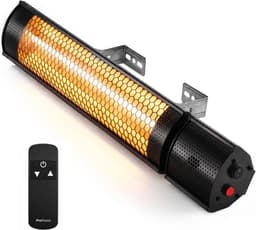
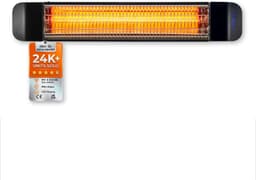
A halogen or carbon patio heater is the tool when people sit under a gazebo, awning or café canopy and you accept a visible element. It feels warm quickly. It is the wrong tool for a full shift at a bench if the glare fights the work, which is why the workshop page steers you back to a bar. In this set the glowing listings are Pro Breeze, both Devolas, both SOUTHEATIC heaters and the Luxeva. Pro Breeze PB-H16-UK is the halogen, £79.99, 1000 W and 2000 W, 4.1 from 316 reviews, with a 182 cm lead. The title says IP65. Several reviews say the carton or the instructions say indoor use only or not waterproof. One buyer shattered the lamp and could not buy a replacement. Tansun’s buyer’s guide notes that a sealed unit you cannot re-lamp is not automatically the better spend. Devola DVPH2000B at £109.99 and DVPH2400B at £119.99 are carbon, with remotes and IP claims. Both specification tables print 1200 W against titles of 2000 W and 2400 W. The 2000 W page also prints IP24 beside an IP65 highlight. Reviews describe remote-only control and WiFi that will not pair. One 2400 W review reports a leak after light rain. SOUTHEATIC’s wall halogen at £179.97 offers 1000, 2000 and 3000 W and an IP65 line, with only 11 reviews. The hanging carbon heater names cafés in the bullets, while one review says the instructions exclude commercial use and a meter showed about 2.1 kW on the top step. Luxeva LXV-1 at £169.99 is the freestanding carbon option, IP55 on the title, six modes, and a button on the unit if the app fails. The spec table prints 2500 V and 2500 °C, which are not usable. IP65 on a title does not decide the technology, and it does not mean driving rain if the manual says otherwise.

No-light far-infrared bar

A far-infrared bar is the tool when the zone is indoors, you do not want a glow, and the listing is actually an indoor heater. Radi8’s LHW18DW is 1800 W at £290, white, about 111.6 cm, with a WiFi thermostat, schedules and a remote. The listing says no visible light and no fan, and it names a garage, workshop, warehouse or restaurant. There are no amazon.co.uk reviews, and no weather rating. The current row prints 7.83 A at 230 V. Plug versus hardwire is unstated. Radi8’s LH30J is 3000 W at £226.80, about 184 cm, with no built-in thermostat or remote. A separate Netmostat is how the listing adds schedules. It prints 13.04 A at 230 V, which is the top of a 13 A socket, and it does not say whether a plug is fitted. Again there are no reviews and no weather rating. It is a long indoor bar, not a terrace heater that happens to be black. Mirrorstone’s Ionis 1200 W at £148.94 is in the shared bullet’s plug-in band of 1.2–1.8 kW. The 2400 W Ionis at £199.97 is in the hardwire band of 2.4–3 kW. Both are non-remote indoor wall bars with tilt and overheat protection. The 1200 W model has two reviews, including a short lead at a mount of at least 2.1 m. The 2400 W model has one positive review and a dimension row that copies the smaller bar. Neither prints an IP rating. Putting either on an open terrace because it is infrared ignores the indoor wording. Under a fully enclosed canopy that the building treats as indoors, you are back to clearance, glare and whether the manual allows that room. You are not in the weatherproof patio category.

When a glowing tube, when a bar

Choose a glowing patio heater when the seats are outside or in moving air, the manual and the carton allow that cover, and you accept glare plus a remote you can lose. In this set that is the Pro Breeze if you will read the carton, the Devola 2400 W if remote-only control and a 1200 W spec line are acceptable, or the SOUTHEATIC wall heater if three steps matter more than a long review file. Leave the hanging SOUTHEATIC for a workplace if the instructions exclude commercial use. Choose a no-light bar when the zone is indoors, glare is a problem for a full shift, and you can hardwire if the bullet says so. In this set that is the Mirrorstone 1200 W on a plug, the Radi8 1800 W if you want a thermostat and can accept zero reviews, or the Radi8 3000 W and the Ionis 2400 W only with an electrician. A covered terrace is the overlap. A carbon patio heater can be right if the manual allows the cover. A far-infrared bar is right if the spot is enclosed and the listing is indoor. It is the wrong object for an open, breezy patio. Bottled gas is the alternative when you have no adequate electric circuit and you accept a cylinder, fumes and a different set of rules. It is not a product in this comparison. If the manual and the title still disagree after you have chosen the type, do not mount it. Named skips are on the best commercial infrared heaters page.

Common questions

What is the difference between a patio heater and a far-infrared bar?
A patio heater in this set is a halogen or carbon tube that glows and is sold for garden, terrace or gazebo seating. A far-infrared bar is an indoor wall or ceiling heater sold with no visible light in normal use. Both heat people and surfaces in line of sight rather than a volume of air. The patio heater is for a cover the manual allows, with glare as the trade-off. The bar is for a workshop or hall, with no weather rating in these listings. They are not two sizes of the same product.
Which one works in the wind?
A glowing short-wave tube is the type makers recommend when air is moving, because you are not relying on a warm pocket of air. Comfort still drops if you leave the beam. BN Thermic’s only-shortwave line is a halogen seller’s view, not a ban on a far-infrared bar under a solid roof. The Radi8 and Mirrorstone bars here are indoor listings with no IP rating. Do not put them on an open, breezy terrace and expect the workshop behaviour. Use a patio heater whose manual allows that exposure.
Is carbon the same as halogen?
No. Pro Breeze and the SOUTHEATIC wall heater use halogen tubes. Devola, Luxeva and the hanging SOUTHEATIC use carbon. Radi8 and Mirrorstone describe far-infrared bars, not those patio tubes. Carbon is often sold as a slightly softer glow than gold halogen, and it is still a patio heater with a remote, an IP claim and a visible element. It does not become a no-light workshop bar because the title says infrared. Read the element row before you compare watts.
Can I use a far-infrared bar on an open terrace?
Not these ones, on the paperwork in front of you. Radi8 and Mirrorstone sell the bars for indoor rooms, and they do not print a weather rating. A far-infrared heater can be right under a permanent, enclosed cover when that maker says so. This set does not say so. Wind on an open patio is the situation the glowing short-wave listings are aimed at, and only when their own manual agrees. An IP65 title on a different heater does not transfer to a Radi8.
Does IP65 decide the technology?
No. IP65 is a claim about dust and water jets on that product, if the manual agrees. Pro Breeze prints it and reviews dispute the carton. Devola’s 2000 W page prints IP24 and IP65 together. The far-infrared bars print neither, because they are indoor listings. A weather rating does not tell you whether the heater glows, whether you can re-lamp it, or whether a remote is the only switch. Read the element, the connection and the control, then read the IP line against the booklet.
Where does bottled gas fit if I am comparing these?
Gas sits outside this set. Consider a cylinder heater when the electric supply cannot take the load and you accept storage, fumes and the rules that go with an open flame near a canopy. It is not a fallback that makes a contradicted IP65 listing safe, and it is not in the amazon.co.uk table this comparison uses. If the circuit can take a plug-in or hardwired electric heater whose manual matches the spot, stay with that paperwork rather than adding a second fuel.

Related pages

Sources

Public UK sources first. amazon.co.uk prices, stars and review counts are from the listing files for this set, read on 19–20 October 2026. Page updated October 2026.

  1. HSE, temperature in the workplace: what the law says (retrieved 20 October 2026)
  2. Electricity at Work Regulations 1989, regulation 4 (retrieved 20 October 2026)
  3. GOV.UK, Approved Document P (retrieved 20 October 2026)
  4. Electrical Safety First, plugs and fuses (retrieved 20 October 2026)
  5. Plugs and Sockets etc. (Safety) Regulations 1994 (retrieved 20 October 2026)
  6. Tansun, infrared heater buyer’s guide (retrieved 20 October 2026)
  7. Infrared Heaters Direct, buying guide (retrieved 20 October 2026)
  8. Consumer Rights Act 2015 (retrieved 20 October 2026)