Independent comparisons. We may earn from shop links. More info

Commercial infrared heater buying guide

Updated: 22 October 2026

You are in a cold workshop aisle, or under a café awning that still drips in October, and every listing says infrared. A commercial infrared heater buying guide has to split that word before it talks about watts. One group is a no-light bar aimed at people indoors. The other is a glowing patio heater whose manual has to allow the terrace you actually have. This page is that decision. It does not rank the ten listings. Shelf prices in our [commercial infrared heater comparison](/hub/heating/commercial-infrared-heater) were captured on 19–20 October 2026 and run from £79.99 to £290.00. Peter F. checked those listings against public UK guidance. There was no lab test. A purchase through our links can earn a commission at no extra cost to you.

You are in a cold workshop aisle, or under a café awning that still drips in October, and every listing says infrared. A commercial infrared heater buying guide has to split that word before it talks about watts.

Our top picks

On this page

Start with the job, not the wattage

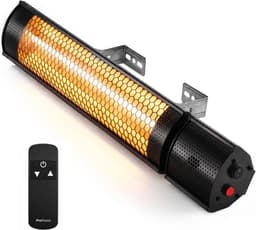
A bench wants heat on the person standing there. Infrared does that in line of sight. It does not first warm a volume of air, and a door left open will dump any air that did warm. A far-infrared bar in this set is the indoor job. A terrace or café seat wants a halogen or carbon tube whose paperwork allows that spot, because wind strips warmth even when the beam is aimed at you. A 3000 W glowing tube over a bench is a glare problem for a full shift. A no-light bar on an open patio is the opposite mistake: Radi8 and Mirrorstone print no weather rating. A retailer rule of thumb, not a measurement, puts small enclosed zones around 500–1000 W and larger zones from about 1500 W. Named picks are on the best commercial infrared heaters page.

Watts, a 13 A plug, and hardwiring

UK mains are 230 V, and the everyday plug is a fused BS 1363 plug. Electrical Safety First treats 3000 W as the top of a 13 A wall socket, not spare capacity. A 3000 W load at 230 V is about 13 A. Mirrorstone’s shared bullet splits the set: 1.2–1.8 kW models can be plugged in, and 2.4–3 kW models require hardwiring. The Ionis 1200 W is the first group. The Ionis 2400 W is the second. Radi8’s 1800 W bar prints 7.83 A at 230 V, but the listing never says whether a UK plug is fitted. Radi8’s 3000 W bar prints 13.04 A at 230 V and also does not say plug or hardwire. That printed current is the moment you stop guessing. Devola’s titles say 2000 W and 2400 W while both specification tables print 1200 W. Bracket and lead length are in the installation guide.

Weather rating against the manual

IP65 means dust-tight and protected against water jets, IP55 means limited dust and water jets, and IP24 means splashing water. Infrared Heaters Direct says an outdoor heater needs at least IPX4, and a permanent outdoor unit should be hardwired. Tansun says a heater under an awning may not need IP65. None of that overrides the manual. If the title says outdoor and the carton says indoor only, goods have to match the description under the Consumer Rights Act 2015. Pro Breeze prints IP65, while several reviews say the carton says indoor use only or not waterproof. Devola’s 2000 W page lists IP24 and IP65. Devola’s 2400 W title says IP65, and one UK review reports leaking after light rain. The far-infrared bars print no weather rating, which rules them out for an open terrace.

A control you can still use

A thermostat targets a temperature. A patio remote usually picks a power step, and a remote that fails is a heater you cannot switch. Devola reviews often describe a remote-only unit and WiFi that will not pair unless the heater is close to the router. Mirrorstone’s bars are non-remote, so a lost handset is not the failure, but a reviewer says that once the 1200 W bar is at least 2.1 m up there is no convenient on/off. Radi8’s 1800 W listing is the only bar with a WiFi thermostat in the box, and it has no reviews. The 3000 W bar points you to a Netmostat sold separately. You can decide the type today: a far-infrared bar on the listing’s plug band, or a glowing heater only after the carton agrees with the title. You cannot decide a square-metre coverage or a pence-per-kWh cost. Stop for an electrician on any hardwired heater, a new outdoor socket, a café terrace, or a unit that has tripped, leaked or smelled of burning. Glow and wind are in patio heater versus far-infrared bar.

Common questions

What wattage do I need for a commercial infrared heater?
There is no single wattage. A retailer rule of thumb puts small enclosed zones around 500–1000 W and larger or outdoor zones from about 1500 W upward, often with more than one heater. That is not a measured result for your unit. Elec-Mate’s 60–80 W per square metre applies to a well-insulated room with a 2.4 m ceiling, not a leaky workshop or an open terrace. People out of the beam stay cold. Match the listing’s stated watts to the socket before you treat the number as heat delivered.
Can I plug a 2400 W or 3000 W heater into a UK socket?
Treat 3000 W at 230 V as about 13 A, which Electrical Safety First puts at the top of a 13 A wall socket, not as spare capacity. Mirrorstone’s own bullet says 2.4–3 kW models require hardwiring, so the 2400 W Ionis is in that group and the 1200 W Ionis is the plug-in size. Radi8’s 3000 W bar prints 13.04 A and does not say whether a plug is fitted. If the maker says hardwire, use an electrician.
What IP rating do I need outdoors?
Infrared Heaters Direct says an outdoor heater needs at least IPX4, and a permanent outdoor unit should be hardwired. IP65 is dust-tight and protected against water jets. IP55 is limited dust and water jets. IP24 is splashing water. Tansun says a heater under an awning may not need IP65. If the title says IP65 and the carton says indoor only, as Pro Breeze reviews report, do not treat the title as settled. Devola’s 2000 W page prints both IP24 and IP65.
Do I need a thermostat or is a remote enough?
A thermostat holds a temperature. A remote usually selects a power step, and on several Devola reviews it is the only switch. If that handset fails, is crushed or never arrives, the heater stays as it was. Mirrorstone’s bars have no remote, which avoids that fault and leaves the switch on a heater that may sit 2.1 m up. Radi8’s 1800 W listing includes a WiFi thermostat. Radi8’s 3000 W listing does not, unless you add a separate Netmostat.
When is this a workplace job for an electrician?
A warehouse, shop or café terrace is under the Electricity at Work Regulations 1989. Systems have to prevent danger so far as is reasonably practicable. Approved Document P is the dwellings document in England, including gardens, and it does not replace that workplace duty. Call an electrician for hardwiring, a new outdoor socket, a fused spur, a bathroom, or a heater that has tripped, warmed a plug, leaked or smelled of burning. A householder fitting one plug-in heater on a dwelling wall is the closer case for a careful DIY mount, and only if the listing says plug-in.

Related pages

Sources

Public UK sources first. amazon.co.uk prices, stars and review counts are from the listing files for this set, read on 19–20 October 2026. Page updated October 2026.

  1. HSE, temperature in the workplace: what the law says (retrieved 20 October 2026)
  2. Electricity at Work Regulations 1989, regulation 4 (retrieved 20 October 2026)
  3. GOV.UK, Approved Document P (retrieved 20 October 2026)
  4. Electrical Safety First, plugs and fuses (retrieved 20 October 2026)
  5. Plugs and Sockets etc. (Safety) Regulations 1994 (retrieved 20 October 2026)
  6. Tansun, infrared heater buyer’s guide (retrieved 20 October 2026)
  7. Infrared Heaters Direct, buying guide (retrieved 20 October 2026)
  8. Consumer Rights Act 2015 (retrieved 20 October 2026)