Independent comparisons. We may earn from shop links. More info

How to use a torque screwdriver

Updated: October 2026

The handle is already on the bench, the collar turns, and the usual mistake is to keep going after the click because the screw still feels light. How to use a torque screwdriver is a short sequence: read the figure on the part, set it inside the scale, stop at the first signal, and put the tool away unwound. This page does not pick a model. The eleven listings are on the [torque screwdriver comparison](/hub/hand-tools/torque-screwdriver). The Products Compared editorial team used maker instructions and these listings on 16 October 2026. There is no laboratory test. If you buy through our links, a qualifying purchase can earn a commission at no extra cost to you.

The handle is already on the bench, the collar turns, and the usual mistake is to keep going after the click because the screw still feels light.

Our top picks

Draper Draper XP1000 9-piece VDE

Best overall

Draper Draper XP1000 9-piece VDE
9.4/10about £74.50
Awang Awang 1–6 Nm 36-piece

Preis-Tipp

Awang Awang 1–6 Nm 36-piece
8.1/10about £28.79
On this page

Set the figure, then lock it

Read the part before you touch the collar, and confirm the unit. If the listing disagrees with itself, do not invent a setting. Both Aurlloct pages say 1–8 Nm in the bullets and 1.5 newton metres in the item-torque field. On the click sets, pull the ring back, turn until the mark meets the figure, and let the ring home. Keep the figure off the last mark. Choosing the window is in the buying guide.

Stop at the first click, buzz, or red light

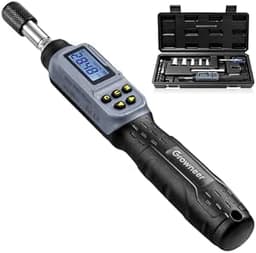
Stop at the first signal. A triggering tool can still add torque if you keep turning. Wera’s notes separate that from a slip-over tool, which cannot keep driving. Do not rebadge BINGCOBBER or Awang as slip clutches because a review mentioned a click. Draper 65372’s bullets say the handle free-spins once the value is reached. Still stop. GROWNEER describes a buzzer and an LED on a 0.3–6 Nm scale and does not say the tool stops driving. Treat the light and the tone as the moment your hand stops. Figures at the low end are covered in torque screwdrivers for small screws.
Draper Draper XP1000 9-piece VDE

Testsieger

Draper Draper XP1000 9-piece VDE
9.4/10about £74.50

Put it away unwound

Wind the adjuster back to the lowest mark, not past it, and take the bit out. Heamar’s storage note is the lowest setting with the bit removed. Advanced Witness Systems says a spring takes a set if you leave the tool wound up for more than a few days, and that you should not wind below the lowest mark. Do this the same day. The Würth sheet uses a check at 12 months or 5,000 operations, and sooner after a drop. A certificate that UK reviews say arrived already old, on both Draper XP1000 sets, is not a fresh calibration.

Inch-pounds are not newton metres

ATsafepro’s line is 1 in·lb = 0.113 N·m. Park Tool uses inch-pounds = newton metres × 8.851. A 4 Nm stem is about 35 in-lb. A 40 in-lb scope screw is about 4.5 Nm. Set the unit printed on the handle. Do not set 40 on a newton-metre dial because the packet said 40. ATsafepro’s title says 1–6 Nm while the description also mentions 10–60 in-lb. Do not average those claims. Stop if the work is live, if you are about to guess a figure, or if the paper is a factory declaration on a joint that needs a current UKAS certificate. Terminals are on the electrician page.

Common questions

How do I set the number without a separate tool?
Pull the locking ring back, turn the collar until the mark meets the figure on the part, and push the ring home so it cannot drift. You do not need a second spanner for the sets on this shelf that use that collar. Sealey’s STS100 sheet describes the same order on a different model. If your listing never states a window, or states two windows, do not pick a number so that the collar has something to point at.
Do I stop at the first click?
Yes. The first click, buzz or red light is the stop. Turning further can still add torque on a triggering tool. Wera’s notes separate that from a slip-over tool, which cannot keep driving, and the cheaper bullets here do not all claim a slip clutch. Draper 65372’s free-spinning handle is that maker’s description. It is still a moment to stop your hand, not a reason to continue.
What do the GROWNEER lights mean?
The listing describes an LED and a buzzer as you approach the preset, on a scale from 0.3 to 6 Nm. The bullet does not say the driver slips or stops. One UK review says it would be better if it did stop. When the light or the tone arrives, stop turning. Do not wait for a click the page never promised, and do not keep going because the screw still feels light.
Where do I leave the scale overnight?
At the lowest marked setting, not below it, with the bit removed. A spring left wound up takes a set if the tool sits for more than a few days. The lowest line is storage. Forcing the collar under that line is not a more careful way to rest the spring. Do it the day you finish, rather than the next time you open the case.
How do I convert inch-pounds if the part is American?
Multiply inch-pounds by 0.113 to get newton metres. Multiply newton metres by 8.851 to get inch-pounds. A 4 Nm figure is about 35 in-lb, and 40 in-lb is about 4.5 Nm. Set the unit printed on your handle. If the converted figure is above the top mark, change the tool. Do not set an inch-pound number on a newton-metre scale.
When do I stop and send the tool for calibration?
At 12 months or 5,000 operations, and sooner after a drop or if you kept turning after the signal. That interval comes from trade guidance for adjustable torque screwdrivers, not from a test of every set here. Also stop using it for a certified joint if the paper in the box is already old. A household stem the same afternoon is a different decision from a joint that needs a current UKAS certificate.

Related pages

Sources

Public UK sources and the amazon.co.uk listings in this comparison. Page updated October 2026.

  1. Heamar: torque screwdrivers (retrieved 16 October 2026)
  2. Advanced Witness Systems: how often to calibrate (retrieved 16 October 2026)
  3. Lambda Calibration: torque calibration (retrieved 16 October 2026)
  4. Electricity at Work Regulations 1989, regulation 14 (retrieved 16 October 2026)
  5. Professional Electrician: insulated hand tools (retrieved 16 October 2026)
  6. IET: consumer units and protective devices (retrieved 16 October 2026)
  7. Electrical Safety First, Q1.21 (retrieved 16 October 2026)
  8. Park Tool: threadless stem (retrieved 16 October 2026)