Wooden mallet for chisels: stop bruising the handle
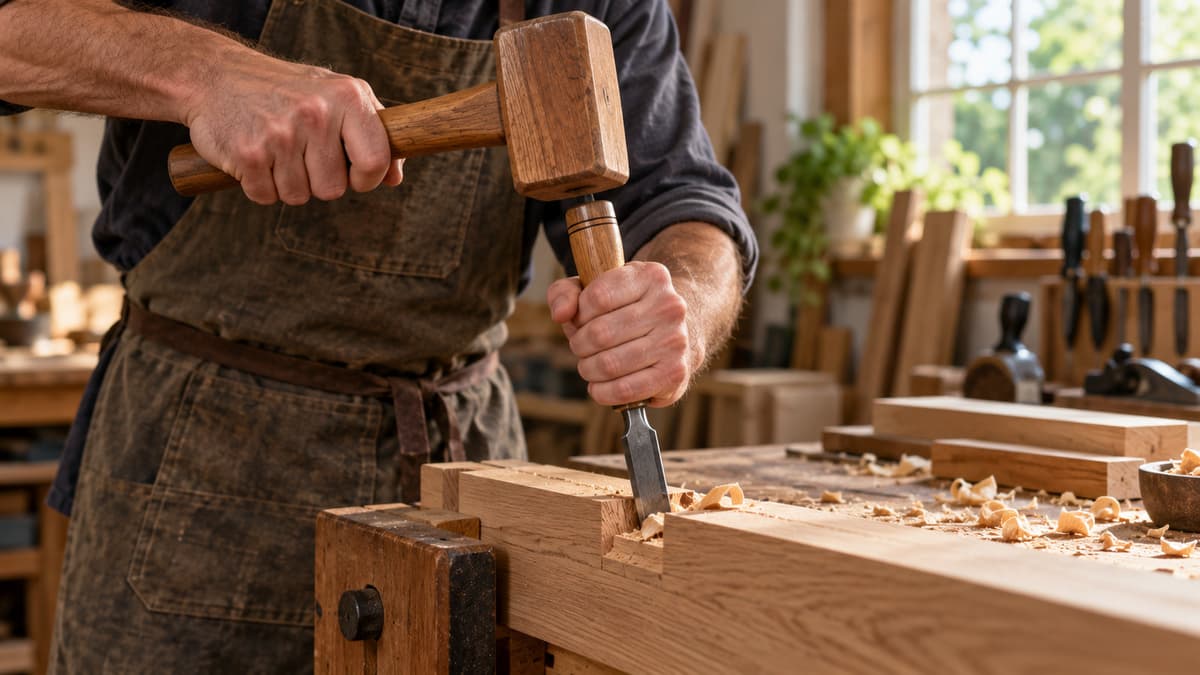
A wooden mallet for chisels meets the handle so you can watch the edge. A claw hammer's small steel face misses, and it bruises a Western bevel-edge handle.
On this page
- 1.In short
- 2.Why a wooden mallet for chisels replaces the claw hammer
- 3.Watch the cutting edge while you strike
- 4.A square face for mortices, a round one for gouges
- 5.Chisels a steel hammer is meant to strike
- 6.A mallet you make, and the blows to refuse
- 7.Where the mallet listings sit
- 8.How we prepared this guide

The hinge is marked, the bevel-edge chisel is on the knife line, and the only striker within reach is the claw hammer from the household kit. Its steel face is a small disc. You look down to place it, the edge wanders off the line, and a miss catches the rim of the handle.
A wooden mallet for chisels is the usual answer on a Western bench. The face is broad enough to meet the handle while you watch the cutting edge. Axminster's chisel-care note says to strike a bevel-edge chisel with an appropriate mallet, and to keep a metal hammer off that handle.
This page is from the Products Compared editorial team. It follows that Axminster note, a Woodworking Masterclasses discussion, a Fine Woodworking maker's account, and Covington & Sons on chisels built for a steel hammer. We did not laboratory-test a mallet. A qualifying purchase through our links can earn us a commission at no extra cost to you.
In short
For a Western bevel-edge chisel, a wooden mallet for chisels gives you a broad face so the blow lands on the handle and your eye stays on the edge. A Japanese chisel made to be struck with steel is a different tool, and a cold chisel on metal sits outside this page.
Why a wooden mallet for chisels replaces the claw hammer
A claw hammer is for nails. The face that starts a nail is small, hard, and easy to miss when the target is the end of a chisel handle. In a Fine Woodworking maker's account, that miss is the whole argument: you watch the hammer to steer it, and the steel still walks off the wood. On a hinge mortice a short run of light blows is normal, and one of them on the rim is enough to dent the end and lift a split along the grain.
Axminster's hand-tool note draws the line for bevel-edge chisels. Strike them with an appropriate mallet. A metal hammer is the wrong face for that handle. The broader wood meets the handle, so the blow can land while your eye stays on the cut.
On the Woodworking Masterclasses thread, a plastic-handled chisel is said to survive steel, and the thread still treats that pairing as poor practice. Plastic does not enlarge the hammer face. If your chisels are plastic-handled, the mallet remains the bench habit. A cold chisel for metal is another tool, and beech does not turn that job into joinery.
Watch the cutting edge while you strike
The broad face is there so your eyes can leave the handle. Fine Woodworking's maker's account puts it plainly: a square mallet face hits the handle and lets you watch the edge. Seat the chisel on the line, look at the cut, and strike. A face larger than the handle end still meets wood when the blow is a little off centre.
In a hinge mortice, a light blow sets the edge and a firmer one follows once it has bitten. Stop when the recess fills with chips, and clear them before you continue. A packed mortice hides the edge. If you cannot see it, reposition the work or pare with hand pressure.
A handle that is already split or crushed is a reason to stop. Another blow drives the split further down the grain. An open split wants a new handle, or a chisel you are willing to retire. The mallet does not close a split that has already opened.
A square face for mortices, a round one for gouges
People reach for a wooden mallet when they mortice because the face is larger. That is the reason given on the Woodworking Masterclasses thread, and it fits the carpenter's pattern: a rectangular head, often angled back toward you. DT Online's workshop note gives about 4–5 inches, roughly 100–125 mm, across the head for most bench and school work. Treat that as a size guide. It is a head size, not a weight.
A round mallet is the other tool. The same Fine Woodworking account calls it lighter and easier to deflect, which is why a carver can roll a gouge and keep striking. That easy deflection is the drawback on a wide mortice chisel. Use the rectangular face for bench chisels, and the round head for gouges.
No source here weighed a correct mallet in grams. Cherry Tree Tools, a UK seller, suggests about 400–600 g for general joinery and a lighter mallet if you carve. That is shop guidance, not a target. A head around 180–200 g, often sold for ice or leather, can look full-size and still be the wrong mass for mortice work. When the item weight and the title disagree, the title is the advertisement.
Chisels a steel hammer is meant to strike
Some chisels are made for a steel hammer on the chisel handle. Covington & Sons describes Japanese chisels, including striking chisels sometimes called tataki, as tools you hit with steel. The handle is built for that face. The Western mallet rule would be the wrong instruction for them. Their hammer would be the wrong instruction for a bevel-edge set on the same bench.
If the chisel is a Western bevel-edge with a plain wooden or plastic handle, stay with the mallet. Axminster's note covers that case. If it is a Japanese pattern whose maker expects a hammer, use the hammer that pattern was built for, and put that hammer down when you put the chisel down. When you are unsure, read the maker's note before the first blow.
On a mixed rack the ordinary failure is one striker for every handle. You finish a Western hinge with the mallet, pick up the other chisel, and keep the same striker out of habit. The dent in the wooden end lasts. Sharpening angles do not choose the striker. If the maker is silent and the handle is a plain Western shape, use the mallet.
A mallet you make, and the blows to refuse
The forum's advice on a homemade mallet is about species and face, not a set of drawings. Use beech rather than pine. Pine dents, and a dented face soon strikes unevenly. Make the face large. The thread gives no grams and no finished length, so none are invented here. A few minutes of hinge chopping will tell you if the head is too heavy or too light.
A bought mallet fails in a different place. A loose head is a reason to send the tool back. Before the first strike, the head should be tight by hand, with no split and no filler. The Health and Safety Executive treats a simple hand tool as something you withdraw when it is unsound. PUWER 1998 does not govern a private shed.
If the mallet is new and the head is detached, or the timber is split, the Consumer Rights Act 2015 gives a 30-day short-term right to reject it against the trader. A carpenter's listing states the mallet is not for metal. Cherry Tree Tools points a wooden mallet at chisels and a rubber mallet at assembly, where you are closing a joint. A dead-blow sits with that assembly work.
Where the mallet listings sit
Shape, face, and a weight you can reconcile belong on our wooden mallet comparison. That page separates a rectangular carpenter's head from a round carver's head, and both from light beech mallets around 180–200 g. In the saved amazon.co.uk set, title grams and item weight often disagree.
For a rectangular bench mallet with a stated face, the Draper Expert 45237 is the clearest match recorded there: angled faces, 80 × 55 mm, and a tapered morticed handle. Item weight is 460 g beside a title weight of 480 g. The saved price is £10.79, with 4.6 from 225 reviews. That is a listing match for bench chisels, not a laboratory score. Skip it for gouges that want a round head.
The Amtech in that set is about 320 g with 4.6 from 731 ratings, and reviewers still call it light. A large count does not tell you the head matches the 4–5 inch bench size DT Online describes. Prices move, and £10.79 is the saved shelf price.
How we prepared this guide
The Products Compared editorial team used Axminster's hand-tool care note, a Woodworking Masterclasses discussion, a Fine Woodworking maker's account of square and round faces, and Covington & Sons on Japanese chisels made for a steel hammer. Weight and rubber-mallet guidance came from Cherry Tree Tools, and the 4–5 inch head size from DT Online. Prices, weights, and review counts are from saved amazon.co.uk pages. We set no gram target.
Common questions
Why keep a claw hammer off a chisel handle?
Does a plastic handle make a steel hammer acceptable?
Should the mallet face be square or round?
What if the chisel is Japanese?
Can I make a wooden mallet for chisels?
Should I look at the handle or the cutting edge?
Which page compares the mallets?
Does this cover a cold chisel on metal?

Products Compared publishes British-English buying guides based on amazon.co.uk listings and public UK sources. We do not run a lab and we do not invent test scores.
Related articles

Oil and a dry place for steel tools
Bare steel rusts in a damp British shed. A thin film and a dry cupboard beat a heavy coat of the wrong oil.

Torx, Pozidriv or Phillips on UK kit
Pozidriv, Phillips and Torx look related and are not. The wrong tip chews the screw on furniture and appliances.

When a torque wrench needs checking
A click can stay crisp after the spring has drifted. The usual check is 12 months or 5,000 cycles from first use.