Independent comparisons. We may earn from shop links. More info

Anvil for jewellery making: stamps, wire and rivets

Updated: 22 October 2026

You are closing a finding or striking a maker's mark into a small silver blank, and the only heavy tool in the house is a bench casting that hides the work. An anvil for jewellery making is a small steel face for stamps and rivets, plus a short horn when the wire is curved. The heavier listings in our [anvil comparison](/hub/hand-tools/anvil) are the wrong mass and the wrong shape. This page stays with the small amazon.co.uk tools, in GBP, and with the faces that scratch or skate. Peter F. used listing text and UK review comments, not a lab. A qualifying purchase can earn a commission at no extra cost to you.

You are closing a finding or striking a maker's mark into a small silver blank, and the only heavy tool in the house is a bench casting that hides the work.

Our top picks

On this page

A flat block or a short horn

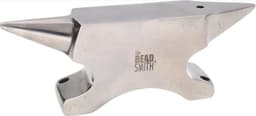
Stamps, punches and rivets need a face with no curve under the tool. Alchemy and Ice, a UK supplier, treats the steel bench block as the better surface for letter punches. jewellerytools.co.uk describes the blow: one firm strike, the stamp vertical, the work on hard flat steel. Several light taps ghost the letters, and wood, plastic or aluminium soaks the strike. A ring or a curved wire needs a beak, which a flat block cannot offer. The Beadsmith dual-horn mini, about £16.99 and 400 g, is the listing UK reviewers describe for findings and wire. A horn will not give you a clean field for a maker's mark, and a block will not cradle a jump ring.

Rubber under the steel, not instead of it

Toolsmith's UK note draws the useful line. Steel returns the blow, which forming and riveting need. Rubber under that steel deadens stamp bounce and cuts the noise. Rubber on its own leaves a shallow stamp. That damping is useful under a maker's mark. The QWORK, about £9.85 and 557 g, has a removable TPR base under a chrome face. The listing calls the body hardened carbon steel. Chrome plate is a finish, not a hardness rating. UK reviews say the face scratches after a few uses, and one reviewer saw pits within minutes.

The small tools on these listings

The HimaPro at about £23.99 is a steel block at 4 × 4 × 3/4 inch and 1.52 kg, with 4.6 from 303 ratings and no UK review text in the file. The Beadsmith at about £16.99 claims stainless steel, weighs 400 g and has two horns that UK reviews use for findings and wire. The H&G at about £17.83 has two horns, a material line that only says metal, and one pockmarked face. The KATSU is cast iron, about 10.3 × 5.3 cm, and a UK review used it for leather rivets after emery on sharp edges.

When the anvil is too much

A 10 kg bench anvil is already awkward under a finding, and a 25 kg casting is worse. The horn is too thick for a jump ring, the face hides a 20 mm blank, and you are still short of the mass hot forging uses. Weight, horn and the hardy hole sit on the anvil buying guide. Extra kilos do not harden a chrome skin. Do not buy a heavy anvil to initial a silver blank.

Screw the light ones down

A 400 g horn or a 557 g block walks when the hammer lands off centre. UK reviews on the Beadsmith say to screw it to a piece of wood, then clamp that board to the bench, so you are not drilling a hardened face. The QWORK TPR base can take some slide and some noise. A rubber foot is still not a fixing if the block hops. If there is no hole, sit the tool on a holed board and fix the board. Hole and clamp notes are on how to mount an anvil.

Common questions

Do I need a horn or a flat block?
Use a flat steel block for a stamp, a punch or a rivet, and a short horn for a ring or curved wire. A horn will not give letter punches a clean field, and a flat block will not cradle a jump ring. In this set the HimaPro and the QWORK are blocks, while the Beadsmith and the H&G are two-horn minis.
Will a rubber base help stamping?
Rubber under a steel block can help. Toolsmith's UK guide says steel returns the blow, while rubber beneath it deadens bounce and noise. Rubber alone leaves a shallow stamp. The QWORK, about £9.85, has a removable TPR base. That base will not stop the chrome face scratching after a few uses.
Why did my bench block scratch?
Chrome plate marks under a punch. On the QWORK, UK reviews describe scratches after a few uses, and one reviewer saw pits within minutes. The chrome is a coating, not a hardness grade. The H&G also pockmarked for one UK user, and its material line only says metal.
Is 400 g enough for wire and findings?
Yes, for wire and findings, if the tool stays still. The Beadsmith is listed at 400 g and about £16.99, and UK reviews use it for that work once it is screwed to wood. It will not behave like a forge anvil, and it is a poor stand-in for a broad block if letter stamps are the main job.
Can I stamp on a cast-iron mini anvil?
Letter stamping wants hard, flat steel and one firm vertical blow. The KATSU in this set is cast iron, with a face of about 10.3 × 5.3 cm. A UK review used it for leather rivets after emery on sharp edges. That is light riveting, not proof of a crisp maker's mark.
Should I buy a 10 kg anvil for jewellery?
Not for findings, wire, stamps or light leather rivets. A 10 kg bench anvil, and a 25 kg casting more so, hides a small blank behind a thick horn. Extra weight does not repair a chrome face that pits, and it does not replace a flat steel block.

Related pages

Sources

Public sources from the research digest. Shelf prices and star lines are the amazon.co.uk figures filed on 19 October 2026.

  1. HSE, Noise at work: advice for employers (retrieved 19 October 2026)
  2. Control of Noise at Work Regulations 2005 (retrieved 19 October 2026)
  3. GOV.UK, General Product Safety Regulations 2005 (retrieved 19 October 2026)
  4. Consumer Rights Act 2015, section 9 (retrieved 19 October 2026)
  5. anvilfire, Selecting an Anvil (retrieved 19 October 2026)
  6. beautifuliron, Anvils (retrieved 19 October 2026)
  7. Waterside Metal, How to buy a quality anvil (retrieved 19 October 2026)
  8. FAO, Blacksmithing tools: the anvil (retrieved 19 October 2026)