Independent comparisons. We may earn from shop links. More info

Anvil buying guide: choose the job before the kilograms

Updated: 22 October 2026

You have a hammer and a results page where every listing is called an anvil. Some weigh about 400 g and belong with jewellery findings. Others are castings near 25 kg, and they still sit under the mass UK smiths talk about for regular hot work. This anvil buying guide names the job, then the kilograms, then the metal the product details actually print. The [anvil comparison](/hub/hand-tools/anvil) lines up the twelve amazon.co.uk listings checked on 19 October 2026. Peter F. checked those listings. A qualifying purchase can earn a commission at no extra cost to you. We did not lab-test rebound.

You have a hammer and a results page where every listing is called an anvil. Some weigh about 400 g and belong with jewellery findings.

Our top picks

On this page

Start with the job, not the brand

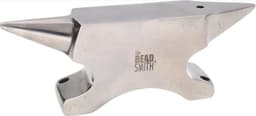
The word on the parcel is shared, and the work is not. Stamping a leather snap, closing a jewellery finding, and drawing down hot mild steel ask for different mass, and a brand name will not sort them. If you only stamp and rivet, a flat bench block or a miniature horn matches the blow. On this shelf those pieces sit around £9.85 to £24. The Beadsmith listing is a 400 g stainless-steel claim, and the QWORK block is about 557 g. A loose 400 g horn walks and marks the wood. Cold brackets want a few kilograms and a horn. Regular hot forging sits outside this amazon sample.

What the kilograms are for

Mass keeps the anvil still and sends some of the blow back into the work. Forge Story treats about 50 kg as a sensible minimum for general blacksmithing and keeps anvils under 30 kg for light shaping only. The FAO forging note says at least 80 kg. None of these twelve listings meets that line. Happybuy’s bullets say 10 kg and the item weight is 8.62 kg. The top of the sample is around 25 kg, at £49.90 and £99.99. Five reviews on the dearer listing are not a durability proof.

Read the material line, not only the title

Kilograms do not name the metal. Several titles say steel while the details say cast iron, and the two do not take a blow the same way. Cast iron keeps the energy. Smithing references call a plain cast-iron body an anvil-shaped object: the edge can chip. Cast steel can be sound or soft. “50 HRC” or “over 70% rebound” on a VEVOR listing is a seller claim. We did not measure it. Open the material field and see whether it agrees with the title. The listings that disagree with themselves are on the cast steel versus cast iron page.

Face, horn and the square hole

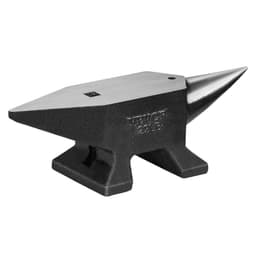
A face you can use is flat. Bladesmithing.co.uk starts a used-anvil check with a straight edge, and the same check suits a new casting here. A horn is for curves. “London style” on the VEVOR 10 kg listing does not make it a London-pattern forging anvil. The square hole helps only when a tool will enter it. Orchard Blacksmith looks for a 3/4 inch or 1 inch hardy hole on a forging anvil, about 19 mm or 25 mm. The VEVOR 10 kg prints 16 mm square and 9.5 mm round, so a 25 mm hardy will not fit. No listing includes a stand.

Where to go next

If the work is findings, wire or light rivets, leave the 25 kg castings and read anvil for jewellery making. If the title says steel and the details say iron, settle that before the price. Hot steel wants more mass than this shelf’s 25 kg top, which those UK workshops still class as light. A used London-pattern anvil is a different purchase: a straight edge on the face, steel rather than cast iron, and a maker’s mark. Stars record what buyers wrote, and they do not measure face hardness.

Common questions

What weight do I need if I only stamp and rivet?
A bench block or a miniature horn is enough, around 400 g to about 1.5 kg on this shelf, roughly £9.85 to £24. Screw or clamp the face down. Compared with a 25 kg casting they are less awkward for findings, though a loose light anvil still walks. Heavier brackets want a few kilograms of bench anvil, and they still sit below forging weights.
Is 10 kg enough to forge hot steel?
For regular forging, no. Forge Story keeps under 30 kg for light shaping and treats about 50 kg as a sensible minimum for general blacksmithing. Orchard Blacksmith starts light forging nearer 23–45 kg. A 10 kg listing, or the Happybuy at 8.62 kg item weight against a 10 kg bullet, is for careful hobby heat. Nothing here meets the FAO note’s at least 80 kg.
Why do titles say steel when the details say cast iron?
The title and the material field are written apart, and on several listings they disagree. Cast iron absorbs the blow and can chip. Cast steel might return the hammer or be soft, and a printed hardness figure stays a seller claim. Where they differ, judge the anvil as the metal the details name.
What size hardy hole should I look for?
Orchard Blacksmith points to a 3/4 inch or 1 inch square hole on a forging anvil, about 19 mm or 25 mm. The VEVOR 10 kg prints 16 mm square and 9.5 mm round, so a 25 mm hardy will not enter. Stamp-and-rivet work may never need a hole. If you own a hardy, match the printed size to it. London style on that VEVOR is not a London pattern.
Should I buy new on amazon.co.uk or a used London-pattern anvil?
Buy new here for jewellery, stamping or light bench work, from about £9.85 up to a bench casting near £37. Take a 25 kg listing only if you accept that smithing rules of thumb still class it as light. A used London-pattern anvil is the usual route nearer 50 kg, which this sample does not stock. Check the face with a straight edge, prefer steel, and look for a maker’s mark.

Related pages

Sources

Public sources from the research digest. Shelf prices and star lines are the amazon.co.uk figures filed on 19 October 2026.

  1. HSE, Noise at work: advice for employers (retrieved 19 October 2026)
  2. Control of Noise at Work Regulations 2005 (retrieved 19 October 2026)
  3. GOV.UK, General Product Safety Regulations 2005 (retrieved 19 October 2026)
  4. Consumer Rights Act 2015, section 9 (retrieved 19 October 2026)
  5. anvilfire, Selecting an Anvil (retrieved 19 October 2026)
  6. beautifuliron, Anvils (retrieved 19 October 2026)
  7. Waterside Metal, How to buy a quality anvil (retrieved 19 October 2026)
  8. FAO, Blacksmithing tools: the anvil (retrieved 19 October 2026)