Independent comparisons. We may earn from shop links. More info

Cast iron vs cast steel anvil: which line to trust

Updated: 22 October 2026

You are on amazon.co.uk with a bench anvil in the basket and two lines that refuse to agree. The title says steel, or forged, and the material field says cast iron. Cast iron vs cast steel anvil is the difference between a face that soaks the hammer and a face that can send some of the blow back. This note sits beside the [anvil comparison](/hub/hand-tools/anvil) of twelve listings captured on 19 October 2026. Peter F. wrote this from those listings. We did not run a rebound test. A qualifying purchase can earn a commission at no extra cost to you.

You are on amazon.co.uk with a bench anvil in the basket and two lines that refuse to agree. The title says steel, or forged, and the material field says cast iron.

Our top picks

On this page

What the blow does in each metal

On a hard steel face, a useful share of the blow comes back into the bar. On plain cast iron, much of that energy dies in the casting. Beautifuliron puts that on the graphite: the face soaks the blow, and an edge chips. Anvilfire’s notes describe a hard face returning about 75–90% of a dropped steel ball, and some cast-iron pieces near 10%. That is not a laboratory method, and we have not run it. A bullet that says over 70% rebound is unmeasured here.

Listings that say cast iron on purpose

The KATSU, about £24.99, and the Draper, a 4.5 kg grey cast-iron bench anvil at about £36.56, state cast iron without a steel title fighting the details. The Draper still costs more than the cast-steel VEVOR at about £18.90. A cast-iron face can back a cold rivet. It will not return the blow the way a hard steel face does, and a corner can chip. Nothing here reaches the FAO note of at least 80 kg.

Listings that say cast steel

Two smaller VEVOR anvils state cast steel and print 50 HRC, which we did not measure. The 4 kg model, about £18.90, shows 4.7 from 184 ratings and a face of 132 × 68 mm. The 10 kg model, about £34.90, shows 4.6 from 171 ratings, a 16 mm square hole and a 9.5 mm round hole. A 25 mm hardy will not enter 16 mm. A UK review calls the 10 kg face not as soft as butter for light hobby forging, and still light. London style is not a full London pattern.

Listings that say both

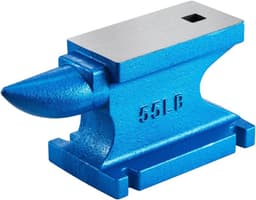
The VEVOR 55 lb, about 24.9 kg and £49.90, is the clearest split. The title says steel, the material field says cast iron, and a bullet says drop-forged iron. More mass does not repair that sentence. Happybuy, about £29.90 with 4.5 from 1,030 ratings, says drop-forged steel and has no material field, while the item weight is 8.62 kg against a 10 kg bullet. AB Tools, about 25 kg at £99.99, has 4.3 from five ratings and a UK review of a dented face. H&G says only metal. BUYSK puts forged iron in the title and cast iron in the bullets, with one rating and no review text.

What you can and cannot conclude

Choose the VEVOR 4 kg or the VEVOR 10 kg when the material field says cast steel and you may put light hobby heat on the face. That is only if the face is hard, which these pages claim and we have not checked. Choose the KATSU or the Draper when the work is cold and the listing says cast iron on purpose. If the title and the details disagree, ask the seller which sentence is the metal. Consumer Rights Act 2015 section 9 treats the description as part of satisfactory quality. Mass and fixing are on the anvil buying guide.

Common questions

Can I forge on cast iron?
You can tap cold work on a cast-iron bench anvil, and you should not plan to draw hot bar on it. Plain cast iron soaks the blow and chips at the edges. The KATSU and the Draper say cast iron plainly. Nothing here is a heavy forging anvil.
Is cast steel as good as forged steel?
Cast steel can be a real anvil face if it is hardened, and the word alone does not prove that. Waterside Metal describes quality anvils as cast or drop-forged and then hardened. On this shelf, the two smaller VEVOR anvils are the clearer buy for light heat than a cast-iron label. The 50 HRC bullet remains untested.
Why does this listing say both?
Sellers split the description across the title, the bullets and the material field. The VEVOR 55 lb title says steel, the material field says cast iron, and a bullet says drop-forged iron. The BUYSK title says forged iron while the bullets say cast iron. Happybuy and AB Tools say steel in a bullet and leave the material field empty. Treat the conflict as unsettled metal.
Will a magnet tell me which it is?
A magnet will not separate cast iron from cast steel. Both are magnetic, so the magnet sticks and the listing stays ambiguous. Anvilfire’s dropped-ball note is a workshop check, not a lab method, with a hard face around 75–90% and some cast-iron pieces near 10%. We have not run it on these twelve.
What does 50 HRC on a VEVOR bullet mean?
50 HRC is a point on the Rockwell C scale, printed as a seller claim on the VEVOR 4 kg and VEVOR 10 kg listings, next to a rebound figure of over 70%. It means the seller says the face is hard. It does not mean we measured it. The same brand’s 55 lb listing says cast iron in the material field, so that bullet does not travel across the range.
What should I do if the anvil is not what the title said?
Keep the listing text. Consumer Rights Act 2015 section 9 makes the description part of satisfactory quality, so a steel title against a cast-iron field is something you can raise with the seller. Do that before you grind or bolt the anvil down, and do not assume a refund is automatic. Ask for one sentence that names the metal.

Related pages

Sources

Public sources from the research digest. Shelf prices and star lines are the amazon.co.uk figures filed on 19 October 2026.

  1. HSE, Noise at work: advice for employers (retrieved 19 October 2026)
  2. Control of Noise at Work Regulations 2005 (retrieved 19 October 2026)
  3. GOV.UK, General Product Safety Regulations 2005 (retrieved 19 October 2026)
  4. Consumer Rights Act 2015, section 9 (retrieved 19 October 2026)
  5. anvilfire, Selecting an Anvil (retrieved 19 October 2026)
  6. beautifuliron, Anvils (retrieved 19 October 2026)
  7. Waterside Metal, How to buy a quality anvil (retrieved 19 October 2026)
  8. FAO, Blacksmithing tools: the anvil (retrieved 19 October 2026)