Independent comparisons. We may earn from shop links. More info

How to use a watering lance

Updated: October 2026

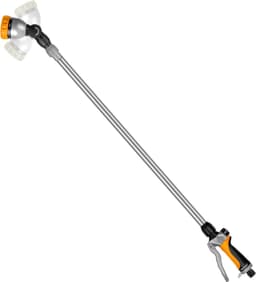
The lance is on the hose, and water is dripping at the nut or trapped behind a shut valve. How to use a watering lance is a short sequence: fit the connector you own, aim a soft pattern at the compost, shut the flow off while you walk, then drain the lance and bring it indoors. This sits beside the [watering lance comparison](/hub/garden-watering/watering-lance). The Products Compared editorial team wrote it on 16 October 2026 from amazon.co.uk review notes and public UK water rules. We did not test these lances in a lab. A qualifying purchase through our links can earn a commission at no extra cost to you. Model choice stays on the [watering lance buying guide](/hub/garden-watering/watering-lance/sub/watering-lance-buying-guide).

The lance is on the hose, and water is dripping at the nut or trapped behind a shut valve.

Our top picks

On this page

Click it on, then aim the head

Start with the fitting on your listing and the connector already on the hose. A 3/4 in BSP or BSPP line, on the LINZI, the 61 cm RESTMO and the telescopic RESTMO, is the closest match to a typical UK click fitting. A 12 mm barb, a 0.25 in NPT barb, or a blank thread means you check the joint first. On the STYDDI, reviews stop a leak by tightening the nut, adding a washer, or using PTFE tape. Open the tap, then set the flow, and point a shower at the compost. For a hanging basket, angle the head up into the compost. Sleeve-soaking and compost on the patio are covered on watering lance for hanging baskets. If the nut weeps, shut the tap, reseat the washer, and try again.

Shut off at the lance, and do not trap mains pressure

Turn the lance control off when you move from one pot to the next. That is the point of a thumb lever or a trigger you can release. Close the outside tap when the round is finished. Leaving the lance valve shut while the hose is still charged is a different habit. A Draper review, separate from any manufacturer notice, says the metal tube inside the plastic coating can burst if the lance stays shut and the hose stays on. Treat that as a Draper review note, and as a reason to avoid parking a closed head on a live hose. If you need both hands for a basket, set the control, water that basket, then shut the lance off before you lower it. Telescopic RESTMO reviewers say the trigger lock is easy to knock off, which stops the flow in mid-air. Check the lock before you reach overhead.

Drain it and store it indoors

When you finish, open the lance so the hose can empty, disconnect it, and hold the head down until the tube drains. Bring lances indoors for winter. Hozelock’s care page says trapped water freezes and expands. That guarantee covers Hozelock tools. Use the same indoor habit with the lances in this set. A telescopic RESTMO leaks at the sliding joint when you change length, so drain that joint as well as the head. Hang the lance where it can dry.

A lance is still a hosepipe

A temporary use ban covers a hosepipe used to water a garden, wash a car, or fill a paddling pool. Ofwat describes a fine of up to £1,000, and a watering can or a bucket as the household alternative. A lance on a mains hose is still a hosepipe. A soft spray does not create an exemption. Check your own company, because exemptions differ. GOV.UK’s England summary for 2 to 8 October 2026 listed temporary use bans for Affinity (Central and East), Anglian except Hartlepool, Bristol, Cambridge, Essex and Suffolk, Southern (Hampshire and the Isle of Wight), South East, South West except Bournemouth, Thames, and Wessex. That note covers that week. Thames Water’s page, updated 12 October 2026, still barred hosepipes for gardens. Scotland, Wales and Northern Ireland sit outside it. A water-butt hose is a different supply. The double check valve sits on the supply under the Water Fittings Regulations 1999 for England and Wales. Water Regs UK treats a typical garden hose as fluid category 3. WaterSafe says to keep the hose out of a pond, bucket or drain. Ofwat’s 0.7 bar minimum is in the communication pipe. A retailer line of about 2 bar is only a rule of thumb.

Common questions

How do you fit a lance to a UK hose?
Match the listing thread to the connector on the hose. A stated 3/4 in BSP or BSPP line is the straightforward case. For a barb, an NPT mark, or no thread, seat the joint and open the tap slowly. On the STYDDI, reviewers stopped a leak by tightening the nut, adding a washer, or using PTFE tape.
Should the lance valve stay shut while the tap is open?
Shut the lance off between plants, and shut the tap when you finish. A closed lance on a hose that is still under pressure is the habit to avoid. A Draper review says the inner tube can burst in that situation. That note is one listing’s review file, and it is a poor way to leave any of these lances.
How do you drain and store it before frost?
Open the lance, disconnect it, and point the head downhill until the tube is empty. Store it indoors. Hozelock says trapped water freezes and expands. In this set, frost split a plastic screw on the 48 cm RESTMO, ruined a GRIFEMA left outside, and showed up as LINZI handle leaks after winter storage.
Can you use a lance during a hosepipe ban?
A lance on a mains hose counts as a hosepipe. Ofwat’s ban covers garden watering, car washing and paddling pools, with a fine of up to £1,000. A can is the usual alternative, and a soft spray does not change the ban. Thames Water’s page, updated 12 October 2026, still barred hosepipes for gardens. Check your company.
Where does the double check valve go?
On the supply, at the outside tap, under the Water Fittings Regulations for England and Wales. Water Regs UK classes a typical garden hose as fluid category 3. If the tap shows no double-check protection, or the thread is neither 1/2 in nor 3/4 in BSP, ask a plumber. Keep the hose out of a pond, bucket or drain. A dripping new lance is a seller question under the Consumer Rights Act 2015.

Related pages

Sources

Sources checked for this comparison; last retrieved on 17 October 2026.

  1. GOV.UK, dry weather and drought in England, 2 to 8 October 2026 (retrieved 17 October 2026)
  2. Thames Water, temporary hosepipe ban (retrieved 17 October 2026)
  3. Water Regs UK, hose union taps (retrieved 17 October 2026)
  4. WaterSafe, hosepipe backflow (retrieved 17 October 2026)
  5. Ofwat, water pressure (retrieved 17 October 2026)
  6. Water Supply (Water Fittings) Regulations 1999 (retrieved 17 October 2026)
  7. Consumer Rights Act 2015 (retrieved 17 October 2026)
  8. RHS, watering (retrieved 17 October 2026)