Independent comparisons. We may earn from shop links. More info

Grafting tool for fruit trees

Updated: 22 October 2026

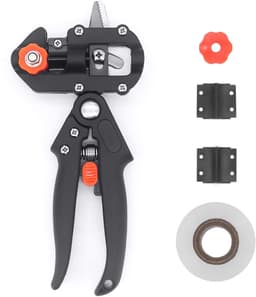
You are grafting an apple or a pear on the allotment, or a plum graft has already failed, and you want to know whether the same stamp is the same job. A grafting tool for fruit trees still only cuts small matched wood. It does not make apples, pears, plums and cherries equally willing, and it does not turn a tree in your garden into a plant you can sell. The seven listings stay in the [grafting tool comparison](/hub/garden-tree-and-hedge-shears/grafting-tool). This page does not rank them and does not repeat the bind. Peter F. used RHS, PTES and GOV.UK, not a take-rate trial. A qualifying purchase can earn a commission at no extra cost to you.

You are grafting an apple or a pear on the allotment, or a plum graft has already failed, and you want to know whether the same stamp is the same job. A grafting tool for fruit trees still only cuts small matched wood.

Our top picks

NAYE NAYE (4336460087)

Best overall

NAYE NAYE (4336460087)
7.6/10about £28.00
Yuhtech Yuhtech (SHEAR-KIT-BK)

Best value

Yuhtech Yuhtech (SHEAR-KIT-BK)
7.3/10about £9.99
On this page

Apples and pears

PTES says apples and pears take more readily than stone fruits. That is still not a promise that every stamp will take. You want one-year scion wood about pencil thick. The RHS puts that at about 8 mm. The rootstock has to sit inside the diameter printed on your tool. If the stock is thicker than that bullet, stop. Diameter and box contents are the checks on the grafting tool buying guide. Pears are grafted onto quince, because a pear on its own roots gets too large for most gardens. The RHS describes Quince A at about 3–4.5 m and Quince C, along with Quince Eline, at about 2.5–3 m. Some pears on quince need an interstock. PTES names Comice as a frequent stem-builder. The RHS describes M9 for a small garden and MM106 as the widely used semi-dwarfing apple stock.

Why stone fruit is stricter

Plums, cherries and peaches are not the apple case with a different label. PTES says stone fruits want warmth and a rootstock that is already growing. If you graft a plum onto a stock that is still fully asleep, in a cold spring, you are copying the easy case onto the stricter one. The RHS grafts plums onto plum rootstocks to limit size. St Julian A is the usual semi-vigorous stock. Pixy is the smaller one. Cherries are grafted onto stocks such as Gisela 5 and Colt. A failed stone-fruit graft is a stop, not a cue to cut the same wood again next weekend. Warmth and a stock that has started to grow are not a setting on the pruner. A trunk thicker than the printed ceiling is outside the tool, whether the fruit is an apple or a plum.
NAYE NAYE (4336460087)

Testsieger

NAYE NAYE (4336460087)
7.6/10about £28.00

Virus-free stock and certification

Suffolk Fruit and Trees makes the practical point: start with virus-free rootstocks, and seal exposed cuts. Virus-free stock is still worth seeking from a fruit nursery if you will live with the tree for years. That is not the same thing as entering a certification scheme. The Fruit Propagation Certification Scheme, on GOV.UK, is for commercial certified fruit plants and rootstocks in England and Wales. A home grafter making a tree that stays in the garden is not that scheme. Do not skip the scheme if you are producing certified plants for sale.

A tree at home, or a tree you will sell

Grafting a tree that stays in your own garden does not, by itself, mean you need a plant passport. GOV.UK’s list for movement in Great Britain includes plants for planting, and cuttings sit in that trade. The plant-passport FAQ treats grafting as growing a plant on, so a nursery that moves that plant may need a new passport and has to keep supplier records. A private gardener is not that operator. If you will sell the tree, read GOV.UK rather than a review count. Northern Ireland movements from Great Britain are a different passport position. The Consumer Rights Act 2015 is about the tool being as described, not a failed graft.

Common questions

Are apples and pears easier to graft than plums and cherries?
PTES says apples and pears take more readily than stone fruits. That is a tendency, not a rate you can hang on a brand of pruner. Plums, cherries and peaches want warmth and a rootstock that is already growing. Using the apple method on a cold, dormant plum stock is the usual way a first stone-fruit graft fails.
What rootstock do pears go onto?
Pears are grafted onto quince, because a pear on its own roots gets too large for most gardens. The RHS describes Quince A at about 3–4.5 m and Quince C and Quince Eline at about 2.5–3 m. Some pears on quince need an interstock, and PTES names Comice as a frequent stem-builder. That is not every variety.
Why might a stone-fruit graft need a rootstock that is already growing?
PTES ties stone fruit to warmth and to a stock that has started to grow, unlike the more forgiving apple and pear graft on dormant wood. A plum or cherry scion on a stock that is still fully asleep, in a cold spell, is the stricter case. If that attempt has already failed once, stop and ask a nursery.
Do I need virus-free stock for one tree at home?
You are not in the commercial certification scheme by grafting one tree, but virus-free rootstocks are still the sound start. Suffolk Fruit and Trees says to start with virus-free stock and to seal exposed cuts. A pruner listing cannot tell you the stock is clean. Buy the stock from a fruit nursery that states it.
Do I need a plant passport to graft a tree that stays in my garden?
No. A tree that stays at home is not the trade in plants for planting. You do not need a passport merely because you joined a scion to a rootstock in your own garden. The passport rules are about movement in trade, not about owning a grafting tool.
When does grafting create a passport job?
When a professional operator grows a plant on and then moves it. The plant-passport FAQ treats grafting as growing on, so the nursery may need a new passport and must keep supplier records. Northern Ireland movements from Great Britain sit under a different passport position.
Can I use the same stamp pruner on a trunk that is thicker than the printed limit?
No. Pencil wood, about 8 mm in the RHS description, is the wood these tools are sold against, and each listing that prints a ceiling means that ceiling. A trunk will not become a graft because you squeeze harder. Stop, and use a knife or a nursery, whether the fruit is an apple or a plum.

Related pages

Sources

Public sources used for timing, cambium contact, tool hygiene, plant passports and advertising claims. Listing prices, stars and review counts are the amazon.co.uk lines saved on 20 October 2026. This is not a graft trial.

  1. RHS — grafting ornamental fruit trees (retrieved 20.10.2026)
  2. RHS — cleaning tools (retrieved 20.10.2026)
  3. PTES — whip and tongue graft (retrieved 20.10.2026)
  4. Orchard Link — grafting new trees (retrieved 20.10.2026)
  5. GOV.UK — plants that need a plant passport (retrieved 20.10.2026)
  6. Plant passport FAQ (retrieved 20.10.2026)
  7. GOV.UK — Fruit Propagation Certification Scheme (retrieved 20.10.2026)
  8. ASA — substantiation (retrieved 20.10.2026)