Independent comparisons. We may earn from shop links. More info

Garden sieve mesh size

Updated: 21.10.2026

You are holding two sieves that both say fine, and one would cover a seed tray while the other would still drop gravel into the pot. Garden sieve mesh size is the opening in millimetres, and one opening cannot be a seed cover and a stone riddle. The twelve rows, with prices and review counts, are on the [garden sieve comparison](/hub/garden-tools/garden-sieve). What follows is only the hole: about 10–12 mm, about 6 mm, and about 3–5 mm. We did not run a lab test. A qualifying purchase through our links can earn a commission at no extra cost to you.

You are holding two sieves that both say fine, and one would cover a seed tray while the other would still drop gravel into the pot.

Our top picks

On this page

Three jobs, three openings

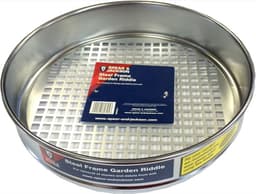
About 10–12 mm is the stone and coarse-compost opening. Pieces larger than that stay on the mesh, and smaller grit falls through, so you will not get a dust-free mix. The Spear & Jackson plate in this set is 10 mm square and nothing else. None of these bands is a British Standard. They agree closely enough to stop you buying a 3 mm disc for a lawn full of stones. About 6 mm is the general crumb. It takes out twigs and leaves a texture finer than a 10 mm riddle and faster than a dust mesh. Use it on compost for a bed or a pot, not as the last layer on a tiny seed. If the heap is damp, this opening clogs too. What you do with the lumps is on sieve compost. About 3–5 mm is a thin cover over small seed, or a small volume of loam. On sowing in pots, the RHS wants a thin sieved layer over small seed. The sieve does not sterilise the heap. A 3 mm mesh on a whole damp heap is a slow clog, not a better riddle. About 1 mm is a dust mesh. It is not a garden riddle for a barrow.

Inches on the same shelf

ADEPTNA’s AD-SI prints 1/4 inch, 3/8 inch and 1/2 inch in powder-coated steel, at £14.95, with no millimetre line beside them. Keep the inches. A 1/4 inch hole is a little over 6 mm, so it sits near the general crumb rather than the 3 mm seed mesh. A 3/8 inch hole is a little under 10 mm, and a 1/2 inch hole is a little under 13 mm, which is the stone end of the rule of thumb. The same brand’s ADSI150 prints 3, 5, 8, 10 and 12 mm. One UK review measured 5, 8, 10, 12 and 15 mm. That is a single report, not a new specification. Do not convert the inch model into those millimetres and drop the inch line. Opening and retention are different faults. Handles, coatings and rust claims stay on the garden sieve buying guide.

One opening, then a second pass

A whole heap does not go through 3 mm. The workable order is coarse, then fine on the portion that needs it. A 10 mm or 12 mm pass takes the bricks, the roots and the twigs out of a barrow. From the fines, you take a bucket and run it through 6 mm if you want a potting crumb, or through 3–5 mm if you only need a seed covering. That two-stage order is a rule of thumb, not a duty to own five discs. Flatro’s inserts run from 3 mm to 12 mm and can do that sequence only if you change the mesh. Spear & Jackson cannot change mesh. If 10 mm is the only job, that is an advantage. If you later want a seed cover, you need a second opening, not a longer shake.

Which listing prints which holes

These are the openings as printed. Spear & Jackson: 10 mm square, one plate. KOOLPUG: 3, 6 and 12 mm. The johgee set: 3, 6, 9 and 12 mm, with one bullet that says three sizes. Flatro and ADEPTNA ADSI150: 3, 5, 8, 10 and 12 mm. ADEPTNA AD-SI: 1/4, 3/8 and 1/2 inch. Armo: the mesh opening is not stated, so you cannot place it on this scale however large the title sounds. The 10 mm plate has 1,806 reviews and cannot cover seed. Armo has 109 reviews and no hole at all.

Common questions

What opening removes stones without turning the job into dust?
About 10–12 mm, or the 3/8 inch and 1/2 inch screens if the listing speaks in inches. The Spear & Jackson plate is 10 mm. Grit smaller than the hole still falls through. That is what the riddle is for.
What opening is a general compost crumb?
About 6 mm, with about 6–8 mm as the wider rule of thumb used in UK buying guides. It is finer than a stone plate and kinder to a heap than 3 mm. Damp compost will still sit on it if you overload the frame.
When is 3 mm actually useful?
For a thin layer over small seed, or a small volume of loam, which is how the RHS uses a fine sieve. KOOLPUG’s bullets name 3 mm for seedbeds. It is a poor opening for a barrow of stones or a wet heap, because the mesh blinds.
Is 1 mm a garden riddle?
No. It is a dust mesh. Jokapy includes one. It holds ordinary crumbs and passes only the finest particles, and it clogs as soon as the material is damp. Do not buy a set for the 1 mm disc if the job is compost or stones.
What is 1/4 inch in this set?
The finest of the three ADEPTNA AD-SI screens, a little over 6 mm, still labelled 1/4 inch on the listing. The 3/8 inch and 1/2 inch screens are the coarser pair, near 10 mm and 13 mm. Keep the inch line when you compare that row with millimetre titles.

Related pages

Sources

Public UK sources used for this comparison. Listing prices, stars, and review counts are the amazon.co.uk lines in the product rows. A 20 October 2026 search snapshot is a price-band rule of thumb only, not a second check of these ASINs. We did not run a lab test.

  1. RHS — How to make your own potting mix (retrieved 20.10.2026)
  2. RHS — Four steps to perfect compost (retrieved 20.10.2026)
  3. RHS — John Innes potting compost (retrieved 20.10.2026)
  4. RHS — Sowing in pots (retrieved 20.10.2026)
  5. BBC Gardeners' World Magazine — How to make a soil sieve (retrieved 20.10.2026)
  6. Spear & Jackson — Garden riddle (retrieved 20.10.2026)
  7. HSE — Good handling technique (retrieved 20.10.2026)
  8. Consumer Rights Act 2015 — notes on goods remedies (retrieved 20.10.2026)