Independent comparisons. We may earn from shop links. More info

Garden sieve buying guide

Updated: 21.10.2026

You have a heap of stony soil, a sack of lumpy compost, or a seed tray that needs a thin cover, and the amazon.co.uk titles mostly say fine or large. A garden sieve buying guide has to turn those words into a hole size, a diameter you can read, and a mesh that stays in the frame. In this set the shelf prices run from £6.99 to £51.99, and the full star lines sit on the [garden sieve comparison](/hub/garden-tools/garden-sieve). We did not run a lab test. A qualifying purchase through our links can earn a commission at no extra cost to you.

You have a heap of stony soil, a sack of lumpy compost, or a seed tray that needs a thin cover, and the amazon.co.uk titles mostly say fine or large.

Our top picks

On this page

What you are actually buying

A garden sieve and a garden riddle are the same tool: fine material falls through, and stones, roots, twigs and clods stay on top. A riddle at 10 mm and a sieve at 10 mm are not two categories. You are buying an opening and a way of holding it, then a frame you can lift. Decide the job before the brand. Stones and coarse compost want about 10–12 mm. A more even potting crumb wants about 6 mm. A thin cover over small seed wants about 3–5 mm. About 1 mm is a dust mesh, not a barrow sieve. That split is a rule of thumb, not a British Standard. The millimetre jobs in more detail are on garden sieve mesh size.

Opening, then how the mesh is held

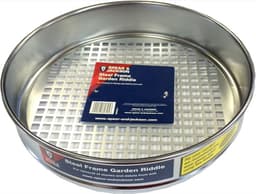
A fixed plate cannot fall out. The Spear & Jackson RIDDLE is chrome-plated steel with 10 mm square holes, a 315 mm bullet and a 31.5 × 31.5 × 7 cm table, 586 g, at £14.95. You get one opening. If that opening is the job, the plate is the safer buy, because UK reviews of drop-in sets in this comparison often say the disc leaves the rim when the sieve is tipped. A drop-in set is worth the spare meshes when you genuinely have two jobs. KOOLPUG lists 3, 6 and 12 mm in a metal frame the bullets call 30 cm, at £24.99. The page says two crossing steel rods lock the mesh. Several UK reviews still say an insert falls out when the sieve is tipped. Lift the disc out to empty it. Do not turn the frame upside down. Handled scoops are a third tool, and they are not a rim you rest on a bucket. How you load any of these is on how to use a garden sieve.

A diameter you can read

A stated 30 cm rim is the usual hand riddle in this set. Flatro’s table is 29.5 × 29.5 × 7.5 cm at 655 g, so the diameter and the depth describe one object. A title that says large and a table that says 20 cm is a description conflict, not a bigger sieve. Armo is plastic, £6.99, title 20 cm, table 20 × 20 × 1 cm and 180 g, and the mesh opening is not stated. Many UK reviews say the large wording did not match what arrived. Spear & Jackson is the clean comparison: 315 mm and 31.5 cm agree, and the manufacturer page states 330 mm.

Material word and the review count

Quote the coating the listing uses. Spear & Jackson says chrome-plated steel. Flatro says stainless. Armo is plastic. Those words are not interchangeable, and a will-not-rust line is not a corrosion test. Some Spear & Jackson reviewers call that riddle stainless or galvanised. The listing does not. Stars without a count are not a verdict. Spear & Jackson is 4.6 from 1,806 reviews. Flatro is 4.6 from 28 at the same £14.95 as the fixed plate. A five-star average from three people does not outrank a 4.6 from 1,806. There is no sieve-specific British Standard to treat as a pass mark.

Common questions

Is a riddle a different tool from a garden sieve?
No. In UK garden writing the two names cover one framed mesh. A 10 mm riddle and a 10 mm sieve do the same job if the hole and the frame match. The difference that matters is fixed plate, drop-in disc, handled scoop or rotary drum, which you can see in the type column on the main table.
What should you decide before the brand?
The opening, then whether the mesh can fall out, then a diameter the listing actually prints. About 10–12 mm, about 6 mm and about 3–5 mm are different jobs. Price and star average come after those three, because a cheap sieve with no millimetre line does not become a stone riddle.
When is a fixed plate the safer buy?
When you have one job and you empty the sieve by tipping it. The Spear & Jackson 10 mm plate cannot drop out. You give up the spare meshes. If you need 3 mm on Monday and 12 mm on Saturday, a drop-in set is the point of the extra discs, provided you lift them out instead of inverting the frame.
When is a drop-in set worth the spare meshes?
When the holes match two real jobs and you will live with a disc that UK reviews often say slips. KOOLPUG’s 3, 6 and 12 mm and Flatro’s five inserts from 3 mm to 12 mm are that kind of set. They are a poor swap for a fixed plate if your habit is to tip stones straight into a bucket.
What does a readable diameter look like on a listing?
The same figure in the title and the table, in centimetres or millimetres, with a depth that belongs to that rim. Flatro’s 29.5 × 29.5 × 7.5 cm does that. Armo’s 20 cm table against a large title does not, and Solkraes’s 2.54 cm cube does not. A homemade barrow sieve in a magazine is not a size you can claim for these rows.

Related pages

Sources

Public UK sources used for this comparison. Listing prices, stars, and review counts are the amazon.co.uk lines in the product rows. A 20 October 2026 search snapshot is a price-band rule of thumb only, not a second check of these ASINs. We did not run a lab test.

  1. RHS — How to make your own potting mix (retrieved 20.10.2026)
  2. RHS — Four steps to perfect compost (retrieved 20.10.2026)
  3. RHS — John Innes potting compost (retrieved 20.10.2026)
  4. RHS — Sowing in pots (retrieved 20.10.2026)
  5. BBC Gardeners' World Magazine — How to make a soil sieve (retrieved 20.10.2026)
  6. Spear & Jackson — Garden riddle (retrieved 20.10.2026)
  7. HSE — Good handling technique (retrieved 20.10.2026)
  8. Consumer Rights Act 2015 — notes on goods remedies (retrieved 20.10.2026)