Independent comparisons. We may earn from shop links. More info

How to use a garden sieve

Updated: 21.10.2026

You already have a sieve, the compost is damp, and the last attempt left a mat of soil on the mesh and a disc somewhere in the barrow. How to use a garden sieve is a sequence: support the frame, keep each load small, move it, and clear what stays on top without tipping a loose insert onto the ground. The twelve listings, if you are still choosing, are on the [garden sieve comparison](/hub/garden-tools/garden-sieve). We did not run a lab test. A qualifying purchase through our links can earn a commission at no extra cost to you.

You already have a sieve, the compost is damp, and the last attempt left a mat of soil on the mesh and a disc somewhere in the barrow.

Our top picks

On this page

Set the frame down before you load it

Rest the rim on something that takes the weight. A bucket is the usual seat for a hand riddle around 30 cm, which is how UK reviews describe the KOOLPUG in use: the frame sits on the bucket lip and the fines fall in. A barrow or a trug works the same way if the rim is wide enough to span it. The container holds the frame. Your back does not. HSE guidance has no kilogram limit for this job. Keep the load close, do not twist while you are bent, and do not shake a full frame at arm’s length. If your back already limits you and the volume is tonnes, or the fill is builder’s rubble, stop and hire the work out. Put the sieve down empty, then add soil. Which opening belongs to which job is on garden sieve mesh size.

A small load, then move it

A heaped wet load blinds the mesh. Water holds the crumbs together, the holes fill, and shaking harder packs them tighter. Take a slice you can still see light through after a few moves. If the heap is sticky, let it dry, or take less. Do not add another spadeful to force the first one through. Slide or rock the soil so crumbs find the holes. A hard press turns damp compost into a lid. On a fixed plate, dry clods can skate, which one Spear & Jackson review describes, and that review also calls the base sharp enough for gloves. What stays on top is the overs: stones, roots, twigs, and lumps that were never going to fit the hole. Brush or knock them off into a separate trug. On a compost heap those overs go back on the bin, which is the point of sieve compost. Do not keep rubbing them until they powder through a hole that was meant to stop them.

Fixed plate or loose disc

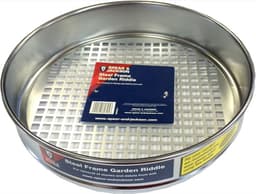
A fixed plate can be tipped. The Spear & Jackson 10 mm base is part of the frame, so turning it over dumps the stones and leaves the mesh where it was. You still support the rim and keep the load small. Do not assume every round sieve in the cupboard is built that way. A drop-in disc is the failure this set’s UK reviews actually describe. KOOLPUG’s page says two steel rods lock the mesh, and several reviews say the insert falls out when the sieve is tipped. ADEPTNA’s powder-coated screens draw the same note: the disc slips because the rim is slightly larger. The move is to lift the disc out, or to hold it down with one hand, and tip the overs off the mesh while the frame stays upright. Turning the whole thing upside down dumps the insert with the stones.

A thin cover, then drying and storage

Seed is a different quantity. The RHS, on sowing in pots, says to crumble compost and sieve a thin layer over small seed, or to use a pot with holes in the base as a makeshift riddle. Indoors, that covering is usually no deeper than the seed itself. You are dusting, not processing a heap. A 3 mm or 5 mm mesh does that on a small volume. A 10 mm plate lets through pieces that bury small seed unevenly. Sieving does not sterilise the compost. The RHS still warns that unsterilised soil can carry weeds, pests and diseases. When you stop, knock the mesh clear and let it dry before it goes away. None of the rust-resistant bullets is a licence to store the sieve wet and caked. If the disc is removable, keep the inserts where you will find all of them. A sieve that is honestly coarse is the wrong opening, not a defect.

Common questions

Where do you rest the sieve?
On the rim of a bucket, a trug or a barrow that can take the frame’s weight. UK reviews of the 30 cm drop-in sets describe a bucket. A handled scoop is held over the pot instead. Do not shake a loaded frame at arm’s length.
How full should one load be?
Thin enough that you can still see the holes after a few moves. A wet heap that covers the mesh will blind it, and adding more soil makes that worse. The LeQi two-thirds line applies to that drum’s bullets, not to a hand riddle.
Do you shake, rock or press?
Rock or slide the soil so crumbs find the holes. Pressing a damp load packs it into a lid. On a flat 10 mm plate, break dry clods first, because they can skate across the metal.
What do you do with what stays on top?
Knock it off into a separate container. Compost overs go back on the heap. Stones from a bed are not compost. Stop when the pieces are larger than the hole you chose, rather than grinding them through.
Why does the mesh fall out when you tip?
Because it is a drop-in disc, and in this set UK reviews of KOOLPUG, the ADEPTNA inch screens and Jokapy say the insert slips or shifts. Lift the disc out, or hold it, and keep the frame upright. A fixed plate does not have that fault.

Related pages

Sources

Public UK sources used for this comparison. Listing prices, stars, and review counts are the amazon.co.uk lines in the product rows. A 20 October 2026 search snapshot is a price-band rule of thumb only, not a second check of these ASINs. We did not run a lab test.

  1. RHS — How to make your own potting mix (retrieved 20.10.2026)
  2. RHS — Four steps to perfect compost (retrieved 20.10.2026)
  3. RHS — John Innes potting compost (retrieved 20.10.2026)
  4. RHS — Sowing in pots (retrieved 20.10.2026)
  5. BBC Gardeners' World Magazine — How to make a soil sieve (retrieved 20.10.2026)
  6. Spear & Jackson — Garden riddle (retrieved 20.10.2026)
  7. HSE — Good handling technique (retrieved 20.10.2026)
  8. Consumer Rights Act 2015 — notes on goods remedies (retrieved 20.10.2026)