Independent comparisons. We may earn from shop links. More info

Electric wheelbarrow vs manual wheelbarrow

Updated: 21.10.2026

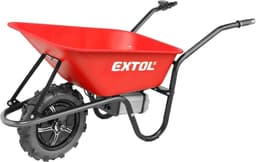
A few bags of compost on a flat path still move with the barrow in the shed, and the powered listings start at £493.57 before you have shifted anything. An electric wheelbarrow vs a manual wheelbarrow turns on how often the load is heavy or uphill. If the work is light, flat and rare, keep the manual barrow. The five Extol machines in our [battery wheelbarrow comparison](/hub/garden-tools/battery-wheelbarrow) ran from £493.57 to £2,305.33 on 19 October 2026. This page is from Peter F., editor for DIY & tools. We ran no lab test. A qualifying purchase can earn us a commission at no extra cost to you.

A few bags of compost on a flat path still move with the barrow in the shed, and the powered listings start at £493.57 before you have shifted anything.

Our top picks

On this page

What stays hard either way

Both tools are pedestrian. You steer, you watch the path, and you tip the tray yourself. Reviews of the 300 litre tray at £1,179.84 say a full tip still takes strength. The single-wheel barrow at £740.63 weighs 35 kg empty, and you hold that wheel upright. The Health and Safety Executive treats a slope as a force problem whether or not a motor helps. You still need to see over the load. A manual barrow hangs on a nail. The powered weights that are printed start at 35 kg, then 45 kg, then 108 kg, before soil, and the 300 litre frame is 181 cm long.

Where owners say the manual barrow loses

The gap shows up on repeated loads, soft ground and slopes, not on one bag of bark. On the £493.57 cart, one reviewer describes soil on a slope, about 50 cubic metres and about 500 loads, and says a normal barrow was impractical for that move. That is one season, not a time-saving percentage. On the £987.69 listing, reviews describe paddock and manure work with little weight on the arms. That is where a manual barrow loses, when the hill and the repetition arrive together. On the 300 litre listing, light slopes were taken full, and steeper ground meant less fill. The pattern here is repeated slope loads.

What you take on with a battery machine

You take on mass, charging, assembly and a brake you must test. One 100 litre soil day emptied the pack by lunch. Assembly is required on four listings. The 300 litre reviews describe Czech-only instructions and missing nuts. Only the 100 litre listing names a charger, and its reviews disagree about braking downhill. None of the five states a BS 1363 plug. The £2,305.33 page claims a manual downhill brake and has no reviews.

Price against how often you do the job

Shelf prices are £493.57, £740.63, £987.69, £1,179.84 and £2,305.33. A manual barrow around £25 does not need a battery line the title and the bullets agree on, and it will not walk a paddock load uphill. Twice a year on the flat, the powered price buys an afternoon you could already finish. A weekly manure run on a hill is a different sum, set against arms, time and a barrow that stalls. The £740.63 single-wheel listing, 4.1 from 15 ratings, is the top pick because chemistry, wheel count and the 35 kg weight are printed. The £987.69 machine is the best value on a named charger and a 260 kg sticker, with 3.7 from 11 reviews and a downhill-brake complaint. How often you repeat the job decides which, if any, is rational.

A conditional recommendation

Keep the manual barrow when loads are light, the ground is flat and trips are rare. Choose a powered listing when the same hill comes back with manure, soil or rubble often enough that the push stops the day. Match the printed kilograms, test the brake on the flat, and expect to tip by hand. If the hill is the reason, read the electric wheelbarrow for slopes page before you trust a brake bullet. Do not expect a time-saving percentage, a UKCA mark these pages do not print, or a star rating for the £2,305.33 listing.

Common questions

When is a manual barrow enough?
It is enough when the load is light, the path is flat and the job is rare. A few bags of compost, or one trip with logs, do not need a 35 kg machine and a charger. You still tip by hand either way. Keep what you have until the repetition or a real slope changes the day.
When do owners say the motor changed the day?
They say it on repeated soil, manure and paddock slopes. One £493.57 review describes a large soil move where a normal barrow was impractical. The 100 litre reviews describe hill work with little weight on the arms. The 300 litre reviews describe full loads on light slopes and less fill when it steepened. The motor changed the push. It did not remove the tip.
Is the powered machine lighter to store?
No. Printed empty weights are 35 kg, 45 kg and 108 kg, and the 300 litre frame is 181 cm long. A manual barrow can stand in a corner without a battery to mind. You also need a dry charge point, and none of these listings states a BS 1363 plug. Storage is part of the price.
Does electric always win on a slope?
No. Owners describe help on the way up, and a brake has to hold on the way down. On the 100 litre listing the reviews disagree about downhill braking. No page here prints a gradient, and the £2,305.33 manual brake has no reviews. A short rise with a light load can stay manual.
How should price change the decision?
Divide the shelf price by the heavy days you have. From £493.57 to £2,305.33, a twice-a-year flat job is a costly way to skip a manual afternoon. A weekly hill run is a different sum. The top pick here is the £740.63 listing, and best value is the £987.69 listing that names a charger. Price does not fix a brake or a Czech-only sheet.
What must this comparison not promise?
It must not promise time saved as a percentage, a waterproof machine, or a safe slope in degrees. IP64 is not a rain claim, and no UKCA mark is printed in the Extol text we held. The £2,305.33 listing has no star line, so it gets no buyer verdict. Light, flat, rare work still belongs with a manual barrow.

Related pages

Sources

Public UK sources used for this comparison. Listing prices, stars, and review counts are from amazon.co.uk on 19 October 2026.

  1. HSE — Pushing and pulling loads: risks (retrieved 19.10.2026)
  2. HSE — Risk assessment of pushing and pulling (RAPP) (retrieved 19.10.2026)
  3. HSE — INDG291, Providing and using work equipment safely (retrieved 19.10.2026)
  4. GOV.UK — Supply of Machinery (Safety) Regulations 2008 (retrieved 19.10.2026)
  5. GOV.UK — Electrical Equipment (Safety) Regulations 2016 (retrieved 19.10.2026)
  6. OPSS — Product safety report: lithium-ion battery charger 2511-0084 (retrieved 19.10.2026)
  7. GOV.UK — Recycling batteries and electrical waste (retrieved 19.10.2026)
  8. legislation.gov.uk — Consumer Rights Act 2015 (retrieved 19.10.2026)