Independent comparisons. We may earn from shop links. More info

Electric wheelbarrow for slopes

Updated: 21.10.2026

The path rises from the gate to the compost, the manual barrow has already stuck, and the listing says slope without a number. An electric wheelbarrow for slopes can take some of the uphill push, and it can still run away downhill if the brake is only a bullet. None of the five Extol listings in our [battery wheelbarrow comparison](/hub/garden-tools/battery-wheelbarrow) prints a gradient. Prices on 19 October 2026 ran from £493.57 to £2,305.33. This page is the hill only, from Peter F., editor for DIY & tools. We ran no slope test. A qualifying purchase can earn us a commission at no extra cost to you.

The path rises from the gate to the compost, the manual barrow has already stuck, and the listing says slope without a number.

Our top picks

On this page

What a slope asks of you

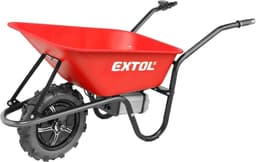
Uphill and downhill are different jobs. Uphill, you want the tray moving without your arms taking the whole mass. Downhill, the load wants to leave, and the brake has to disagree. The Health and Safety Executive treats a slope as extra force and names brakes, wheels and the route. You still steer. The £740.63 single-wheel barrow is 35 kg empty and has to stay upright while the motor pushes. Two wheels share some tip-over risk and can still be pulled off line by a rut or a side slope.

What these listings claim, and what they do not print

Every kept listing claims an electric brake. The £2,305.33 machine, 200 litres and 400 kg at 108 kg empty, also claims a manual downhill brake and a drive with a gear and a differential. It prints no wattage and no reviews, so that manual brake is an untested bullet. The other four print 500 W. No page prints a gradient. Titan's FAQ and a Titan manual disagree about driving up a slope or across the face, and neither is an Extol instruction. Do not copy another brand's percent onto these five.

What owners reported on hills

On the 100 litre machine, reviews describe paddock and manure work with little weight on the arms. One review says the brake worked. Another says that unit did not brake downhill and had one speed only, against bullets that claim normal and turbo. The same soil day emptied the pack by lunch. On the 300 litre tray, reviews describe light slopes with a full load of soil, and less fill on steeper ground. The 54 V listing has no owner hill at all.

Householder or workplace

In your own garden or paddock, with nobody employed to drive it, you are a householder. HSE leaflet INDG291 says PUWER 1998 does not apply to domestic work in a private household. The Consumer Rights Act 2015 still covers a dented arrival or a brake that is not as described. PUWER applies when an employer provides the machine. Wheelbarrows remain manual handling at work, including on slopes, and staff need instructions they can read. That split is about duty, not about inventing a safe percent.

When a powered barrow is the wrong hill tool

Do not buy on a slope claim you cannot test. The 108 kg empty weight is awkward before a 400 kg load, and nobody has reviewed that manual downhill brake. If your ground is steeper than the light slopes in the 300 litre reviews, those owners already filled the tray less. These listings do not claim a powered tip. The electric wheelbarrow versus a manual barrow page is that choice. Test the brake on the flat first, using the how to use an electric wheelbarrow sequence. If it will not stop there, it is the wrong hill tool.

Common questions

Will a motor remove the hill problem?
It can cut the uphill push and leave the downhill risk with the brake and with you. Only the £2,305.33 page adds a manual downhill brake, and it has no reviews. You still balance the barrow, see over the load and tip by hand. The Health and Safety Executive still treats a slope as extra force. You know the brake only after a test.
What did reviewers actually do on slopes?
They moved soil and manure and published no gradient. One £493.57 review describes a large soil job and wants more power. The 100 litre reviews describe paddock hills, and one unit that did not brake downhill. The 300 litre reviews describe light slopes taken full, and less fill when it steepened. The 54 V listing has no review text. Those are amazon.co.uk accounts, not our hill test.
Can you quote 30 percent or 12 degrees for these listings?
No. None of the five prints a gradient. Titan's FAQ and a Titan manual disagree, and both are another brand. An older model's degree limit stays with that model. Copying either figure onto an Extol barrow would invent a rating. Try the brake on your ground, empty first, or do not treat the bullet as a limit.
What happens to the battery on a loaded slope?
On the 100 litre listing, one soil day emptied the 40 V pack by lunch. A top-up lasted until coffee, and another charge was empty by 18:00. Bullets claim up to 16 km, or 20 km with 300 kg on the larger tray. Those are seller lines. Plan a charge. IP64 is not permission to charge in the rain.
Does two wheels solve a side slope?
Two wheels can feel steadier than the 35 kg single-wheel listing, and a rut can still pull them off line. The 300 litre reviews ask for support wheels the page does not include. The 45 kg two-wheel listing is also the one with a downhill-brake complaint. Side slope is steering and brake, not a wheel count.
When should you keep the manual barrow?
Keep it when the hill is short, the load is light and the trips are rare, or when a powered brake has failed on the flat. PUWER applies to employers, not to domestic work in a private household. A powered barrow that prints a weight is already 35 kg, 45 kg or 108 kg before the load. A percent the listing never printed is not a reason to switch.

Related pages

Sources

Public UK sources used for this comparison. Listing prices, stars, and review counts are from amazon.co.uk on 19 October 2026.

  1. HSE — Pushing and pulling loads: risks (retrieved 19.10.2026)
  2. HSE — Risk assessment of pushing and pulling (RAPP) (retrieved 19.10.2026)
  3. HSE — INDG291, Providing and using work equipment safely (retrieved 19.10.2026)
  4. GOV.UK — Supply of Machinery (Safety) Regulations 2008 (retrieved 19.10.2026)
  5. GOV.UK — Electrical Equipment (Safety) Regulations 2016 (retrieved 19.10.2026)
  6. OPSS — Product safety report: lithium-ion battery charger 2511-0084 (retrieved 19.10.2026)
  7. GOV.UK — Recycling batteries and electrical waste (retrieved 19.10.2026)
  8. legislation.gov.uk — Consumer Rights Act 2015 (retrieved 19.10.2026)