Independent comparisons. We may earn from shop links. More info

How to use an electric wheelbarrow

Updated: 21.10.2026

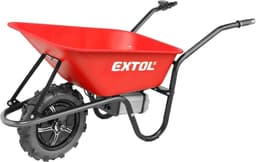
How to use an electric wheelbarrow starts before that load: charge a removable pack, check the fixings, test the brake on the flat, then take a light tray and tip it by hand. The five Extol listings in our [battery wheelbarrow comparison](/hub/garden-tools/battery-wheelbarrow), from £493.57 to £2,305.33 on 19 October 2026, claim a motor and an electric brake, and none claims a powered tip. This sequence is from Peter F., editor for DIY & tools. We ran no hill test. A qualifying purchase can earn us a commission at no extra cost to you.

How to use an electric wheelbarrow starts before that load: charge a removable pack, check the fixings, test the brake on the flat, then take a light tray and tip it by hand.

Our top picks

On this page

What the motor does and does not do

The motor drives the wheels. It does not balance a single wheel, hold the tray on a camber, or lift the load when you tip. Where a wattage is printed these listings say 500 W, with forward and reverse. The 54 V machine at £2,305.33 prints no wattage, so that figure is not shared. You still walk behind the barrow, and you still need to see over the load. The Health and Safety Executive's pushing and pulling guidance treats the route, the view and the brakes as part of the job even when a motor takes some of the push.

Assembly and the language of the manual

Four listings say assembly is required. The £493.57 cart marks assembly as not required, which is a listing line, not proof that every nut is in the box. On the £1,179.84 tray, reviews describe a Czech-only sheet, missing nuts, brackets posted later, and a damaged grip. You need English for the brake and the charge steps. The Electrical Equipment (Safety) Regulations 2016 expect instructions a user in Great Britain can follow. If fixings are missing, stop and photograph the shortfall. The Consumer Rights Act 2015 covers goods that are not as described. Do not drill new holes so a rubbing connector clears the axle.

Charging and the plug

Charge before you trust a kilometre bullet. Four titles say lithium-ion, at 40 V and 6,000 mAh or, on the 108 kg machine, 54 V and 15 Ah. The £493.57 title says two 12 V lead-acid batteries while the bullets say 24 V, 12 Ah and 288 Wh, so check the box before you pick a charger. Only the 100 litre listing names a charger. A removable pack is not the same sentence as a charger in the box. None of the five states a BS 1363 plug, and UK mains are 230 V. OPSS report 2511-0084 rejected a different drill charger for failing that standard, so look at the pins before you force a two-pin plug into an adapter. Charge a lithium pack indoors, off the tray and out of the rain. One soil-and-slope review of the 100 litre machine was empty by lunch.

First run, brake and tip

Start on level ground, empty, on a path you have walked. You should see over the tray before a load blocks the view. All five claim an electric brake. The £2,305.33 listing also claims a manual downhill brake, and the saved listing has no reviews to support it. Stop the empty barrow and confirm it holds. Then add a light load. Wet soil can pass the kilograms before the tray looks full, which is a rule of thumb. You still lever the tray. A 300 litre review says the brake helped when tipping and that the tip still needs strength. Tip on the flat first, with nobody at the lip. Hill limits are on the electric wheelbarrow for slopes page.

When to stop

Stop if the brake creeps on the flat. Stop if the pack is swollen, cracked, or was rubbing the axle. GOV.UK recycling guidance says not to bin lithium packs, and a damaged pack should have its terminals taped for a proper collection point. Do not open the case. A householder can reject a short delivery under the Consumer Rights Act 2015. An employer who hands the barrow to staff is under PUWER 1998, which HSE leaflet INDG291 says does not apply to domestic work in a private household. If the first run fails, leave the soil and read the best electric wheelbarrow page for the listing that matches the fault.

Common questions

What should you do before the first load?
Charge a removable pack with the charger the listing names, then check the nuts and brackets against the sheet. Only the £987.69 page names a charger, and four listings require assembly. Walk the route empty and test the brake on the flat before soil goes in. If the plug is not a UK 13 A pattern, sort that before the first metre.
How do you test the brake?
On level ground, with the tray empty, drive a few metres and stop as the sheet describes. The barrow should hold still. All five claim an electric brake, and the £2,305.33 manual downhill brake has no review behind it. Repeat with a light tray. A flat pass is not a gradient. If it creeps while empty, contact the seller.
How full should the first trays be?
Keep them light enough to tip and still see the path. The printed loads are 150 kg, 260 kg, 300 kg and 400 kg on the 80, 100, 300 and 200 litre trays. Wet soil can pass the kilograms while the rim looks short. One reviewer's 50 cubic metres on the £493.57 cart is that person's season, not a first-run target.
Why does tipping still hurt?
The motor drives the wheels and leaves the tray to you. A 300 litre review says a full tip still takes strength even when the brake helped. The £2,305.33 bullets describe a tilt rod, which is still a manual unload. Try a lighter load on level ground before a wet tray on a slope.
What if the instructions are not in English?
Ask for an English copy before you drive. The £1,179.84 reviews describe a Czech-only sheet, and an Italian buyer of the 100 litre machine had no manual and then a broken part. You need the brake steps and the load line. Guessing the symbols is how a missing nut becomes the first job.
When should you stop and call the seller?
Call if the brake fails on the flat, if fixings are missing, if the pack arrives damaged, or if the battery in the box does not match the title. The Consumer Rights Act 2015 covers goods not as described. Do not keep loading, and do not open a damaged lithium pack. Staff use is an employer duty, not a household trial.

Related pages

Sources

Public UK sources used for this comparison. Listing prices, stars, and review counts are from amazon.co.uk on 19 October 2026.

  1. HSE — Pushing and pulling loads: risks (retrieved 19.10.2026)
  2. HSE — Risk assessment of pushing and pulling (RAPP) (retrieved 19.10.2026)
  3. HSE — INDG291, Providing and using work equipment safely (retrieved 19.10.2026)
  4. GOV.UK — Supply of Machinery (Safety) Regulations 2008 (retrieved 19.10.2026)
  5. GOV.UK — Electrical Equipment (Safety) Regulations 2016 (retrieved 19.10.2026)
  6. OPSS — Product safety report: lithium-ion battery charger 2511-0084 (retrieved 19.10.2026)
  7. GOV.UK — Recycling batteries and electrical waste (retrieved 19.10.2026)
  8. legislation.gov.uk — Consumer Rights Act 2015 (retrieved 19.10.2026)