Independent comparisons. We may earn from shop links. More info

Electric wheelbarrow buying guide

Updated: 21.10.2026

A manual barrow has failed you on a slope, a soft paddock or wet soil, and amazon.co.uk answers with kilograms, litres, voltage and a brake claim in one block. This electric wheelbarrow buying guide sorts that block into printed load, wheels and empty weight, battery and plug, then brake, tip and paperwork. The five Extol listings in our [battery wheelbarrow comparison](/hub/garden-tools/battery-wheelbarrow) ran from about £494 to about £2,305 on 19 October 2026. Peter F. checked those listings and the public UK sources. We ran no hill test. A qualifying purchase can earn us a commission at no extra cost to you.

A manual barrow has failed you on a slope, a soft paddock or wet soil, and amazon.co.uk answers with kilograms, litres, voltage and a brake claim in one block.

Our top picks

On this page

Start with the load, not the brand

Start with the rated load in kilograms, and keep it only if it matches what you move. These listings print 150 kg in an 80 litre tray, 260 kg in 100 litres, 300 kg in 300 litres, or 400 kg in 200 litres. Litres are volume. Kilograms are the load the maker prints, and a bigger tray can still carry a lower kilogram rating. Wet soil is where the two numbers part company. Damp topsoil can pass the kilogram limit before the tray looks full.

Wheels, empty weight and width

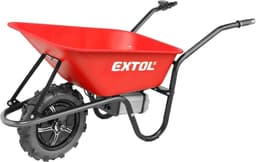
The motor pushes the load, while balance and a side gate stay with you. The single-wheel listing is 35 kg empty, 80 litres and 150 kg, at about £741, with 4.1 from 15 ratings. The 45 kg figure is the 100 litre, 260 kg machine at about £988, and 108 kg is the 54 V machine before its 400 kg load. Two listings, including the 300 litre tray, print no empty weight. No figure we held is a gate width, so measure the narrowest opening yourself before you choose a battery.

Battery, charger and the plug

Read the title and the bullets separately. Four titles say lithium-ion, at 40 V and 6,000 mAh, or 54 V and 15 Ah on the heavy listing. The £493.57 title says two 12 V lead-acid batteries, while its bullets say 24 V, 12 Ah and 288 Wh. Only the 100 litre listing names a charger in its special features. None of the five states a BS 1363 plug. OPSS report 2511-0084 rejected a different drill charger for failing that standard, so ask before you trust a shed socket.

Brake, speed and how it tips

All five claim an electric brake, and the 54 V listing also claims a manual downhill brake. None prints a slope in degrees or percent. The Health and Safety Executive still treats slope pushing as manual handling when a motor does some of the work. On the 100 litre listing, one review says the brake worked and another says it did not brake downhill. Those two lines do not average into a pass. If the hill is the purchase, read the electric wheelbarrow for slopes page before you trust a bullet. Tipping stays manual.

Instructions, assembly and returns

Four listings require assembly. The £493.57 page does not. Reviews of the 300 litre listing say the guide was only in Czech. The Electrical Equipment (Safety) Regulations 2016 are the UK frame for instructions a buyer can use, so a Czech-only sheet is a reason to pause. The Consumer Rights Act 2015 covers goods that arrive damaged, incomplete or not as described. The 400 kg listing costs about £2,305, weighs 108 kg empty and holds 200 litres, with no star line on file. If a manual barrow is still in the running, the electric wheelbarrow versus a manual barrow page is the next check.

Common questions

What load should you buy for?
Buy for the heaviest load you will move, in kilograms. These listings print 150 kg, 260 kg, 300 kg or 400 kg. Compost can sit in the 150 kg band, though wet soil can pass that limit before an 80 litre tray looks full. Step up when the lighter rating fails on the path you actually use.
Is 80 litres the same decision as 150 kg?
Eighty litres is tray volume, and 150 kg is the printed load on both 80 litre listings, at about £741 and at £493.57. Dry leaves can fill the volume and stay inside the kilograms. Wet soil can overload the kilograms while the tray still looks short. Use both figures together before you order.
Should you choose one wheel or two?
Choose one wheel for a narrow path if you can balance the 35 kg empty machine. Choose two wheels for support under a heavier load, as on the 45 kg listing at about £988, though a rut can still pull it off line. The 300 litre reviews ask for support wheels the page does not include.
Is the lead-acid title a lithium barrow?
The £493.57 title says two 12 V lead-acid batteries, and the bullets say 24 V, 12 Ah and 288 Wh. The other four titles say lithium-ion. Until the seller names the pack, this stays a description conflict. A 240 Wh figure from 40 V and 6 Ah is arithmetic you do yourself.
Does the listing include a charger and a UK plug?
Only the 100 litre listing names a charger in its special features. The other four leave that line blank, so read the box list before you count on a first-day charge. None of the five states a BS 1363 plug. The OPSS rejection of a different drill charger is another product. Ask how this charger meets a UK 13 A socket.
What does a brake claim not prove?
An electric-brake bullet leaves the gradient, the speed and the downhill stop unproved. All five claim an electric brake, and only the 54 V listing adds a manual downhill brake. On the 100 litre machine, the reviews disagree about braking downhill. No kept listing prints a slope. Try the brake on the flat, then on the ground where you will stop.

Related pages

Sources

Public UK sources used for this comparison. Listing prices, stars, and review counts are from amazon.co.uk on 19 October 2026.

  1. HSE — Pushing and pulling loads: risks (retrieved 19.10.2026)
  2. HSE — Risk assessment of pushing and pulling (RAPP) (retrieved 19.10.2026)
  3. HSE — INDG291, Providing and using work equipment safely (retrieved 19.10.2026)
  4. GOV.UK — Supply of Machinery (Safety) Regulations 2008 (retrieved 19.10.2026)
  5. GOV.UK — Electrical Equipment (Safety) Regulations 2016 (retrieved 19.10.2026)
  6. OPSS — Product safety report: lithium-ion battery charger 2511-0084 (retrieved 19.10.2026)
  7. GOV.UK — Recycling batteries and electrical waste (retrieved 19.10.2026)
  8. legislation.gov.uk — Consumer Rights Act 2015 (retrieved 19.10.2026)