Independent comparisons. We may earn from shop links. More info

Where to put a cat scarer

Updated: 22 October 2026

The stake is in the ground, the light never flashes, and the cat still crosses the same corner of the lawn. Where to put a cat scarer is mostly a question of the route the animal already uses, the height of the sensor, and a two-minute walk to see whether the cone is awake. This page is that evening's job. It does not rank the eleven listings. The [cat scare comparison](/hub/garden-supplies/cat-scare) does that. Peter F. used amazon.co.uk reviews in this folder, the RSPCA and RHS notes on cats, and manufacturer instructions labelled as such. Links to Amazon can earn a commission at no extra cost to you.

The stake is in the ground, the light never flashes, and the cat still crosses the same corner of the lawn.

Our top picks

On this page

Find the entry before you push the stake

Walk the garden at dusk and look for the path, not for a tidy spot beside the patio chairs. Flattened grass, fur on a fence rail, a dug hole in the same bed every morning, or a gap under a gate tells you where the cat already comes in. Point one cone at that gap, that path or the middle of that bed. Pointing the sensor at the back door covers the people who live in the house and misses the animal that slips in at the side. PestBye's own instruction page lists that house-facing sensor as a common miss. If the mess is a toilet rather than a route, the soil itself needs changing too, which is stop cats fouling.

Height and a clear view

Set the sensor about 20–30 cm off the ground, upright, with nothing in front of the lens. That band is a UK rule of thumb drawn from other battery-stake manuals, including a Dobies sheet that puts sensor height at 13–35 cm on a different model, and a rough 20 cm wall-screw height on a Garden Gear sheet. It is not printed as a PestBye amazon bullet, so treat it as a starting height you will correct with the walk-test. If the listing is Nitoer, keep at least 3 m from occupied rooms, because that page says the output runs from 20 Hz to 18 kHz.

Walk the path and watch for the flash

Arm the unit, then walk the route you think the cat uses. You are looking for the LED or the flash as you cross the cone. If the unit flashes when you open the back door and stays quiet when you walk the side gap, it is covering the house. Move it. Joomouney buyers in this folder had to aim at the entry path and, in one case, wait until the panel sat in longer sun. An XWGKLN unit started working once the cone was repositioned onto the cats' path. A flash means the sensor saw you.

Sun, a PestBye dial, and how long to wait

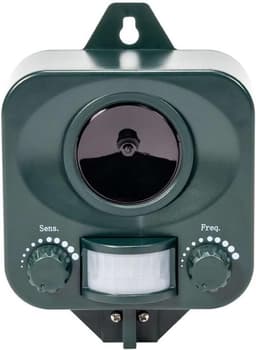
Face the panel at open sky and keep the sensor facing the cat. A side passage under a fence can be the right aim and the wrong sky. In that hole a battery PestBye is the power choice, which solar or battery sets out. Do not expect a solar-only unit with no USB lead, such as the RUTIDA or YRIGHT listings here, to wake up after a dark week just because you aimed it well. If the stake is a PestBye and the paper in the box skips the dial, the manufacturer's frequency page is what buyers end up using. They describe setting 3, about 18–24 kHz, for cats.

Common questions

Where do I point a cat scarer?
Point it at the gap, path or bed the cat already uses, which you find by walking at dusk and looking for flattened grass, fur or a dug patch. One cone faces that entry. It should not face the back door, because the sensor then watches the household. A second entry needs a second stake. The range printed on the box, often about 8–12 m or 10 m on PestBye, is the length of that wedge, and only if nothing solid sits in front of the lens.
How high should it sit?
Start at about 20–30 cm off the ground, with the sensor upright. That figure comes from other UK stake manuals, not from a PestBye amazon bullet, so correct it with a walk-test. Lower than the grass, and the lens fills with blades. Higher than a cat's shoulders, and you are watching air. Keep shrubs, fence panels and a warm wall out of the immediate line, and do not hammer the head to force the height.
How do I know the sensor is seeing the path?
Walk the path after you arm the unit and watch for the LED or flash. A trip as you cross the gap means the cone covers that line. No trip means the aim, the lens or the charge is wrong. A trip only when you stand at the back door means the stake is aimed at the house. Do the walk at cat height, and repeat it after the spike is firmed, because a loose stake sags.
Why did it fire at my family and miss the cat?
The cone is a wedge in front of the sensor. If that wedge includes the door and misses the fence gap, people will set it off and the cat will not. Warm brick and a tumble-dryer vent can trip a PestBye unit with no animal there, according to their own mistake list. Move the face towards the real entry, clear the lens, and keep an audible unit such as Nitoer at least 3 m from occupied rooms.
Can one stake cover an L-shaped garden?
One stake covers one cone. An L, or a second bed on the way out, leaves a shadow the first sensor never sees. Ultrasound does not bend around the corner of the house. The RHS describes better results in open ground. A second unit, aimed at the second entry, is the fix. A bigger number on an unreviewed listing does not replace that second cone.
How soon should anything change, and where must a solar panel face?
Judge the garden over one to four weeks, not overnight. Some cats leave and some stay. The panel, if you have one, faces open sky, while the sensor still faces the cat. Deep shade under a tree or a tall fence is a battery site, not a solar site. PestBye's cat setting on their own frequency page is a manufacturer dial guide, not a universal mark, and children may still hear the low end of it.

Related pages

Sources

Sources from the research digest, last checked on 22 October 2026. Listing prices, stars and review counts are the amazon.co.uk captures named in the digest. The RSPCA sheet from April 2015 is included for the humane-method list. Its penalty figure is out of date.

  1. RSPCA, how to keep cats out of your garden (retrieved 22.10.2026)
  2. RSPCA, Advice on deterring cats (April 2015) (retrieved 22.10.2026)
  3. Animal Welfare Act 2006, section 4 (retrieved 22.10.2026)
  4. Crown Prosecution Service, offences involving domestic and captive animals (retrieved 22.10.2026)
  5. RHS, Cats (retrieved 22.10.2026)
  6. Nelson, Evans and Bradbury (2006), ultrasonic cat deterrent trial (retrieved 22.10.2026)
  7. PestBye, frequency settings (retrieved 22.10.2026)
  8. amazon.co.uk, PestBye cat repellent set of 2 (retrieved 22.10.2026)