Independent comparisons. We may earn from shop links. More info

Hanging chair stand or ceiling hook

Updated: 22 October 2026

You are standing in a rented flat, or in a house where the loft hatch is still shut, and both options fail in a different way. A freestanding frame uses floor you may not have. A ceiling hook uses structure you may not be allowed to touch, and a plug in plasterboard is the version that pulls out. This page is the fork: hanging chair stand or ceiling hook, with one recommendation that depends on the joist and the lease. The frames kept for this set are on the [hanging chair frame comparison](/hub/garden-furniture/hanging-chair-frame). UK install guides and those freestanding listings were used. Hook kits from older searches are not scored. A ceiling was not drilled. A qualifying purchase can earn a commission at no extra cost to you.

You are standing in a rented flat, or in a house where the loft hatch is still shut, and both options fail in a different way. A freestanding frame uses floor you may not have.

Our top picks

On this page

What each option actually carries

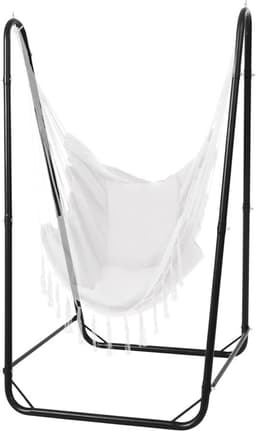
A frame carries the chair on its own tubes and passes the load into the floor. You give up a footprint. In this capture that runs from the WUDLEP plan of 103 × 85 cm to the Trekassy plan of 2.01 m square and the GOUTIME plan of 2.05 × 1.32 m, plus swing room you still have to tape. The Trekassy bullet sells no ceiling drilling. The other kept rows are freestanding too. None of them is a hook kit. A ceiling hook carries the chair as a point load in the timber above the plasterboard. Your weight is the main figure, and movement adds more. Furniture in Fashion calls that dynamic load higher than body weight, without a multiplier you can treat as a standard, and it notes that leases in flats often limit fixings. Checkatrade asks for about three feet of clearance. Egg Chairs UK asks for about a metre. Both are rules of thumb, and both assume the fixing is in structure. If you cannot name the timber, the frame stays on the floor you can see. Load and the words stand only are in the hanging chair stand buying guide.

Plasterboard is not the structure

Plasterboard holds paint. It does not hold an egg chair with you in it. Checkatrade's guide says not to hang the chair on drywall, and to find the centre of a joist. If you are unsure, the same guide points you to a tradesperson. A MyBuilder thread from December 2022 says plasterboard is not strong enough, and the fixing has to go into the joist. Some replies suggest noggins or a plate to spread the load. Those are forum opinions, not a British Standard, and they are not a screw length to copy. One reply's bolt size stays on that thread. GOV.UK's account of the General Product Safety regime is concerned with foreseeable use. Sitting and shifting on a picture plug is a foreseeable way for it to pull out. A plug can feel firm in the hand and still be the wrong substrate once you drop into the seat. You need timber deep enough for the hook's own instructions. If the loft is boarded and you cannot see a joist, you do not have that answer yet. Prices here start at about £40.79 and reach about £132.99. After the footprint, the lease decides whether the floor option is the only one that flat allows.

When the frame is the better buy

Buy a frame if you rent, or if you cannot see the joist. A rental often forbids holes in the ceiling, and a deposit dispute is a worse outcome than a stand in the corner. An owner with a boarded loft is in a similar position until the board comes up. Unknown timber is not a reason to guess with a longer plug. The freestanding listings are the buy that avoids that guess. They still cost floor. A 2.01 m square Trekassy plan will not hide in a box room, and a 180.1 cm SELFLA still needs headroom and an arc. A hook remains a structural job, not a way to cheat the tape. The frame is the weaker choice when the floor is not there: a landing, a room whose only gap is a doorway, or a plan that already fails once you add clearance. In that room a joist you have found, in a home you may alter, can be the better buy, because the chair then hangs in the volume under the hook. You still need the chair's hanging height to suit that hook, and a load path into timber. If the joist is not where you want the chair, you do not move the joist to suit the window. You move the chair to the joist, or you stay with the frame.

When you stop and hire

Hire a carpenter when you will drill and the timber is uncertain, when a joist has already been cut or notched, or when the lease needs consent you do not have. Spreading a load across more than one joist is the work the MyBuilder replies point at, and it is joinery, not a Saturday plug. Checkatrade's short version is the condition on this recommendation. Choose a frame if you rent or you cannot see the joist. Call a carpenter if you will drill and the timber, or the permission, is unclear. A wall-mounted stand is a third product. Simply Hammocks lists the Palmera Rockstone as a wall-fixed stand, about 225–250 cm high, with a stated 120 kg and a wall footprint around 100 × 60 cm. It still needs a wall that can take the load. A hollow stud wall fails in the same family of ways as a plasterboard ceiling. Hook ASINs that older searches still show were removed from this comparison. They are not scored. Once a frame is the decision, assemble it on a level floor and stop if a tube bends. The hook, if you still choose it, waits until someone who can see the joist has fitted it.

Common questions

Can I use a plasterboard plug for an egg chair?
Plasterboard is the wrong substrate. Checkatrade tells you not to hang an indoor hammock chair on drywall, and to fix into the centre of a joist. A MyBuilder thread from December 2022 says plasterboard is not strong enough. A plug can feel solid under a hand tug and still pull out when you sit and shift. If you cannot find timber, use a freestanding frame, or hire someone who can open the ceiling safely.
Is a freestanding frame the better choice in a rental?
It is the option that does not depend on drilling a ceiling the lease may forbid. The frames in this comparison stand on the floor, and the Trekassy listing says you do not drill. You still give up space: plans run from about 103 × 85 cm to 2.01 m square, before any swing. A frame can tip or bend if the motion is wrong for that stand. In a rental, that floor limit is usually the one you can accept.
How much floor do I give up if I refuse to drill?
You give up the base plus room to get in. Plans here run from the WUDLEP set at 103 × 85 cm to the Trekassy set at 2.01 m square, and the black SELFLA adds 180.1 cm of height on a 143 × 113 cm plan. Add clearance beyond the steel. A hook avoids the base only after the joist is real.
Does my weight or the chair's weight decide the joist?
Your weight decides it, together with the chair and with the extra load when you move. Furniture in Fashion describes dynamic load as higher than body weight. An empty egg on the bathroom scales is the small number. This page does not give a screw size or a joist section. Those belong to the hook's instructions and to whoever can see the timber. A stated 136 kg on a frame listing is a frame claim. It is not a rating for your ceiling.
What if the joist is not where I want the chair?
The joist wins, or you buy a frame. You do not shift structural timber to centre the chair on a rug. Forum replies that mention noggins or a plate are describing carpentry, and that work needs consent if the lease requires it. A cut or notched joist is a reason to stop and hire. If the only comfortable spot has no timber, the freestanding frame is the honest option, provided the floor tape still fits.
When do I hire someone?
Hire when you intend to drill and you cannot confirm the timber, when the joist is cut or notched, or when the lease requires consent you have not got. Checkatrade sends you to a tradesperson if you are unsure you have found the centre of a joist. Spreading the load across joists is a structural alteration. If you will not drill, a bolt-together frame does not need that visit. You need it the moment the plan says the ceiling has to be opened.
Is a wall-mounted stand a third option?
It is a third product. The Palmera Rockstone from Simply Hammocks is a wall-fixed stand, listed around 225–250 cm high with a stated 120 kg and a wall footprint near 100 × 60 cm. It removes a four-leg base and still asks the wall to carry the load. A plasterboard partition is the wrong wall, in the same way a plasterboard ceiling is the wrong ceiling. It does not sit in this comparison. If you are guessing at the wall, stay with a freestanding frame.

Related pages

Sources

Public UK sources used for this comparison, last checked on 22 October 2026. Listing prices, stars and review counts are the amazon.co.uk lines saved on 19 October 2026. There is no laboratory test.

  1. General Product Safety Regulations 2005 (retrieved 22 October 2026)
  2. Consumer Rights Act 2015, section 11 (retrieved 22 October 2026)
  3. BSI, BS EN 581-2 outdoor seating tests (retrieved 22 October 2026)
  4. EN 581-2:2026, CEN catalogue entry (retrieved 22 October 2026)
  5. FIRA suspended seating workshop, 4 June 2019 (retrieved 22 October 2026)
  6. CAP Code 3.7, objective claims (retrieved 22 October 2026)
  7. Egg Chairs UK assembly instructions (retrieved 22 October 2026)