How to move a heavy garden pot: plan before you lift

Move a heavy garden pot empty, and get help on steps or with a round jar. The HSE 25 kg figure is a filter for an easy grip, not a legal limit for clay.
On this page
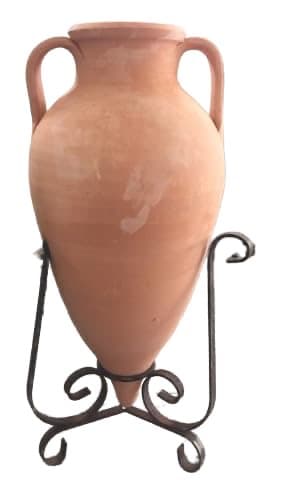
The carton is in the drive, the patio is three steps up, and the point of the jar is still wrapped in cardboard. How to move a heavy garden pot starts with that shape and that route, before you hunt for a kilogram that will make the job feel allowed. A round terracotta belly has no handles. A pointed amphora rolls if the tripod is off. Steps and a wet flagstone fail the floor the Health and Safety Executive assumes when it quotes its best-known figure.
We used the HSE agriculture manual handling page, the HSE good handling technique page, an RHS note on trees in containers, one seller's pallet terms, and the amazon.co.uk listings in our amphora and stone fountain sets. We did not weigh a jar and we did not run a lifting test. A qualifying purchase through an amazon.co.uk link can earn us a commission at no extra cost to you.
In short
Move the pot empty, on a clear level route, and put it down before you adjust it. About 25 kg, on the HSE agriculture page, is a filter for a load that is easy to grip, held close to the body, on a sound floor. A large clay jar fails that filter, so the real choices are two people, a trolley on flat hard standing, or a stop. Plant and water only after the pot is where it will stay.
The 25 kg line, and why a jar fails it
The Health and Safety Executive publishes no single legal maximum weight for a lift. On its agriculture manual handling page, about 25 kg is a filter for a load that is easy to grip, held close to the body, on a sound floor. A garden pot fails all three. The pages describe workplaces.
A round jar gives you a belly instead of a handle, so your forearms stick out. A pointed amphora stays unstable until the tripod is on level ground. The pointed amphora with tripod in our amphora comparison is titled at 70 cm, with item dimensions of 70 × 30 × 28 cm, at £77.12. The listing does not state a weight. You cannot test the lift against 25 kg, and a known weight would still fail the grip.
The Arborus vase in the same set is about 19 cm and 3.05 kg, at £26.99, with 4.2 from 162 ratings, and the listing says indoor. That is a table object. The outdoor jar is the top pick because the page says outdoor use, drainage yes, and a tripod. Its star line is 5.0 from one rating, and the only review text is from France on 27 June 2026. That text does not show you can carry it.
Move a heavy garden pot empty, then plant
Decide the move before compost goes in. The Royal Horticultural Society notes that frost-proof clay is heavy and hard to move, and that the same weight helps stop a container tree blowing over. You want that weight on the patio, after the stand is level. Fill and water the jar there. Wet compost grips the slabs, so the dry bag you carried in is no longer the load.
The 70 cm page states no empty weight, no capacity, and no frost line. Which of 70, 30 and 28 cm is the height is not clear, so measure the belly and the doorway before the driver leaves. If 70 cm is the width, use the side gate. Plant once the stand no longer rocks. Our how to plant an amphora page is the next job. Keep a planted pot upright. Dragging by the rim chips the lip. A blocked drain and a wet freeze crack clay, which is a different repair, on our amphora frost page.
Empty a fountain bowl before anyone lifts. In our stone fountain comparison, listed dry weights run from a 4.75 kg solar lion head to about 18 kg on a tall cascade. One row prints 19.84 kg in a bullet and 4.13 kg in the details. Those smaller figures match the bullet only if read as inches, while the file still labels them centimetres. Treat a clash as weight unknown. A 4.75 kg resin mask is a wall offer-up. A full bowl, or this unweighed jar, is not.
How to move a heavy garden pot on steps
Clear the floor before anyone takes the weight. On a dry, level patio, a strapped pot trolley replaces the hug. Casters run on flags and firm decking. They dig into gravel and a wet lawn, and they stop at the first riser. A sack truck is only a short, strapped roll on hard concrete, and it is not a way up steps. Fit the tripod on level ground where the jar will live. A pointed amphora with the stand off can roll off the bed or into a wall.
Agree the set-down spot, and who says stop, before either of you bends. Hands go under the mass, not on a rim pinch that slips and chips the lip. If the only way to reach the base is straight legs and a rounded back, fetch the trolley or book help. Lift once, smoothly, with your nose and toes pointing the same way. Put the pot down fully, then turn it.
On steps the lower person takes more than half. Two people can move an empty jar one dry, wide tread at a time. They are the wrong pair if a slip would pin one of you. Wet stone fails the sound-floor condition, so wait, and put the pot down before you turn a corner.
Parcel, courier, and pallet
The delivery line tells you whether the work starts at the kerb or the door. Some pointed amphorae on amazon.co.uk showed a delivery charge around £39. Do not treat that parcel price as the plan for this £77.12 jar. Read the line on the page you pay. A pallet may be left where the truck can stand. Foalyard's note for a large pithari describes mainland pallet delivery and excludes the Highlands and Islands. If you are there, or on a street a rigid truck cannot enter, ask where the shipment ends before you pay.
Photograph the pallet, the rim, the point, and the stand in the drive, and write damage on the note before you sign. Goods that are not of satisfactory quality remain a question under the Consumer Rights Act 2015. A signature is not a waiver. Unpack on flat ground, with a hand on the point until the tripod is on. The listing names a tripod and does not say the jar stands on its point. If the stand is missing or bent, stop and treat it as a return. A brick under the point on a windy terrace turns a delivery fault into a broken pot. Outdoor use and drainage are stated in the amphora comparison; frost and weight are not.
When to stop and get help
Stop if the weight is unstated and you have not scaled the pot, if there are steps and you are alone, if the pot is full of wet compost, if the stand is missing, if you would twist in a doorway, or if the flags are wet. HSE good handling technique says not to lift more than you can manage.
Two people are the start when you cannot hold the jar close. They are the wrong ending on a long flight, a narrow landing, or a back that already notices a shopping bag. Book a landscaper or a removals pair with a stair trolley. Say "clay, pointed, steps, weight not stated", and give the belly and height from your tape once the pot is on the ground. If the pot is already where you want it, leave it. Pack a thin shim under a proud tripod leg instead of lifting the jar to stop a rock.
Common questions
Products Compared prepared this on 22 October 2026 from the HSE pages, an RHS container note, and the amazon.co.uk listings above.
Common questions
Is 25 kg the legal limit for lifting a garden pot?
Should I plant the pot before I carry it?
What if there are steps between the drive and the patio?
Who is responsible if a pallet arrives chipped?
Is a sack truck enough for a round jar?
When do I need two people?
Does a full pot of wet compost change the job?
Are fountain bowls the same problem as a heavy clay pot?

Peter F. is the editor for DIY & tools at productscompared.co.uk. Comparisons in this category are checked against amazon.co.uk listings, review evidence and public UK sources.
Related articles

Why a terracotta amphora cracks in a British winter
Frost-resistant clay still cracks when a wet freeze meets a blocked drain. Moving the jar does not undo a split that is already there.
Draining a garden fountain before the first hard frost
Ice in a bowl and a pump left full of water are the winter failures. Drain the basin before you try to lift it.

Fixing a garden gargoyle to brick
A heavy casting hung on one fixing in weak mortar is a wall job. Weigh the piece before you drill, and stop if the leaf is unsound.