Terracotta amphora cracking in frost: why it splits

Terracotta amphora cracking in frost usually means water held in the clay. A blocked drain or a saucer splits both frost-resistant and frost-proof jars.
On this page
You find the line in March, usually after a wet fortnight and one hard night. By the time the patio dries, a vertical split has opened from the base, or a flake has lifted on the shoulder. Terracotta amphora cracking in frost is almost always water that froze inside the clay or inside the compost, not a single cold number on the forecast.
Peter F. read Royal Horticultural Society container notes, Apta’s FAQ, Mud Mountain’s frost advice, and the two amazon.co.uk listings in our amphora comparison on 20 October 2026. We did not freeze a jar in a lab. Fuller label notes sit on frost-proof amphora planters. Prices are GBP as shown that day. A qualifying purchase can earn us a commission at no extra cost to you.
In short
A terracotta amphora cracks when water in the clay, or water trapped in the compost, freezes and expands. Frost-resistant is the softer label and frost-proof the stronger one, and a blocked drainage hole or a saucer defeats both. The pointed 70 cm jar on amazon.co.uk states no frost temperature, so do not borrow a −20 °C line from another seller.
Water in the clay, not the air temperature alone
Unglazed terracotta is porous. The Royal Horticultural Society describe ordinary clay as a material that takes up water and then cracks in winter, which is why they prefer a frost-proof pot for anything left outside. A saturated pot, thawed by day and frozen again the next evening, is the one that opens.
Garden Ornaments explain the expansion as about 9 percent when water turns to ice. Treat that as their account of freezing water, not a measurement of your amphora.
Mud Mountain warn that waterlogged compost can crack a pot the maker already calls resistant, so a frost resistant pot fails when the hole is silted up. Clear snow off the rim, because melt runs into the neck and refreezes. Crocks that seal the base are on how to plant a terracotta amphora. Keep the outlet open, and take the saucer away.
The two labels sellers use
Apta’s FAQ separates the two shop phrases. Frost-proof means the pot can take prolonged cold and wet, including freeze-thaw, when drainage is proper, and their ten-year guarantee applies when feet are used. Frost-resistant copes with most conditions if you raise the pot, but water in the body may still damage it, so they tell you to shelter it in a long freeze. The Royal Horticultural Society side with the stronger wording for terracotta left outside.
A temperature is that seller’s claim, not a British Standard you can lend to every jar. Riverhill’s Aegean amphora, on 20 October 2026, was £34.95 for a 40 × 26 cm jar with a drain and frost resistant to −20 °C. That is the softer label plus one shop’s figure, and it does not travel onto a different shape. Foalyard’s −20 °C claim and 50-year line apply to their Cretan pots if you register them and keep them on the feet supplied, on a range that started at £255 and was sold out when we read it. If neither phrase is printed, you have no number for a hard inland freeze.
Feet, saucers, and what a guarantee requires
Pot feet matter when the label sounds strong, because that label is conditional. Apta tie the ten-year guarantee they describe to feet. Foalyard’s pithari line needs the supplied feet and registration. Feet keep the drainage hole off the paving so meltwater can leave.
A saucer left under the jar from October to March holds meltwater against the hole, which works against raising the base. Pot feet in winter are there to leave a gap under the outlet.
Check the hole on a dry weekend, before the frost warning, and clear silt, root, and any crock that has sealed the outlet. If the jar is too heavy to tilt, do not discover the weight on icy steps. Feet in place, the hole open, and a base out of standing water are the conditions they publish. A crack already on the jar at delivery, before any frost, belongs with the retailer.
A pointed jar, a neck, and a tripod
The neck is narrower than the belly, so melt sits in the throat and can lever a ring around the mouth. Brush snow out of the opening.
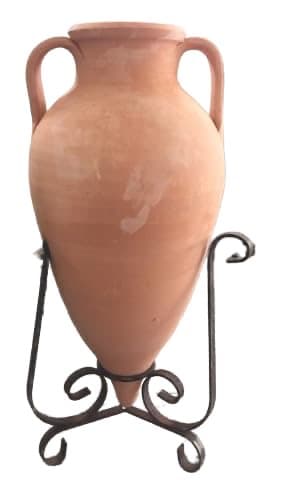
A pointed jar outlets at the tip, and the tripod holds that tip off the ground. It helps only while the tip is open and the stand is not in a dish. Look up the point with a torch. Kiln dust or a shipping bung turns it into a cup. Shape and delivery are on the garden amphora buying guide.
Le Terrecotte di Cassiano Fabio, ASIN B0CY8X42S9, was £77.12 on 20 October 2026: a pointed amphora with a tripod, outdoor use, drainage set to yes, and dimensions of 70 × 30 × 28 cm with no axis named as the height. The weight is not stated, and no frost figure is printed. It is the top pick in this two-listing set because it is the outdoor planter. It is not a freeze test.
The star line is 5.0 from one rating, headed as reviewed in France on 27 June 2026, and the text does not describe a British winter. Do not copy Riverhill’s or Foalyard’s −20 °C onto it. The listing is Le Terrecotte di Cassiano Fabio on amazon.co.uk.
What to do with an unlabelled import
Empty or move a pot whose listing never says frost-proof or frost-resistant, if you can lift it before the compost is saturated. You have no temperature to quote. Store it dry, on battens, in a shed or porch that stays above freezing.
Arborus model 754, ASIN B0GQYP2B76, was £26.99, about 19 cm high and 3.05 kg, with the special-features field set to indoor and 4.2 from 162 ratings about a table vase. Best value in the set is that indoor job.
The 70 cm pointed jar says outdoor and drainage, states no frost line, and gives no weight. Store it if two people can lift it empty. If you cannot, leave it, empty standing water, clear the tip, take the saucer away, and brush the neck. Thickness is not a rating, and thin cheap clay is where terracotta flaking often starts.
A white bloom is often firing salts, which Riverhill say can wash off. A crack you can see through, or a wall that weeps, is the damage. A ringing tap is a shop rule of thumb, not a British Standard, and it will not forecast January.
After the crack, and what not to pour on it
Leave a frozen jar to thaw on its own. Mud Mountain say not to use boiling water, because hot water shocks clay that ice is already stressing. A small pot can go to a cool porch if the lift is safe. A large one stays put. Clear snow from the rim, and do not let a cover seal the base into meltwater.
A hairline you cannot see through may be watched for a season if the jar stays empty and dry. A leak means it is finished as a planter, though the shell can remain an empty ornament. Sealant on a wet salty crack usually opens at the next thaw. Replace it if you still want to plant, and read the frost sentence first.
A lighter stand-in is on terracotta versus plastic. Plastic does not take water into the wall the way clay does, though a thin rim can split if you drop it, and a brown title is sometimes only a colour. The £34.95 Aegean can still need shelter in a long wet freeze. The £77.12 jar has no frost figure, so the open tip is the winter plan.
Common questions
If two jars shared the patio and only one split, look at the hole and the saucer before you blame the forecast. How to shift a large amphora when the empty weight is not on the listing is on how to move a heavy garden pot.
Common questions
Why did my amphora crack after one winter?
Is frost-resistant the same as frost-proof?
Do pot feet matter if the label is strong?
Should I empty a small unlabelled pot?
Are white marks on terracotta frost damage?
Will a guarantee pay if I left a saucer under it?
Does the pointed 70 cm amazon jar state a frost rating?
Can I thaw a frozen pot with hot water?

Peter F. is the editor for DIY & tools at productscompared.co.uk. Comparisons in this category are checked against amazon.co.uk listings, review evidence and public UK sources.
Related articles

How to move a heavy garden pot: plan before you lift
How to shift a large amphora when the grip is awkward and the empty weight is not on the listing.
Garden fountain winter UK: drain before hard frost
Empty the bowl and take the pump out before ice forms, including a fountain that only looks like stone.

Artificial boxwood ball outdoor: how the colour holds
Outdoor artificial foliage still fades, and the pot under a boxwood ball still has to drain through winter.