Garden fountain winter UK: drain before hard frost
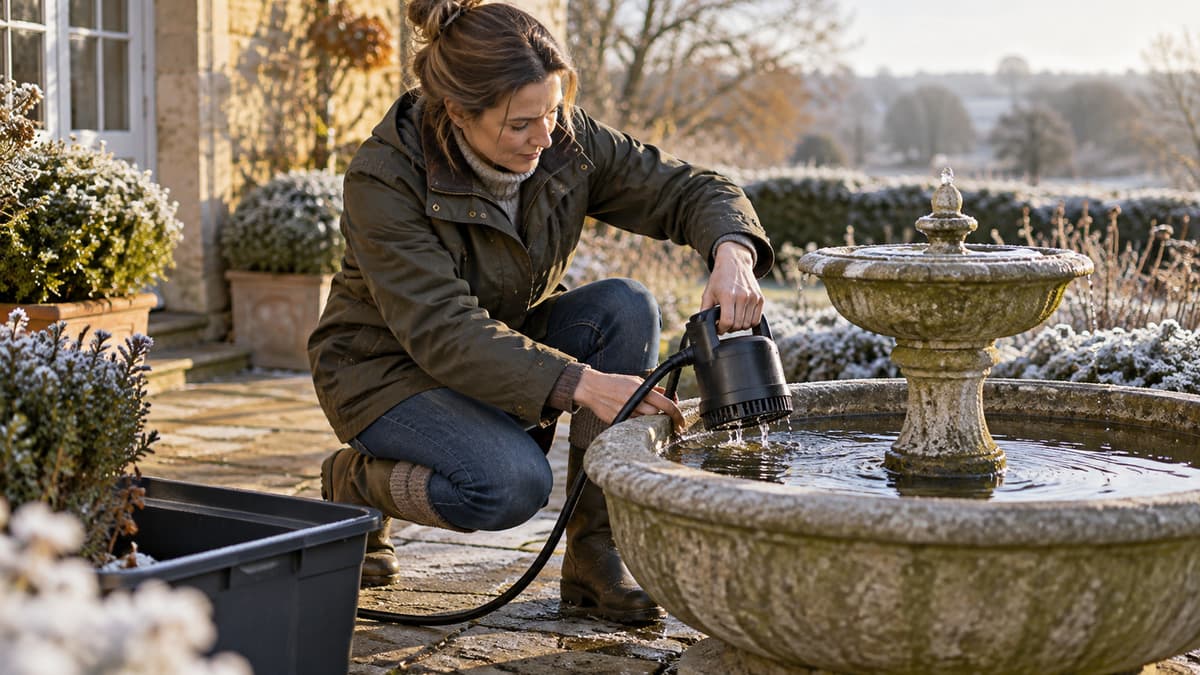
Empty the bowl and store the pump before a hard frost. Frost-resistant stone still cracks if water freezes in the basin, the pipe, or the impeller housing.
On this page
The bowl is still full, the forecast has a frost on it, and the garden fountain winter UK job will not wait until spring. That water expands as it freezes, in the basin, in the short pipe, and inside the pump housing. A frost-resistant body is built for cold air. It is not built to hold a block of ice. Haddonstone, which makes cast-stone water features for British gardens, tells owners to drain before a hard frost, clean the impeller, and store the pump.
This is for a self-contained bowl, a wall cascade, a solar pump in a pot, or an amphora with a pump hole. It is not a wiring guide. A mains pump still needs a sound outdoor socket and a BS 1363 plug. Products Compared used Haddonstone's maintenance guide and pump sheet, UK Water Features' support note, and the amazon.co.uk listing named below. We did not freeze a fountain in a lab. A qualifying purchase through our links can earn us a commission at no extra cost to you.
In short
Unplug the pump, empty the bowl and the pipe, and get standing water out of the impeller before the first hard frost. Bring the pump into a place that stays above freezing, and follow that pump's own storage note, because some seals are meant to stay wet and some are not. A tennis ball or a rain cover is what you use when you cannot drain, not a substitute for an empty basin.
Unplug the outdoor pump before you lift it
Switch the fountain off at the socket and take the plug out before your hands go into the water. Pennington Aquagarden's advice is specific: do not lift the pump by its cable. An October tug is how the seal at the cable entry starts to weep by April. If the plug is a transformer block, pull the block itself. UK mains are 230 V, and the plug should be a BS 1363 13 A type in a socket meant for outdoors. Haddonstone's pump sheet mentions a 10 m outdoor cable. A taped joint in a short lead is not a winter fix.
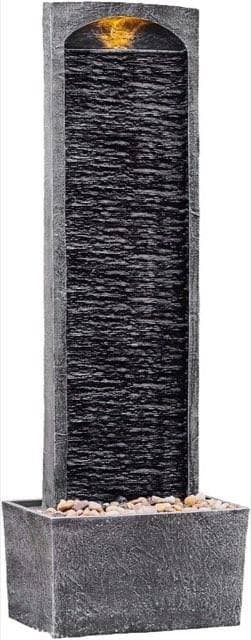
The Teamson Home waterfall in our garden fountain comparison is a scale check, not a winter test. The amazon.co.uk listing states a 9 litre bowl, a 7 W pump at 450 litres an hour, 230–240 V, and a 200 cm cable, at £88.99, with 4.2 from 919 ratings. It says the pump should not run without water, and it names no automatic cut-out. UK texts say the transformer plug will not sit under a closed outdoor-socket lid. Frost protected, on the seller's bullet, is a sentence. Cover a solar panel before you pull that pump, or a bright spell will spin a dry impeller. The solar fountain comparison separates floating pumps from units with their own panel.
Drain the bowl, the pipe, and the impeller
Water left in the riser, the hose, and the impeller housing is what cracks a joint, and the pump then sucks air in spring. If the piece is light enough to tip, empty it onto a border, not onto a path that will ice overnight. The Teamson model is about 5.4–5.5 kg before you add water, so one adult can carry it empty. Do not roll a full cast-stone bowl onto its side. Drain it with a jug, a siphon, or a separate pump you then remove, and sponge the last centimetre. GardenSite's winter note matches that order: bring it in if you can, soak up what remains, then cover.
Clean the impeller while it is in your hand. Haddonstone asks for that now, not in April when algae has dried hard. Twist the cover off, rinse the grit with plain water, and seat the impeller again. An amphora sold as a water feature is a jar with a pump hole. A Weston Mill amphora water pot we looked for on amazon.co.uk was unavailable, so there is no live UK price to cite. Water left in that cavity over a freeze works on the clay the way a blocked drain works on terracotta. Pump it out and sponge it. The jar sits in our amphora comparison.
Store the pump frost-free
The pump does not spend winter in the bowl. One night cold enough to freeze a bird bath can split a plastic housing. UK Water Features says bring the feature in if you can, and never run a pump dry. Some pumps are stored under water so the seals do not shrink, and others are stored dry. A bucket of water belongs indoors, lidded, and above zero, not in a greenhouse that frosts. If the sheet says store dry, dry the housing and bag it. A shed often tracks the outside air. Bring the pump, the transformer, and any solar battery inside if you are guessing, and do not leave the lead plugged in, because a timer can start an empty bowl. The ornament can stay outside once it is empty. Stone fountains run from a light resin wall mask to a tier you should not carry alone.
If the fountain cannot come inside
Some pieces will not move, and forcing them is how backs and brackets get hurt. Drain a wall lion, a fixed column, or a heavy stone bowl where it stands. Power off, lift the pump by its body, and sponge until the reservoir is damp rather than dripping. Each tier holds its own puddle. The lower basin can look empty while the upper lip still has a centimetre, and that centimetre freezes and spalls the rim. If a hose pulls off a barb without tearing, drain it downhill and leave it off. If it is glued, siphon it and plug the open end.
Fit a cover only after the water has gone. It stops January rain refilling the bowl. It does not save water you left behind, and a sagging sheet becomes a second pond and a sail. Weight the edges and look again after the first gale. If the pump housing is cracked when you open it, replace it. Tape that almost seals will empty the bowl and leave the pump running dry.
A tennis ball is the fallback
Haddonstone and UK Water Features both mention a tennis ball, and both treat it as what you do when you cannot drain. The ball takes up volume so expanding ice has something soft to press. It does not empty an impeller or a pipe, and it does nothing for a pump left underwater. Use it only after the pump is out and the bowl is down to a film you could not sponge. If you can still see a depth of water, you have not finished. A ball frozen into a solid block means too much water was left. Wait for a thaw rather than chipping the stone.
Skip bleach as a shutdown ritual. None of the notes used here set a dose for a frost drain. Rinse the impeller with water. If the manual names a cleaner, save it for a mild day when you can flush the bowl. A pump left full of water still fails, however many balls you float in the bowl.
Refill after the hard frosts
Put the water back when you are willing to lose it again. A hard frost is still plausible after the first warm weekend. Inland gardens, higher ground, and much of Scotland stay at risk later than a sheltered south-coast patio. There is no single UK date. Use the next fortnight where you live.
Check the pump on a bench before it goes back. The impeller should spin freely, with no grind. Look for a split at the cable entry and a cracked transformer case. Seat the pump flat, not on a pebble. Fill to the maker's line or, if there is no line, to the level that covered the intake last summer, plus a margin for wind. The 9 litres on the Teamson listing belong to that bowl. Do not copy them onto a stone urn. Plug in and stay for five minutes. Switch off if you hear the pump sucking air. Treat frost protected on a product page as a prompt to read the pump note, not as permission to leave the basin full.
Common questions
If you cannot tip the fountain, empty it where it stands and sponge every tier. A cover only keeps rain out of a bowl you have already drained. Refill when a hard frost looks unlikely for a couple of weeks in your own garden, and replace a cracked housing before the pump runs.
Common questions
Do I have to drain every garden fountain before winter?
What if I cannot tip the fountain over?
Where should I store a fountain pump over winter?
Can the pump stay in the bowl if the water will not freeze solid?
Is a winter cover enough on its own?
Can I leave a solar fountain outside all winter?
Should I pour bleach into the fountain before I store it?
When is it safe to refill a garden fountain?

Peter F. is the editor for DIY & tools at productscompared.co.uk. Comparisons in this category are checked against amazon.co.uk listings, review evidence and public UK sources.
Related articles

Why a terracotta amphora cracks in a British winter
A frost-resistant amphora still cracks when water freezes in the clay and the drain is blocked.

How to move a heavy garden pot without hurting your back
How to shift a large fountain or amphora without treating the HSE 25 kg figure as a hard limit.

Do solar garden lights work in a UK winter?
Short, dull UK winter days cut solar path-light runtime, and a panel under trees or snow may not charge.