Do solar garden lights work in winter UK: a shorter night
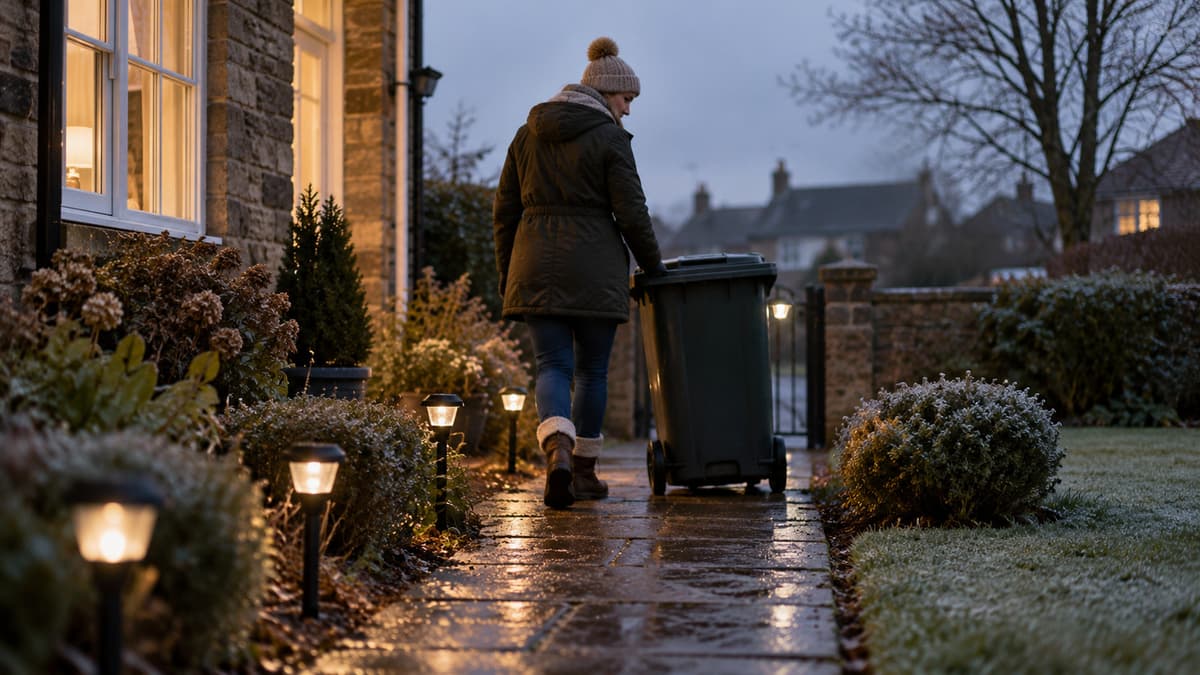
Solar garden lights still switch on in a UK winter, but a dull December day can leave a path stake glowing for about an hour. Here is what to adjust first.
On this page
The path looks settled in August. By the second week of December it is a row of faint dots, and the last of them has gone out before you have wheeled the bins to the gate. Do solar garden lights work in winter UK gardens? They switch on. The charge in the cell is a fraction of a June evening, so a cheap path light can be finished in under an hour.
The Solar Centre, a UK solar retailer, publishes about seven sun hours in summer and one or two in the deepest winter, and it says a typical DIY-store light then runs for under an hour at night. Which?, in its garden-light tests, recorded both ends of a short sunny winter day: some stronger sets still reached morning, while others managed about an hour. Products Compared set those published ranges beside amazon.co.uk listing text. We did not run a winter lab, and we do not fold competing runtime claims into one figure for every stake.
In short
Solar garden lights work in a British winter for as long as that day's charge allows. Shade, dirt, or snow on the panel can leave a glow that dies before you lock the back door. Use them to mark a path, and keep a mains or battery light where you actually need to see the step.
What a short British day does to the battery
The cell in a stake is small, often a few hundred milliamp-hours of nickel-metal hydride, and it fills only while the panel sees usable light. The Solar Centre's one or two winter sun hours are their published averages, and they also describe weeks below half a sun hour. On those weeks the battery never reaches the full charge a long runtime on the box assumed. Outdoor-Lights.co.uk, in a buyer guide rather than a test we repeated, often quotes quality lights at four to six hours in winter against a longer summer run. Which? sits wider: about an hour at one end, through to morning at the other, after a short sunny winter day.
Bright cloud still feeds a panel, only slowly. Ideal Home's experts put it plainly: shorter days and a weaker sun make the light dimmer and shorter. A panel under a bare tree, a close-board fence, or the north wall starves in what looks like daylight, because the cell needs sun on its face.
Where you put the panel, and how you clean it
Placement fixes more winter complaints than a fresh ten-pack. Aim the panel south, with a clear view from late morning through mid-afternoon, out of the shadow the house draws across the border. Ideal Home's advice is to wipe the panel and, where the design allows, to use a separate panel aimed south. That lead earns its cost when the stake must sit in shade and the cable reaches a sunny fence. It wastes money when the extra panel is a tiny cell on a short lead under the same eaves.
Clean the solar panel in winter with a regular wipe, while the charge is already thin. Algae, leaf stain, or road grime cuts what December can barely spare. Wipe glass or plastic with a damp cloth every few weeks, and again after sticky leaves. Snow is stricter: a covered panel does not charge. Brush it off in the morning if these lights mark the path that night. Even a light dusting covers a cell about the size of a drinks coaster.
Bringing the lights indoors overnight does not fill the cell. Bring a set in only to spare brittle plastic from a hard freeze the maker rules out, or to store lights you are retiring. Outdoors, the failures are a panel left face-down in a tray, and a stake pushed so deep that the panel sits in the grass. Pull it up until the face clears the turf, and tilt a movable head so the panel faces south through the middle of the day.
When solar is the wrong only light
A path marker and a light you walk by are different jobs, and winter makes the gap obvious. If the stake only has to show the edge of the lawn, a short glow can be enough. A solar path light comparison is the place to judge pack size, colour, and the listing claims. If the path is the only route to the bins, the side gate, or a step, an hour of dim light becomes a trip hazard when it cuts out. Add a mains porch light, a plug-in outdoor fitting on a timer, or a battery lantern you switch yourself. Solar marks the route.
A solar security light still needs a charged cell before the sensor can help. The winter runtime on the box is a full-charge figure, and a grey week can leave the cell too flat for more than a brief flash. A solar lantern on a table is pleasant while the charge lasts. Our solar garden lighting comparison separates marker lights from fittings meant to throw a beam. A panel under a porch lamp or a street light may never switch on, because the dusk circuit still reads day. Move that stake clear of the other lamp for one night before you call the cell dead.
What to read on the listing
Runtime lines refuse to average. One box says ten to twelve hours. Another says up to eighteen hours after a full charge in about six hours. Read the charge condition beside the hour count. "Up to", after a full charge, is a ceiling. The week before Christmas is closer to one or two sun hours if you use The Solar Centre's published winter average as the yardstick.
On amazon.co.uk, four lines beat a lumen boast. An IP65 line is the maker's claim. A stated milliamp-hour figure can be compared, while "battery included" cannot. With no switch, you cannot rest the cell. A separate panel, or a head you can tilt south, matters more in December than colour temperature.
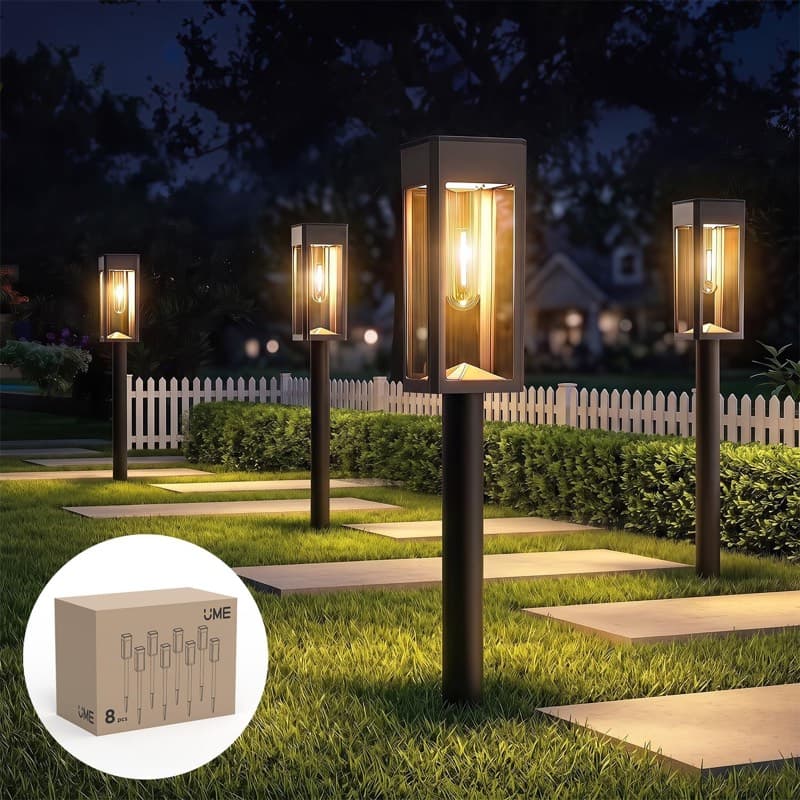
The top pick on the stored score is the UME eight-pack of warm white stakes at £39.89. The listing says 3000 K, 8 lumens, and up to 18 hours after a full charge in about six hours, with 4.9 from 18 amazon.co.uk ratings, a thin sample that can move. Cell size is absent, and there is no IP code, only a water-resistant line. The material line says plastic, the shade line says glass, and reviews describe a metal post. A qualifying purchase through that link can earn us a commission at no extra cost to you. We did not measure this pack on a December night, so the eighteen-hour line stays a listing claim. Six hours of charge is a summer-shaped assumption, and the staged height of about 53 cm clears a lawn.
A check you can finish in one afternoon
Move one stake and leave the rest, so you can see whether placement was the fault. On a clear day, set it where the panel faces south and nothing shades it from late morning to mid-afternoon. Wipe the panel, leave it out, and note when it comes on and when it dies. Several hours means the rest of the set wants the same sky. Under an hour after that clear day means a tired cell or a low-output design, and shuffling the row will not repair it.
Knock snow or wet leaves off every panel you are keeping, and lift any face buried in the lawn. Check that a porch light is not holding the sensor in day mode. If you need the path after the glow ends, fit a mains timer or leave a battery lantern by the door this week. January rarely supplies the six-hour charge those long bullets assume.
Common questions
Products Compared prepared this on 22 October 2026 from published UK solar guidance and amazon.co.uk listing text in the solar path light comparison. A qualifying purchase through our links can earn a commission at no extra cost to you.
Common questions
Will my path lights stay on all evening in December?
Do solar garden lights charge on a cloudy day?
Should I bring solar lights indoors overnight?
Does snow stop a solar panel from charging?
Where should a solar light panel face in the UK?
Can I rely on a solar security light in winter?
Why were my solar lights fine in August?

Peter F. is the editor for DIY & tools at productscompared.co.uk. Comparisons in this category are checked against amazon.co.uk listings, review evidence and public UK sources.
Related articles
Draining a garden fountain before the first hard frost
How to empty a garden fountain before a hard frost so ice does not sit in the bowl or wreck the pump.

Why a terracotta amphora cracks in a British winter
Why a terracotta amphora splits in a British winter, and why a frost-resistant label still leaves the clay at risk.
Using a paraffin lamp in the garden
What to watch if you light a terrace with a paraffin lamp, from the fuel to a base that can tip.