Underfloor Heating Cracked Tiles: Repair or Replace?

Underfloor heating and cracked tiles can point to movement below the surface. Learn when a small repair is reasonable and when the floor needs checking.
On this page
A fine mark across a warm kitchen tile can look like a simple filling job, but underfloor heating cracked tiles are often telling you about movement below the visible surface. One isolated chip caused by a dropped pan may be repairable. A crack that runs through grout and into the next tile needs investigation before you reach for paste.
In short
Repair a small impact chip only when the surrounding tile, grout and joints remain sound. Do not fill across a movement joint, and do not expect a cosmetic repair kit to replace flexible tile adhesive or correct movement in the screed, substrate or heated floor build-up.
Why heated floor tiles crack
Underfloor heating does not automatically crack tiles. A correctly designed floor treats the covering, adhesive, substrate, heating system and movement joints as one assembly, with materials chosen to accommodate expected changes. Trouble starts when expansion and contraction are restrained or when an existing weakness concentrates stress beneath a rigid tile.
Different layers do not necessarily warm, cool or move at the same rate. A rapid change may expose a weak bond, an inadequate joint layout or a crack already in the screed. Impact, substrate deflection, poor adhesive coverage and structural movement can leave a similar mark. Heating being present is not proof that heating caused the crack.
Look at the pattern before you decide. A neat crater beside where a heavy object fell is different from a long crack passing through several tiles. Cracks that follow a straight route, cross grout lines or reappear after filling are stronger warnings of movement below. A photograph cannot confirm the cause. Tile and Stone Journal advises gradual commissioning: use the manufacturers' start-up instructions, and do not invent a daily temperature ramp on a newly installed system or a recently cured screed.
Movement joints filler must not bridge
A movement joint is not a defect to disguise. It is a planned flexible break that allows parts of a tiled area to move without transferring that stress into brittle tiles and rigid grout. Typical locations can include perimeters, divisions within larger areas and boundaries between heated and unheated sections, though the correct layout depends on the floor.
Tile and Stone Journal reports BS 5385 guidance that heated floor bays should be no greater than 40 square metres, with no edge longer than 8 metres. Treat those figures as reported design guidance, not permission to lay out a floor from two measurements. Room shape, columns, doorways, substrate joints and separate heating zones can all affect where joints belong.
Do not bridge a movement joint with ordinary filler, grout or tile repair paste. Contract Flooring Association guidance says movement joints should not be covered or filled with ordinary grout. A rigid bridge can crack again or transfer stress to a tile edge.
If the visible line is in a joint, first establish what that joint is. Failed grout, perimeter sealant and a designed movement joint are not interchangeable. Our guide to a cracked grout line or a cracked tile can help with the first visual check. Uncertain joint details are a reason to ask a tiler.
When one chip can be repaired
A genuinely isolated impact chip can still be a cosmetic repair, even on a heated floor. The useful signs are a known impact, damage confined to one small part of the tile face, no crack continuing to an edge, firm surrounding grout and no change when the floor cycles between normal operating temperatures. The repair restores appearance and may make a sharp edge safer. It does not strengthen the floor below.
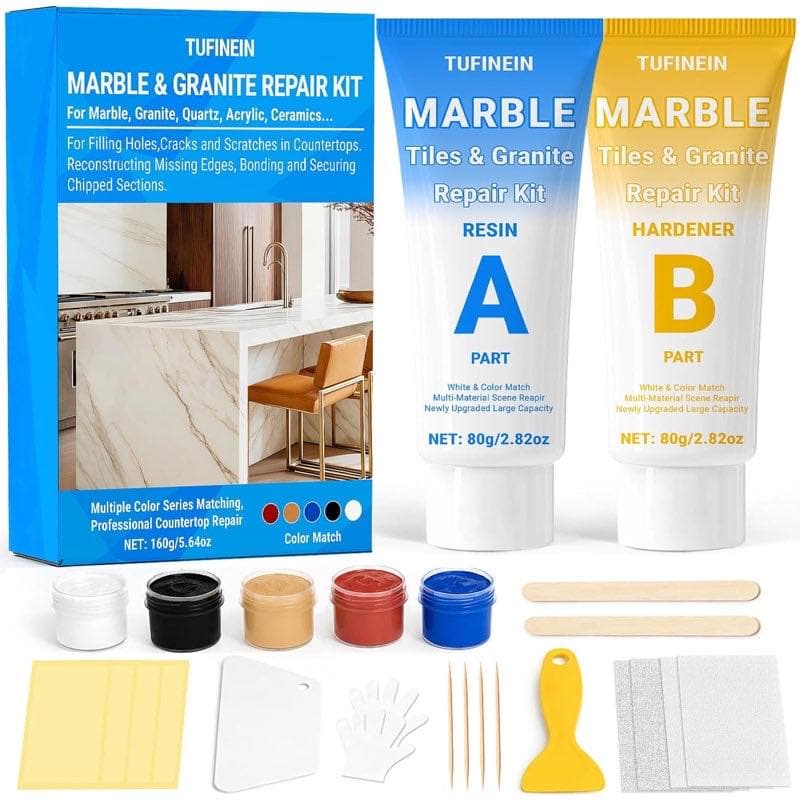
The featured Tufinein 160 g stone and tile repair kit was listed at £16.99 and rated 4.4 from 185 amazon.co.uk reviews at the time of this article. It is an option to compare for a small surface chip, not evidence that the underlying installation is sound. The kit does not fix movement joints, replace bedding adhesive or stop an active crack.
Compare what is included, the colours, the cure and whether the paste suits the tile finish. A match on glossy ceramic may stay obvious on matt porcelain or textured stone. See other options in our tile repair kit comparison, and use the repair or replace guide if the damage is more than a shallow chip. Stop if a line develops beyond the patch. Recurring damage is a diagnosis, not another coat of filler.
Why a line of cracks needs investigation
A line of cracks is a floor problem until inspection shows otherwise. The line may track a screed crack, substrate joint, board edge or omitted movement joint, and covering it tile by tile hides useful evidence. If it crosses several tiles or runs through both tile and grout, pause before removing anything and record the route with clear photographs.
Note whether the line lies between two heating zones, between a heated and unheated area, across a doorway or near a perimeter. Record when it first appeared and whether it changes with the heating cycle. These observations do not replace inspection, but they give a tiler better information than a freshly filled surface.
Spreading more material into the line will not stabilise the layers beneath it. Face filler cannot restore missing adhesive coverage, release restrained screed movement or create a correctly detailed joint. Replacing one tile may only reset the symptom if the same stress remains. A tiler should assess the pattern, joint layout, bond and substrate before recommending local replacement or wider work. If tapping sounds hollow, read what a hollow-sounding floor tile can mean. Sound alone does not prove a tile is loose. Suspected screed or structural cracking may need a specialist.
What flexible adhesive is meant to do
Flexible tile adhesive is part of the installation beneath the tile. Repair paste sits in surface damage. Those products solve different problems. Adhesive classifications under BS EN 12004 describe properties such as adhesive type, performance and deformability, so a specification can match the substrate and floor build-up.
C denotes a cementitious adhesive, and S1 is a deformability classification. The Tile and Stone Journal adhesive note cites a minimum C1 S1 class for the prepared timber-floor situation it discusses. That is a specific minimum in a specific context, not a shopping instruction for every heated floor. Other systems and substrates may require a different or higher specification.
C2 S1 also appears in product descriptions. The 2 indicates improved performance within the classification. The label alone does not confirm a match to your tile, substrate, heating system, bed depth and site conditions. Check the manufacturer specification and the tiler's requirements. A paste that cures hard inside a chip is not an S1 bedding adhesive, and it is not a movement-joint sealant. Surface filling cannot correct unsuitable adhesive or poor coverage.
What to do before repairing
Start with evidence rather than a tube of filler. These checks preserve the crack pattern and help separate a small impact from movement that needs professional attention.
- Photograph the full floor and a close-up with a ruler beside the damage. Note the date, the temperature setting and whether the crack crosses grout or reaches another tile.
- Check the route without forcing the tile. Look for the nearest perimeter, doorway, heating-zone boundary and visible flexible joint. Do not prise the crack, flood it or tap hard around electric heating whose layout you do not know.
- Find the heating maker's commissioning instructions, the adhesive details and any joint drawings. Follow those operating limits rather than an improvised heating cycle.
- A known impact chip with stable surroundings can be considered for cosmetic repair. A through-crack, a repeated crack, a loose tile, a long straight line or damage across several tiles should be inspected first.
- Use a tile repair kit only for a small face defect. Leave movement joints flexible and unobstructed. If a tile must come out above electric matting or pipes, ask a professional so you do not damage the heating.
Stop DIY work when you cannot tell whether the line is a tile crack, a substrate crack or a deliberate joint.
Products Compared reviewed the supplied public guidance and amazon.co.uk listing details for this article. We did not conduct a laboratory test. If you buy through a qualifying affiliate link, we may earn a commission at no extra cost to you.
Common questions
Why did my tiles crack after the underfloor heating was turned up?
Can I fill one cracked tile and leave the heating on?
What is a movement joint in a tiled floor?
Is tile repair paste flexible enough for underfloor heating?
What does C2 S1 tile adhesive mean?
How large can a heated tiled bay be?
Who should inspect a line of cracked tiles?
Does this apply to electric mats and wet underfloor heating?

Products Compared publishes British-English buying guides based on amazon.co.uk listings and public UK sources. We do not run a lab and we do not invent test scores.
Related articles

What a hollow-sounding floor tile means
Find out why a hollow note can indicate a void, yet does not automatically mean that the tile is loose.

A cracked grout line or a cracked tile
Learn how to distinguish failed grout from tile damage before choosing a repair material.

What a chipped tile costs to repair in the UK
Compare the cost of a small cosmetic repair with calling a tiler to replace a damaged tile.