Independent comparisons. We may earn from shop links. More info

Jointing compound vs sand and cement on one patio

Updated: October 2026

You can mix a damp mortar or buy a ready tub, and they are not two prices for the same joint. Jointing compound vs sand and cement is a rigid cement point against a permeable brush-in, and the base you already have decides which one can work. Packs and review counts are on the [paving joint mortar comparison](/hub/flooring-tools-and-accessories/paving-joint-mortar). Measuring the gap is the [buying guide](/hub/flooring-tools-and-accessories/paving-joint-mortar/sub/paving-joint-mortar-buying-guide). Named picks are on [best paving joint mortar](/hub/flooring-tools-and-accessories/paving-joint-mortar/sub/paving-joint-mortar-best). Why you do not dry-brush is [how to point patio slabs](/hub/flooring-tools-and-accessories/paving-joint-mortar/sub/paving-joint-mortar-how-to-point).

You can mix a damp mortar or buy a ready tub, and they are not two prices for the same joint.

Our top picks

On this page

Two different joints

A sand-and-cement point, mixed damp and pressed in, sets as a rigid, low-permeability joint. Water leaves by the fall of the slabs, not through the joint. A permeable brush-in lets water through only if the bed underneath can take that water away. Mortar fails by cracking. Compound fails by washing out or never curing when the drainage is wrong. A maker's blog that says compound always wins is a sales page. Weeds use a crack or a joint that never hardened. If the slabs already rock, neither joint is the next purchase.

When sand and cement is the one to mix

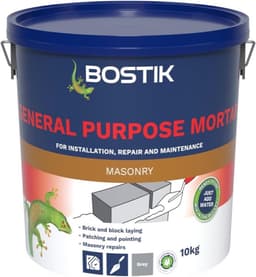
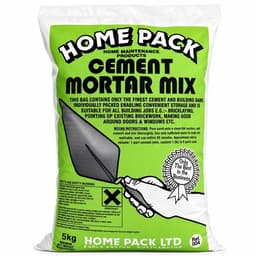
Choose a damp mortar when the flags are stable concrete, the joint is around 10 mm, the slab is at least about 22 mm thick, and you want a rigid finish on a full bed. You accept a joint that does not drain through itself. Bostik Cementone is the pre-mixed version: add water, no millimetre width on the label. Laeto also names bedding. Jetcem is the fast premix. All three are cement joints. None is a permeable compound. A 1:6 Home Pack is not that point, and it is not a brush-in compound.

When the tub is the one to brush

Choose a brush-in when the joint sits inside that tub's width and depth and the patio already drains. The UK sheet for Bostik All Weather says 5–30 mm wide and at least 25 mm deep, curing in air, and it excludes a base that stays wet. The amazon bullets still mention driveways. One reviewer found a part-used tub solid after resealing, so finish the open tub in one go. If the joint is under 5 mm, or the bed is solid and wet, the tub is not the fix.

Water on a front garden

The filler is not the whole surface. A cement point is low permeability, so a new frontage over the size limit needs another route for the water. A permeable compound only helps if the layers under it are permeable too. Northern Ireland is not the England, Scotland or Wales rule. Cementone at £14.99 against the Bostik tub at £39.35 is a real gap on these listings. You pay less for a different joint.

Common questions

When is a damp sand-and-cement joint the better choice?
On stable concrete flags around 10 mm wide and at least about 22 mm thick, on a full bed, when you want a rigid joint and the water can leave across the surface. Mix about 1:4 damp, or use Cementone at £14.99, and sponge the face. It is the worse choice if you need a stated permeable joint, if the slabs rock, or if the units are thin porcelain.
When is a brush-in compound the better choice?
When the joint is 5–30 mm wide and at least 25 mm deep, on a path or patio whose base drains. That is the Bostik All Weather window, at £39.35 and 4.4 from 46 reviews. It is the worse choice on a driveway if you follow the UK sheet, on block paving, on a bed that stays wet, and on any gap under 5 mm. A permeable label does not empty a ponding patio.
Is a 1:6 bag the same as a 1:4 pointing mix?
No. The Home Packs at £8.99 and £9.98 say mix 1 part cement to 6 parts sand, and reviews say the parts arrive separately. Marshalls' damp mix for many flags is about 1:4. Buyers of the 1:6 packs have reported soft joints. The bags are sand and cement. They are not that pointing mix, and they are not a jointing compound.
Can you brush the cement in dry to avoid stains?
Dry brushing is how the stains happen. Marshalls says dry or semi-dry sand and cement must not be brushed across the slabs. Mix a damp mortar, press it into the joint, and sponge the face while the cement is wet. The compound tub is the alternative only if your joint and base match that tub.
Will a permeable compound drain a patio that ponds?
Only if the water can leave through the joint and through the base. Bostik's sheet says the compound is not for a base that stays wet, because it cures in air. A patio that holds water because the fall is wrong will not become a draining patio when you brush a tub into the joints. Fix the fall or the bed first.
Does a rigid joint break the front-garden paving rule?
It can, if that rigid surface is what you are building. In England, more than 5 m² between house and highway must be porous or drain within the garden. A cement joint is low permeability, so the rest of the build has to deal with the water. Scotland's Class 3C note has no 5 m² exception. A permeable joint is not consent either.
Why is Joint-it dearer than Bostik if both are compound?
They are both ready fillers and they are not the same buy. Bostik All Weather is £39.35, states 5–30 mm, and has 4.4 from 46 reviews, with a UK sheet you can check. Joint-it Simple is £155.58, 3.4 from 9 reviews, the texts in the file are American, and the listing states no width. One text says it was not permeable. Dearer does not mean a wider joint in this set.

Related pages

Sources

Public sources used for this comparison, with the amazon.co.uk listings read on 20 October 2026.

  1. Bostik UK TDS02249, All Weather jointing compound (retrieved 20 October 2026)
  2. Joint-it Simple (retrieved 20 October 2026)
  3. Dansand Kerama (retrieved 20 October 2026)
  4. Marshalls concrete paving installation guidelines (retrieved 20 October 2026)
  5. England: permitted development technical guidance (retrieved 20 October 2026)
  6. BSI on BS 7533-101 (retrieved 20 October 2026)
  7. HSE: cement (retrieved 20 October 2026)
  8. HSE: chasing concrete and raking mortar (retrieved 20 October 2026)