Paving joint mortar for a measured patio gap
You have a tape on a patio joint and three products that all sound like paving joint mortar. A cement bag, a brush-in tub and a thin-tile grout fill different gaps. Start with the width and depth you can see, then the slab and the base, and only then the pack. The [paving joint mortar comparison](/hub/flooring-tools-and-accessories/paving-joint-mortar) holds the cards and prices. One listing per job is on [best paving joint mortar](/hub/flooring-tools-and-accessories/paving-joint-mortar/sub/paving-joint-mortar-best). Thin slabs sit on [porcelain paving joint mortar](/hub/flooring-tools-and-accessories/paving-joint-mortar/sub/paving-joint-mortar-porcelain). The damp mix versus a permeable tub is [jointing compound vs sand and cement](/hub/flooring-tools-and-accessories/paving-joint-mortar/sub/paving-joint-mortar-vs-sand-and-cement).
You have a tape on a patio joint and three products that all sound like paving joint mortar. A cement bag, a brush-in tub and a thin-tile grout fill different gaps.
You have a tape on a patio joint and three products that all sound like paving joint mortar. A cement bag, a brush-in tub and a thin-tile grout fill different gaps. Start with the width and depth you can see, then the slab and the base, and only then the pack. The paving joint mortar comparison holds the cards and prices. One listing per job is on best paving joint mortar. Thin slabs sit on porcelain paving joint mortar. The damp mix versus a permeable tub is jointing compound vs sand and cement.
Our top picks
| Badge | Product | Joint width | Product type | Stated use | Note | Price | Offer |
|---|---|---|---|---|---|---|---|
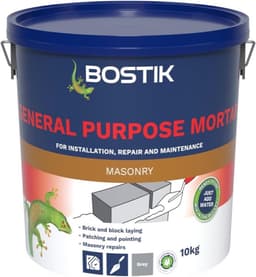
| Best overall |  Bostik Bostik Cementone mortar, 10 kg | Not stated | Pre-mixed general purpose mortar | Pointing, patching, brick and block laying | 9.0 | about £14.99 | View offer |
| Alternative |  Bostik Bostik All Weather jointing compound, 15 kg | 5–30 mm | Ready jointing compound | Paths, patios, driveways and domestic paving | 8.8 | about £39.35 | View offer |
| Alternative |  Dansand Dansand Kerama patio grout, 15 kg | Up to 10 mm | Brush-in patio grout | Ceramic and porcelain 20–30 mm thick | 0.0 | about £39.99 | View offer |


On this page
Measure the joint before you choose a tub
Mix-it mortar, brush-in compound, or a thin-tile grout
What the kept listings actually state
Drainage, weeds and the front garden
Common questions
What should you measure before you buy paving joint mortar?
When is a damp sand-and-cement point the right branch?
When does a brush-in compound replace that mix?
Why is a 1:6 Home Pack not the same as a pre-blended tub?
Can a cartridge replace a bag?
Does a permeable joint let you skip the front-garden rule?
Which listing has no UK star line at all?
Related pages
Sources
Public sources used for this comparison, with the amazon.co.uk listings read on 20 October 2026.
- Bostik UK TDS02249, All Weather jointing compound (retrieved 20 October 2026)
- Joint-it Simple (retrieved 20 October 2026)
- Dansand Kerama (retrieved 20 October 2026)
- Marshalls concrete paving installation guidelines (retrieved 20 October 2026)
- England: permitted development technical guidance (retrieved 20 October 2026)
- BSI on BS 7533-101 (retrieved 20 October 2026)
- HSE: cement (retrieved 20 October 2026)
- HSE: chasing concrete and raking mortar (retrieved 20 October 2026)