Porcelain paving joint mortar for 20–30 mm slabs
Porcelain paving joint mortar is a narrower question than which cement is cheapest. You are jointing slabs about 20–30 mm thick, often with a gap of only a few millimetres, and the unit barely absorbs water. A bricklaying bag that never mentions porcelain is the wrong default. Every pack is on the [paving joint mortar comparison](/hub/flooring-tools-and-accessories/paving-joint-mortar). How the families split is the [buying guide](/hub/flooring-tools-and-accessories/paving-joint-mortar/sub/paving-joint-mortar-buying-guide). The lead listing for ordinary flags is [best paving joint mortar](/hub/flooring-tools-and-accessories/paving-joint-mortar/sub/paving-joint-mortar-best). The damp method for concrete flags is [how to point patio slabs](/hub/flooring-tools-and-accessories/paving-joint-mortar/sub/paving-joint-mortar-how-to-point), and it is not the method to copy here.
Porcelain paving joint mortar is a narrower question than which cement is cheapest. You are jointing slabs about 20–30 mm thick, often with a gap of only a few millimetres, and the unit barely absorbs water.
Porcelain paving joint mortar is a narrower question than which cement is cheapest. You are jointing slabs about 20–30 mm thick, often with a gap of only a few millimetres, and the unit barely absorbs water. A bricklaying bag that never mentions porcelain is the wrong default. Every pack is on the paving joint mortar comparison. How the families split is the buying guide. The lead listing for ordinary flags is best paving joint mortar. The damp method for concrete flags is how to point patio slabs, and it is not the method to copy here.
Our top picks
| Badge | Product | Joint width | Stated use | Product type | Note | Price | Offer |
|---|---|---|---|---|---|---|---|
| Best overall |  Bostik Bostik All Weather jointing compound, 15 kg | 5–30 mm | Paths, patios, driveways and domestic paving | Ready jointing compound | 8.8 | about £39.35 | View offer |
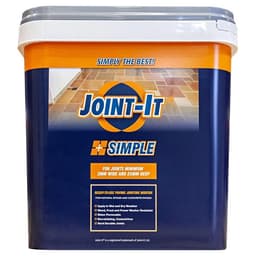
| Alternative |  Joint-It Joint-it Simple, 12.5 kg dark grey | Not stated | Pavers, flagstones, slabs, porcelain | Ready jointing mortar | 6.8 | about £155.58 | View offer |
| Alternative |  Dansand Dansand Kerama patio grout, 15 kg | Up to 10 mm | Ceramic and porcelain 20–30 mm thick | Brush-in patio grout | 0.0 | about £39.99 | View offer |


On this page
Why a cement bag is a poor default on porcelain
What Dansand Kerama actually allows
Joint-it and Bostik on ceramic or porcelain
If the joint is narrower than the product
Common questions
What joint width does Kerama allow?
Can you use Kerama on a mortar bed?
Is a 2 mm joint close enough?
Does Joint-it Simple state a porcelain joint size on amazon.co.uk?
Will Bostik All Weather fill a 3 mm porcelain joint?
Can you point porcelain with Cementone or Laeto?
What weather does Kerama require?
Related pages
Sources
Public sources used for this comparison, with the amazon.co.uk listings read on 20 October 2026.
- Bostik UK TDS02249, All Weather jointing compound (retrieved 20 October 2026)
- Joint-it Simple (retrieved 20 October 2026)
- Dansand Kerama (retrieved 20 October 2026)
- Marshalls concrete paving installation guidelines (retrieved 20 October 2026)
- England: permitted development technical guidance (retrieved 20 October 2026)
- BSI on BS 7533-101 (retrieved 20 October 2026)
- HSE: cement (retrieved 20 October 2026)
- HSE: chasing concrete and raking mortar (retrieved 20 October 2026)